

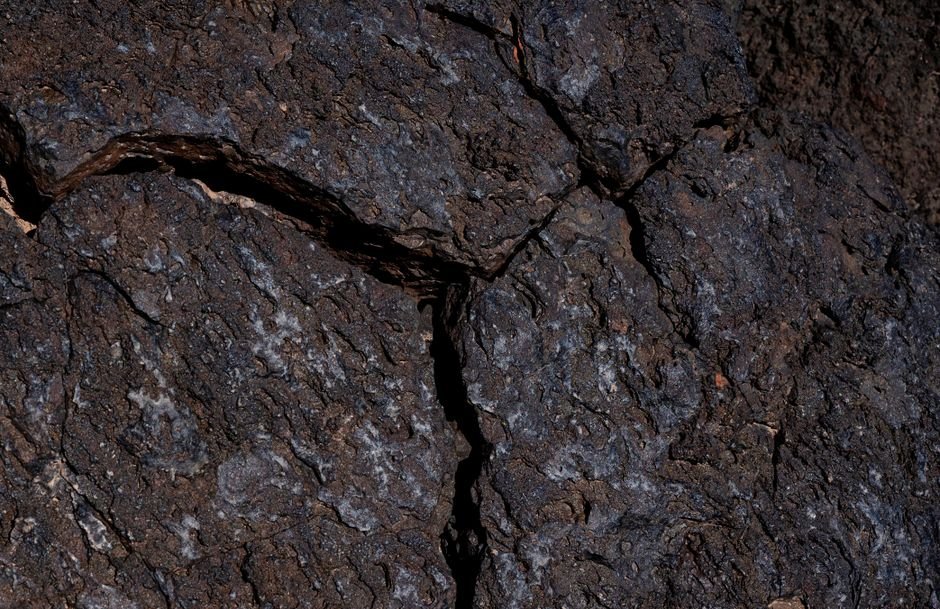
NASA’s Perseverance rover has detected abundant complex organic carbon in mudstones on the floor of Jezero Crater, the most robust detection of organic matter on Mars outside Gale Crater. The finding, published June 24 in Science Advances and reported this week by Ars Technica, is both encouraging and inconclusive: the carbon could be the remains of ancient microbial life, or it could have formed through entirely non-biological processes.
The detection was made by the SHERLOC instrument (Scanning Habitable Environments with Raman and Luminescence for Organics and Chemicals), mounted on Perseverance’s robotic arm. SHERLOC uses deep-ultraviolet resonance Raman spectroscopy to identify organic compounds at concentrations as low as one part per million.
The target was a mudstone informally named Cheyava Falls, located in the Bright Angel outcrop of Neretva Vallis, an ancient river channel that once fed Jezero Crater’s lake. Perseverance abraded the rock’s surface and found macromolecular carbon (MMC), a solid, cross-linked network of reduced carbon atoms.
“The detection of macromolecular carbon on the dust-cleared, but otherwise unprepared surface of the Cheyava Falls rock represents the shallowest detection of organic matter on the surface of Mars,” said Kyle Uckert, SHERLOC Deputy Principal Investigator at NASA’s Jet Propulsion Laboratory and co-lead author of the study.
Hundreds of detections
The SHERLOC team analyzed four targets across three rocks, finding hundreds of MMC detections. The carbon was associated with carbonate minerals at one target and sulfate minerals at another, suggesting at least two separate emplacement events: initial deposition as sediments were laid down in the ancient lake, and later alteration as fluids moved through the rock.
This is the first detection of macromolecular carbon in Martian mudstones outside Gale Crater, where NASA’s Curiosity rover previously found organics. The two sites are more than 3,500 kilometers (2,200 miles) apart, suggesting that complex organic compounds were broadly distributed across ancient Mars.
“It is encouraging for Martian habitability,” said Ashley Murphy of the Planetary Science Institute, co-lead author. “This indicates that billions of years ago, organics may have been more than just locally present and may have been more widely available in ancient lakes and rivers on Mars.”
Life or not?
Raman spectroscopy alone cannot determine whether organic carbon is biological. The G-band parameters of the Cheyava Falls carbon overlap with both biotic references (microbial mats, coals, kerogens) and abiotic references (meteorites, hydrothermal rocks, the Martian meteorite ALH 84001).
“The Perseverance rover payload is not able to evaluate whether organic compounds are derived from biologic or abiologic processes,” Uckert said. “We cannot state that biology played any role in the organic carbon described in this study.”
Cheyava Falls is the same rock that made headlines in 2025 for its “leopard spots”, iron phosphate mineral rims that, on Earth, typically form through microbial metabolism. Together with the carbon detection, the rock holds what scientists describe as one of the strongest collections of circumstantial evidence for past Martian life ever gathered. But circumstantial is not proof.
The sample return problem
Perseverance has cached a core sample from Cheyava Falls, named Sapphire Canyon, as part of its 30-sample collection. But with the Mars Sample Return program canceled by Congress in January 2026, there is currently no funded plan to retrieve these samples. Resolving whether the carbon is biological would require Earth-based instruments, secondary ion mass spectrometry for carbon isotope ratios, and high-resolution electron microscopy for microscopic fabric analysis, that cannot be miniaturized for a rover.
“The presence of organic matter on Mars does not necessarily imply biologic processes,” Uckert said. But if the carbon is biological, it would be the first evidence of extraterrestrial life. If it is abiotic, it would enhance understanding of how complex organic chemistry can operate without life. Either answer would be transformative.