

Published: June 05, 2026, 04:03 UTC
The SETI Institute has completed the most extensive radio search ever conducted on an interstellar object, scanning comet 3I/ATLAS across a broad swath of the radio spectrum for any sign of extraterrestrial technology. After analyzing nearly 74 million narrowband radio signals over seven hours of observations, the result is definitive: the comet is natural, carrying no detectable artificial transmitters.
The study, published in The Astronomical Journal, represents the first dedicated technosignature search of 3I/ATLAS, the third confirmed interstellar object to visit our Solar System after 1I/’Oumuamua and 2I/Borisov. While the null result comes as no surprise given the comet’s clearly natural composition and behavior, it sets stringent new limits and demonstrates the growing capability of rapid-response SETI campaigns.
A Rare and Urgent Target
Discovered on July 1, 2025, by the NASA-funded ATLAS survey telescope in Chile’s Rio Hurtado, 3I/ATLAS was immediately recognized as extraordinary. Its hyperbolic trajectory, incoming speed of 61 km/s (136,700 mph) relative to the Sun, and orbital eccentricity of 6.14 all pointed to an origin beyond our Solar System, from somewhere in the Milky Way’s thin or thick disk. If the comet originated from the thick disk, it could be at least 7 billion years old — older than the Solar System itself.
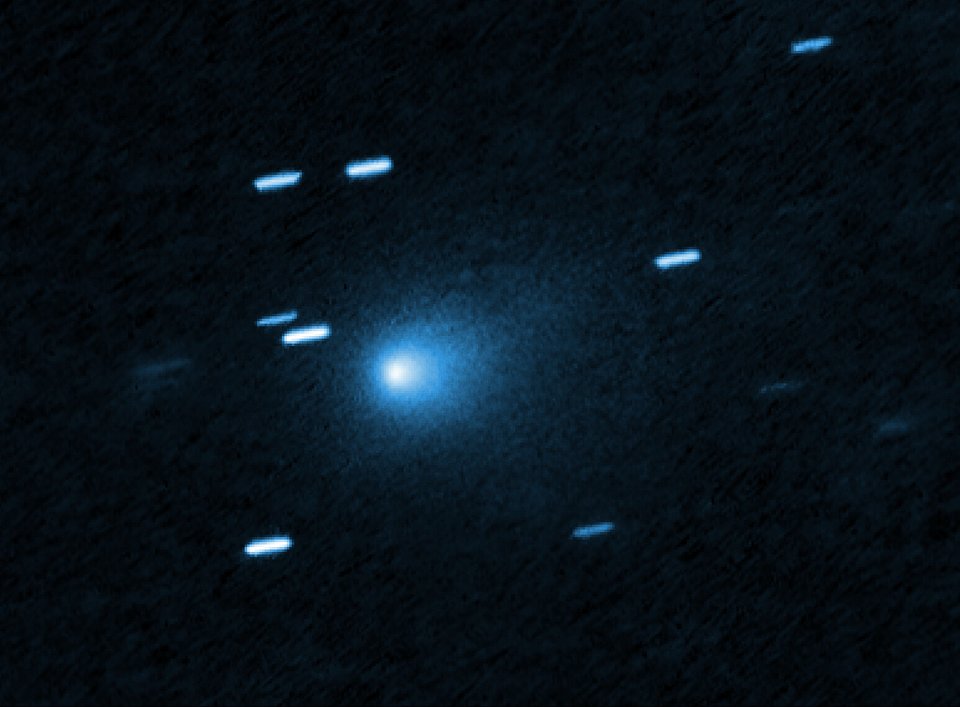
The object is an active comet with a nucleus estimated at roughly 0.5 to 0.7 kilometers (0.3 to 0.4 miles) in diameter, surrounded by a vast coma of gas and dust extending some 700,000 kilometers (435,000 miles). Observations by the James Webb Space Telescope revealed it is unusually rich in carbon dioxide and contains water vapor, carbon monoxide, carbonyl sulfide, and methane. The Very Large Telescope detected cyanide gas and atomic nickel at concentrations comparable to Solar System comets.
For SETI scientists, any interstellar visitor is a compelling target, however unlikely the prospect of artificial origin. “Eventually, our own Voyager spacecraft will be extraterrestrial artifacts in other stellar systems,” said Dr. Sofia Sheikh, lead author of the study. “Given that, it is important that we understand the natural distribution of interstellar objects so that we will be able to identify any anomalies that could one day be signs of an artificial interstellar object.”
How the Search Worked
The team used the Allen Telescope Array (ATA), SETI Institute’s dedicated radio observatory at the Hat Creek Radio Observatory in Northern California. The ATA is a collection of 42 antenna dishes designed specifically for simultaneous wide-bandwidth SETI surveys and radio astronomy.
Observations began less than a day after 3I/ATLAS’s interstellar nature was confirmed, demonstrating the system’s agility. Over more than seven hours, the ATA scanned radio frequencies from 1 to 9 gigahertz, a broad range that covers frequencies where artificial narrowband transmissions might exist. Narrowband signals, concentrated in a very thin slice of frequency, are not produced by natural astrophysical processes and would be a hallmark of technology.
The raw data yielded approximately 74 million narrowband signal detections. From there, the team applied successive filters: first removing signals clearly originating from human-made interference on Earth or from satellites in orbit, then cross-referencing the remaining candidates against 3I/ATLAS’s precise sky motion to identify signals that appeared to move with the comet.
After this rigorous filtering, only about 200 candidate signals remained for manual review. Every single one traced back to terrestrial technology, either ground-based transmitters or Earth-orbiting satellites.
What the Limits Mean
The observations place upper limits on the power of any hypothetical radio transmitter located on or near 3I/ATLAS. The study rules out transmitters stronger than approximately 10 to 110 watts across the observed frequency range, comparable to the power of a household lightbulb or small appliance.
These are not arbitrary numbers. The detection threshold is set by the sensitivity of the ATA and the distance to the comet: at the time of observation, 3I/ATLAS was roughly 3.5 astronomical units (524 million kilometers / 325 million miles) from Earth. A 10-watt omnidirectional transmitter at that distance is the equivalent of trying to spot a nightlight from several hundred million kilometers away. The fact that the ATA could even set such limits speaks to the array’s sensitivity.
“The results from 3I/ATLAS show how realistic it is to detect a signal with the technology we have today,” said co-author Valeria Garcia Lopez of Furman University. “That is why it is important to keep searching for technosignatures, even from objects we might not expect to have signals.”
Context: A Legacy of Interstellar Searches
3I/ATLAS is not the first interstellar object to undergo SETI scrutiny. ‘Oumuamua, the first confirmed interstellar visitor discovered in 2017, was observed by the Robert C. Byrd Green Bank Telescope and the ATA. Those searches found no technosignatures either, though they were limited by the object’s small size and rapid departure from the inner Solar System. 2I/Borisov, discovered in 2019, was also scanned, again with null results.
The 3I/ATLAS campaign benefited from being the longest and broadest set of observations yet, covering more frequency range and collecting far more data than previous efforts. The comet was discovered while still inbound, allowing SETI to plan observations well before it reached its closest approach to the Sun in October 2025. It later swung past Mars in October 2025 at a distance of 19 million miles (30.6 million kilometers) before making its closest pass to Earth in December at a safe 167 million miles (269 million kilometers).
The Voyager analogy that Sheikh and her team invoke is deliberate and thought-provoking. Launched in 1977, Voyager 1 and Voyager 2 are now drifting in interstellar space, carrying golden records and instruments that would be unmistakably artificial to any civilization that encountered them. The twin probes will eventually pass within a few light-years of other stars in tens of thousands of years. If human technology can become an interstellar artifact, the logic goes, then other technological civilizations may have produced similar objects, potentially detectable from afar.
Looking Ahead
As survey telescopes like ATLAS, the Zwicky Transient Facility, and the Vera C. Rubin Observatory continue to scan the skies, the rate of interstellar object discoveries is expected to climb dramatically. Rubin’s Legacy Survey of Space and Time, now in its early operations phase, could identify dozens of interstellar objects per year once fully operational. Each new discovery offers a fresh opportunity to probe for technosignatures, expanding both the sample size and the diversity of objects scrutinized.
For now, the silence from 3I/ATLAS is itself a meaningful scientific result. It tightens the constraints on what kind of technology, if any, accompanies interstellar objects through our neighborhood. And it demonstrates that the observational infrastructure needed to perform these checks is already in place, ready for whoever — or whatever — visits next.