

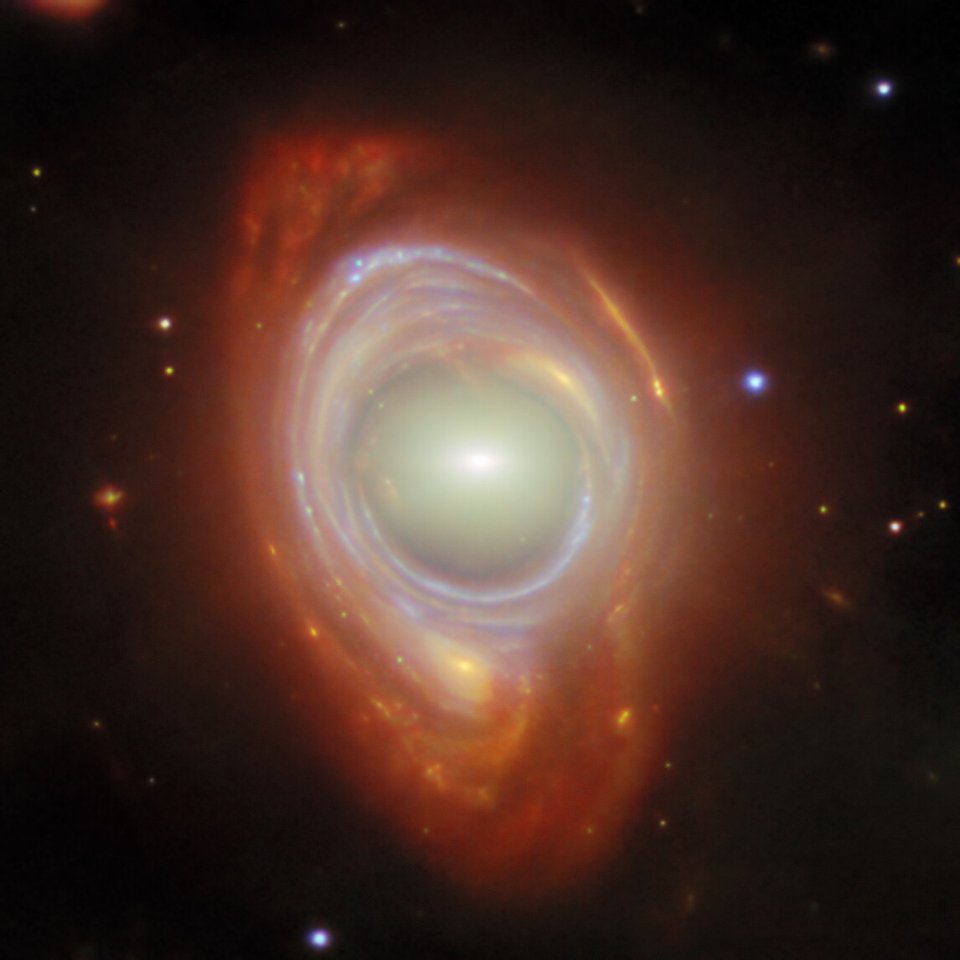
Published: June 05, 2026, 03:44 UTC
The black hole at the center of galaxy MRG-M0138 is a relic. It weighs six billion times the mass of the Sun, placing it among the most massive objects in the known universe. But it has gone quiet. No gas spirals into it. No radiation escapes its event horizon. It sits, dormant, in a galaxy whose star formation has long ceased.
A team of astronomers led by Andrew B. Newman of Carnegie Science and Richard S. Ellis of University College London has now weighed this sleeping giant using the James Webb Space Telescope. The work, published in Science on June 4, marks the first time that stellar dynamics have been used to measure the mass of an inactive supermassive black hole at cosmological distance.
The result challenges existing models of how black holes grow and when they shut down.
How to Weigh an Invisible Object
Black holes cannot be seen directly. When they are active, they reveal themselves through the radiation emitted by infalling gas and dust. When they are dormant, they are detectable only by their gravitational influence on surrounding stars.
This is difficult enough for black holes in nearby galaxies. For a galaxy ten billion light-years away, the challenge is extreme. The stars at the center of MRG-M0138 appear as a blur of light, their individual motions impossible to resolve with conventional telescopes.
The team overcame this limitation with two tools: a gravitational lens and JWST’s NIRSpec integral field spectrograph.
The gravitational lens is the galaxy cluster MACSJ0138.0-2155, which sits between MRG-M0138 and Earth. The cluster’s immense gravity bends space-time, magnifying the background galaxy by a factor of approximately 30. This natural telescope boosted the effective resolution of JWST’s observations to 91 parsecs per spatial element at the galaxy’s center, comparable to what is achieved for nearby galaxies.
JWST’s NIRSpec IFU then captured spectra across 219 spatial bins at the galaxy’s core, measuring the Doppler shifts of starlight. Stars orbiting closer to the black hole move faster than those farther out. By modeling the velocity field using a technique called Jeans Anisotropic Modeling, the team inferred the central mass.
The result: a black hole mass of 6.0 billion solar masses, with a formal uncertainty of about 15 percent combining statistical and systematic errors. The host galaxy’s stellar mass is 2.2 × 10¹¹ solar masses, comparable to the Milky Way.
The Puzzle of a Premature Giant
The redshift of MRG-M0138 is 1.95, meaning its light has been traveling for roughly ten billion years. The universe was about 3.3 billion years old when the light we see today was emitted. The black hole had already reached its full six-billion-solar-mass size and had already stopped accreting.
This is difficult to explain. To grow that massive that early, the black hole must have passed through an extremely efficient accretion phase. If it radiated at 30 percent of the Eddington limit — a typical value for luminous quasars — it would have produced a bolometric luminosity of about 1047 ergs per second, outshining its entire host galaxy. Such luminous quasars drive powerful winds, ejecting gas from the galaxy at rates of thousands of solar masses per year.
This is likely what shut both processes down. The black hole’s own growth blew away the gas that was feeding it. The same winds depleted the galaxy’s gas reservoir, starving it of fuel for new stars. MRG-M0138 became a quiescent galaxy with a dormant black hole, both extinguished by the same convulsive event.
Only 2 of 635 galaxies in the ASTRID cosmological simulation at similar redshift and stellar mass host a black hole this massive. It is an outlier, and outliers reveal the boundaries of theory.
What the Black Hole Tells Us About Galaxy Evolution
The most important result may not be the black hole mass itself, but what it reveals about the relationship between black holes and their host galaxies.
Locally, the mass of a supermassive black hole correlates tightly with the velocity dispersion of stars in its host galaxy’s bulge — the M-sigma relation — and with the bulge mass itself, the M-bulge relation. These correlations suggest that black holes and their hosts co-evolve, though the causal direction remains debated.
MRG-M0138 falls squarely on the local M-sigma relation, suggesting that this correlation has been in place for at least ten billion years. The M-bulge relation, however, tells a different story. The black hole overshoots the local relation by roughly a factor of five, placing it as a 2-to-3-sigma outlier. This implies that many of the stars that now populate the bulges of massive elliptical galaxies had not yet formed at z=2, or had not yet settled into their present configuration.
In other words, the black hole reached its final mass before its host galaxy finished assembling.
A Window Opened
The technique demonstrated in this study opens the door to a more complete census. Only a handful of dormant supermassive black holes at high redshift have been identified, and none before had been weighed using stellar dynamics. The combination of JWST’s infrared sensitivity, its spectrographic capabilities, and the natural magnification of gravitational lensing now makes such measurements routine for suitably aligned targets.
“By demonstrating the feasibility of such a technique for galaxies in the early universe, we can now undertake a more complete census of how black holes develop over time,” Ellis said.
Newman added that the team is already looking for more cindered galaxies: “They are like cinders that we can study to learn what put out the fire. In particular, we are looking for signs of gas that has been blown out of the galaxy, by a black hole more active than the one in MRG-M0138.”
The upcoming Nancy Grace Roman Space Telescope, scheduled for launch this September, is expected to find many more gravitationally lensed galaxies suitable for this technique, turning what is now a single-object study into a population.
Caveats
Several limitations should be kept in mind. The gravitational magnification factor of 29 carries a large uncertainty — plus 13, minus 11 — that propagates into the mass measurement. The black hole’s sphere of influence, the region within which its gravity dominates over that of the surrounding stars, is only marginally resolved. The stellar dynamical modeling relies on assumptions about the initial mass function of stars, velocity anisotropy, and dark matter content. And the sample is one: a single object cannot tell us whether MRG-M0138 is typical of dormant black holes at its epoch or an extreme case.
Still, for a first measurement, the precision is striking. Six billion solar masses, sitting silently in the early universe, with its story written in the light of the stars that still orbit it.
Reference
Newman, A.B., Gu, M., Belli, S., Ellis, R.S. et al. “A Stellar Dynamical Mass Measurement of an Inactive Black Hole in the Distant Universe.” Science (2026). DOI: 10.1126/science.adx5816. arXiv: 2503.17478