

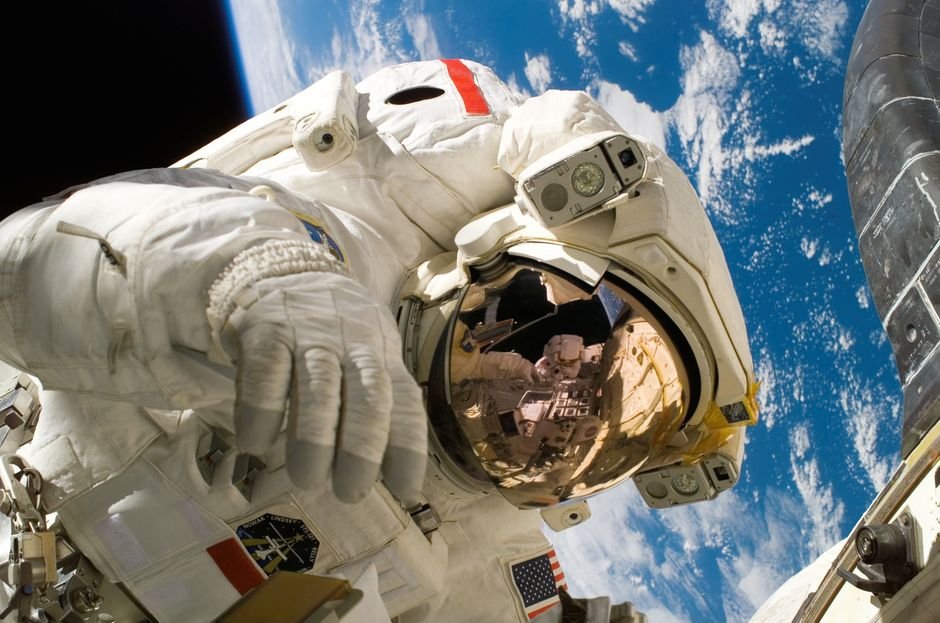
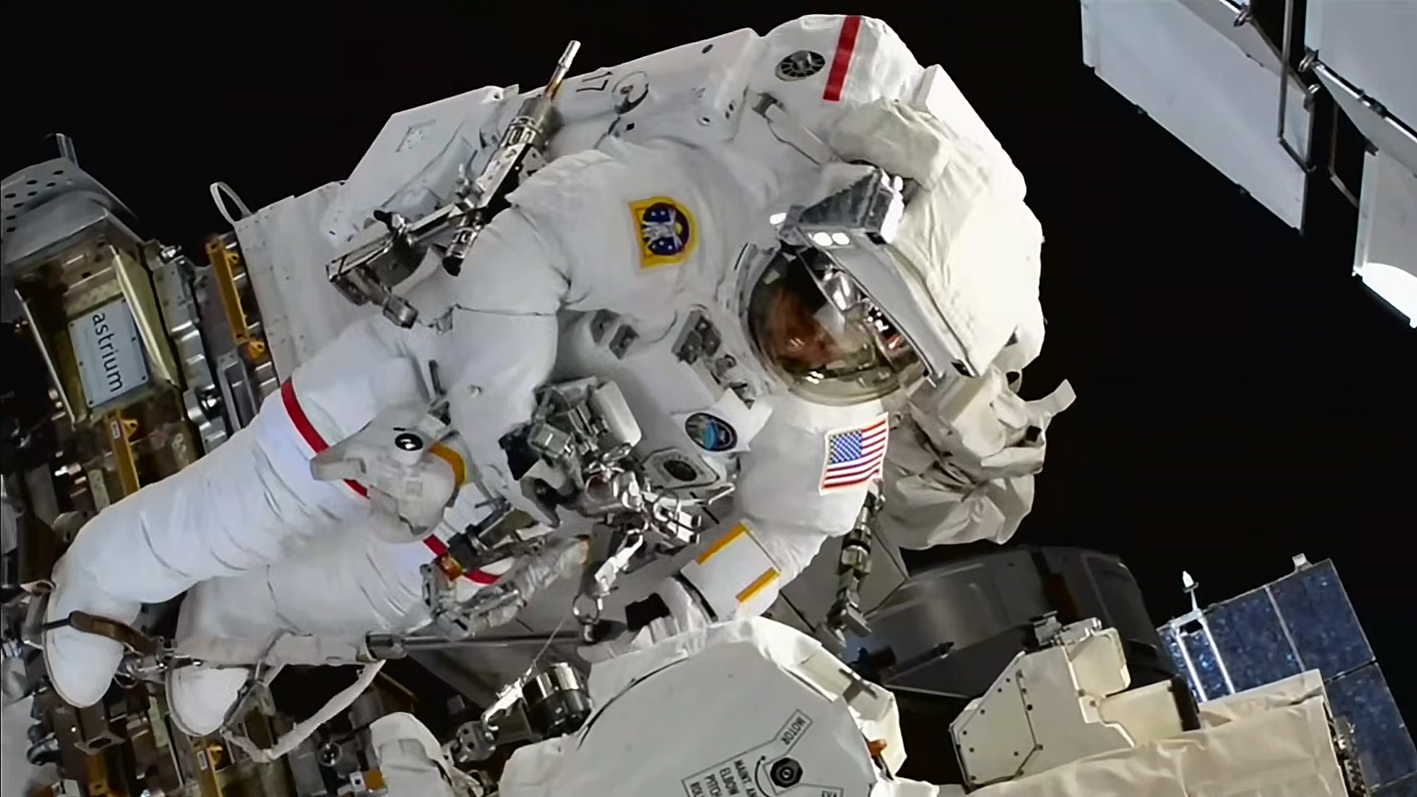
NASA astronaut Chris Williams works outside the International Space Station to replace a wrist joint on the Canadarm2 robotic arm on June 30, 2026. Credit: NASA
NASA astronauts Chris Williams and Jessica Meir completed a 7-hour, 20-minute spacewalk on June 30 to replace a faulty wrist joint on the International Space Station’s Canadarm2 robotic arm, restoring full functionality to the 25-year-old Canadian-built manipulator just in time for Canada Day.
The spacewalk, designated US EVA 95 and the 280th in support of ISS assembly and maintenance, began at 8:20 a.m. EDT when the astronauts switched their spacesuits to battery power and exited the station’s Quest airlock. They concluded the excursion at 3:40 p.m. EDT after successfully removing the malfunctioning joint and installing a spare unit that had been stored on an external equipment panel.
“We are thrilled to have repaired the mighty Canadarm2 just in time for Canada Day tomorrow,” Meir said during the spacewalk. “We hope that all in Canada and everyone around the globe can celebrate this achievement.”
The repair was necessary after Canadarm2’s wrist joint (joint no. 5) failed during routine operations on May 27. The joint drew elevated motor current but did not move as commanded, a fault signature consistent with a seized or failed motor-gearbox assembly. NASA and the Canadian Space Agency (CSA) determined the joint could not be repaired remotely and approved a spacewalk to replace it.
Canadarm2, built by MDA Space of Canada, measures 17.6 meters (58 feet) long and has been in continuous service aboard the ISS since its installation in April 2001, operating more than a decade beyond its original design life. The arm is essential for capturing and berthing cargo spacecraft, moving equipment and supplies, supporting spacewalks, and performing external station maintenance.
The repair procedure required the astronauts to temporarily detach a 408-kilogram (900-pound) Latching End Effector (one of the arm’s grappling “hands”) to access the failed joint beneath it. Williams and Meir unbolted the malfunctioning wrist joint, installed the replacement, restored electrical and data connections, and reattached the end effector.
Following the repair, NASA’s Mission Control in Houston powered up Canadarm2 and successfully completed an initial checkout of the system’s power and data connectivity. Ground controllers will begin moving the arm over the coming week as system checkouts continue.
CSA astronaut Jenni Gibbons served as the capsule communicator in Mission Control, directing the spacewalkers throughout the operation. Inside the station, NASA astronaut Jack Hathaway and European Space Agency astronaut Sophie Adenot assisted with suit donning and doffing and maneuvered Canadarm2 into position for the repair work.
The faulty joint will be returned to Earth for inspection and possible refurbishment for future use.
Williams, completing his second career spacewalk, now has 14 hours and 22 minutes of EVA experience. Meir, on her fifth spacewalk, logged her 36th hour and 6th minute outside the station. Meir previously participated in the first all-female spacewalk in October 2019 alongside Christina Koch.
“For over 25 years, the Canadarm2 has been a crucial part of the International Space Station,” Williams said after completing the repair. “The arm was key to our orbiting laboratory and continues to be a workhorse that we rely on. Whether it is performing maintenance or replacing equipment, moving and operating payloads, catching cargo vehicles or helping us out during spacewalks, the arm has played and will continue to play an essential role in our work on orbit.”
“It is also a testament to international cooperation,” he added. “Canada, the U.S. and the world have come together to make this program a success. We are honored that we were able to give the arm a helping hand.”
This marks the fourth time spacewalkers have serviced Canadarm2 in orbit. Previous repairs included a wrist joint replacement and the swapping of both Latching End Effectors for spare units during spacewalks in 2017 and 2018.