

Published: June 04, 2026, 04:44 UTC
# Grab What You Can: The New Reality in the South China Sea
With US attention fixed on Iran, China is grabbing territory and filling the vacuum. The rules-based order is not holding.
The BBC recently ran a documentary with a title that says everything: “Grab what you can while you can: The new reality in the South China Sea.” It is the kind of phrase diplomats would never use — too blunt, too honest. But it captures the moment perfectly. The old order is collapsing, and the scramble is already underway. Every country is looking out for itself because no one else will.
This is the new reality. And it is being written by Beijing.
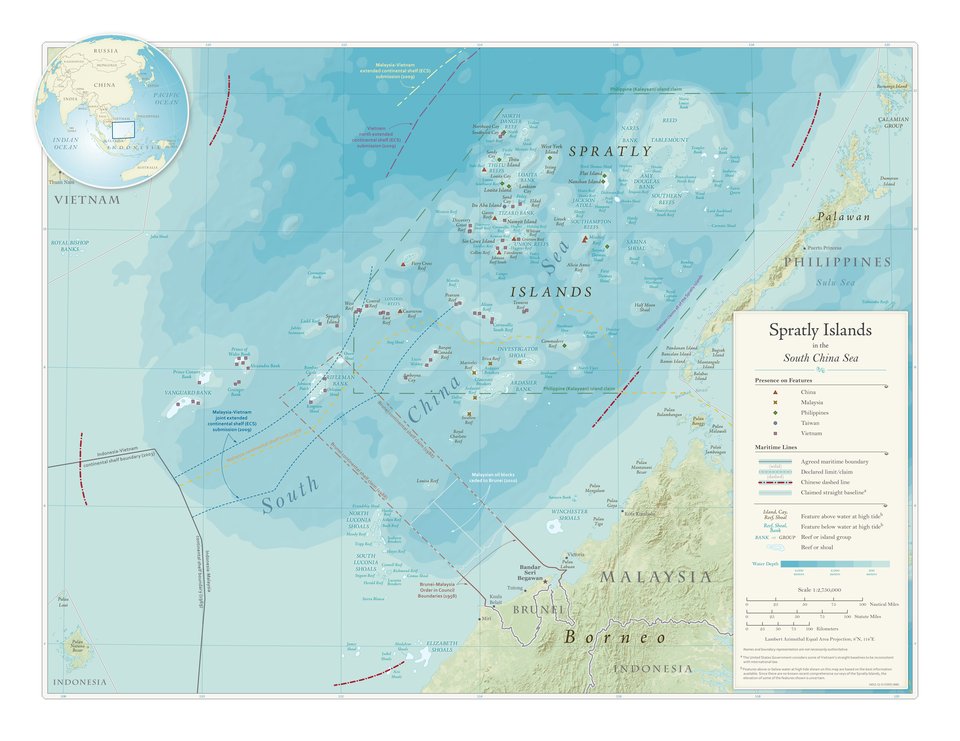
For the better part of a decade, China has been building artificial islands, stationing missile systems, and running naval patrols across a body of water it claims almost in its entirety — roughly 90 percent of the South China Sea. These claims overlap with the exclusive economic zones of Vietnam, the Philippines, Malaysia, Brunei, and Taiwan. The Philippines alone has seen its fishing grounds shrink, its reefs occupied, and its vessels harassed by Chinese Coast Guard ships that are, in practical terms, naval auxiliaries.
In recent months, the pace has accelerated. Satellite imagery obtained by multiple news organizations shows a significant increase in dredging and construction at Chinese-held features across the Spratly Islands. New runways, new hangars, new radar installations. At Subi Reef, Mischief Reef, and Fiery Cross Reef, China has built what can only be described as military installations — airstrips long enough for fighter jets, missile bunkers, and command centers. China calls them “civilian service facilities.” The imagery tells another story.
Most telling is what is happening at Scarborough Shoal, 120 nautical miles west of Luzon. In 2012, China seized control of the shoal after a standoff with Philippine vessels. For years, it maintained a de facto presence, rotating ships to block Filipino fishermen from accessing the rich fishing grounds inside the lagoon. But now China has taken a more permanent step. Satellite photographs confirm that Beijing has erected floating barriers — a chain of buoys and netting strung across the entrance. It is a physical wall at sea. The message is unmistakable: this water belongs to us now.
The Philippine government has protested. It has released diplomatic notes, issued public statements, and called on international arbitration — the same arbitration that ruled in Manila’s favor in 2016, declaring China’s expansive claims to have “no legal basis.” That ruling was a landmark for international law. China has ignored it completely. The floating barriers at Scarborough Shoal are the latest evidence that the 2016 ruling is a dead letter. It exists only on paper. On the water, China does what it wants.
A senior Philippine defense official, speaking on condition of anonymity, described the situation to Reuters as a “long-term struggle.” He said Manila does not expect Beijing to stop. “They are testing limits. Every month, every week, every day. They push, we push back. But they have more ships, more money, more patience. They are playing a game of attrition.”
Why now? The answer is not complicated. The United States is fighting a war in Iran.
In late 2025, US Central Command began a sustained campaign against Iran involving two carrier strike groups, dozens of supporting vessels, and tens of thousands of troops. The Pentagon has been forced to draw down forces elsewhere. The Pacific theater — the one theater where the US had hoped to concentrate its strategic weight — has been raided to supply the Middle East.
The USS Carl Vinson and the USS Theodore Roosevelt, both previously assigned to the Pacific, have been redeployed to the Arabian Sea. The USS Ronald Reagan remains in Japan but has been stripped of several escorts. The net effect is a naval vacuum in the South China Sea — not a complete absence of American presence, but a significant reduction in quick-response capability. When a Chinese Coast Guard vessel rams a Philippine supply ship today, no American destroyer is close enough to intervene. When Chinese dredgers move into a new reef, no US aircraft carrier is positioned to monitor them.
The message from Washington to Asia has been clear for months. At the Shangri-La Dialogue in Singapore earlier this year, Secretary of Defense Pete Hegseth delivered a blunt message: America’s allies need to spend more on their own defense. The United States cannot be the guarantor of every security crisis in the Indo-Pacific.
The logic is not unreasonable. Europe has been told the same thing for decades. But for countries like the Philippines, which spends less than one percent of its GDP on defense, the message arrives at the worst possible moment. Manila has no navy worth the name. Its largest warships are former US Coast Guard cutters, aging and lightly armed. Against the People’s Liberation Army Navy — the largest navy in the world by hull count, with modern destroyers, frigates, and an expanding submarine fleet — the Philippines is outmatched by a factor that cannot be closed by any realistic increase in defense spending. Not this year. Not next year. Not in a decade.
The Philippines is not alone in its predicament, but it is alone in its response.
Vietnam, which also has competing claims, has pursued a quieter strategy. Hanoi continues to protest Chinese incursions and has conducted modest island-building at Sand Cay. But Vietnam has also deepened its economic relationship with China. Bilateral trade reached $200 billion in 2025. Hanoi is unwilling to jeopardize that relationship for a set of reefs that will not appear on any Vietnamese GDP calculation. Its response is calibrated, cautious, and largely private.
Malaysia has claims around James Shoal but has been quieter still. Kuala Lumpur concentrates on oil and gas exploration within its claimed waters and avoids direct confrontation. When Chinese survey ships operate in waters Malaysia considers its own, the government issues diplomatic protests and occasionally sends a patrol boat to observe. But Malaysia has not challenged Chinese construction. It has accepted, in practice if not in principle, that the South China Sea is a Chinese lake.
Brunei, the smallest claimant, has essentially opted out of the dispute entirely. It maintains its claim on paper but has made no move to enforce it. Its navy consists of a handful of patrol boats. Its foreign policy is built on good relations with China. In the current environment, discretion is the better part of valor.
This is what the BBC documentary meant by “every country for itself.” ASEAN was supposed to provide a collective framework for managing these disputes. Negotiations on a binding Code of Conduct have been underway for more than a decade. They have produced nothing concrete. China has insisted any code must not apply to features it already controls. It has stalled every draft. ASEAN, for its part, cannot agree on a unified position because its members cannot agree on whether China is a threat or an opportunity. Some see Chinese investment. Others see Chinese warships. They are not the same thing, but ASEAN cannot reconcile them.
The consequences are not abstract. With no collective deterrent, the US Navy preoccupied in the Middle East, and ASEAN unable to act, China is making the most of its window. The floating barrier at Scarborough Shoal is a test. If the Philippines cannot remove it, and if no outside power intervenes, Beijing will build a permanent structure there — a new island, a new runway. The pattern has been repeated across the Spratly Islands for a decade. Scarborough Shoal is just the next target.
The strategic logic is clear. The South China Sea carries roughly a third of global maritime commerce — oil from the Middle East, container ships from China and Japan, liquefied natural gas from Australia and Qatar. These sea lanes are the arteries of the global economy. China is not trying to block them today. It is trying to control them tomorrow. Every reef fortified moves China closer to the day when it can dictate the terms of passage. The Nine-Dash Line, which Beijing uses to claim almost the entire sea, has no basis in international law. But law is only as strong as the willingness to enforce it.
This is what it means when the world’s policeman looks the other way. The rules-based order in the Indo-Pacific was never a formal treaty. It was a set of norms — freedom of navigation, peaceful resolution of disputes, respect for sovereignty — backed by the credible threat of American naval power. That threat has been hollowed out, at least for now.
The question that hangs over the region is whether this is a temporary window or a permanent shift. If the war in Iran ends quickly and the United States returns to the Pacific, some pressure may ease. But the islands will still be there. The runways will remain. And China will have learned that when the moment came, no one stopped them.
That lesson will shape the credibility of the United States as a Pacific power. It will shape the fate of every small nation that trusted in a rules-based order that, it turns out, had no teeth.
The BBC documentary called it “Grab what you can while you can.” It is not a policy. It is not a strategy. It is a description of the world as it now is. And in the South China Sea, the grabbing has only just begun.