

Published: June 03, 2026, 01:08 UTC
A powerful El Niño appears to be building in the tropical Pacific — one that forecasters warn could rival the strongest events of the past century. With global temperatures already at record highs, the combination could push the planet into unprecedented territory in 2026 and 2027.
The latest forecast from the NOAA Climate Prediction Center (CPC), issued May 14, 2026, places the probability of El Niño emerging in the May–July window at 82% — up sharply from earlier in the year. That probability rises to 96% for the Northern Hemisphere winter (December 2026–February 2027). The International Research Institute for Climate and Society (IRI) ensemble forecast is even more emphatic: 98% probability for El Niño in May–July 2026, with a 97–98% probability persisting through the entire forecast period into early 2027.
The World Meteorological Organization (WMO) echoed the warning on June 2, placing the probability at roughly 80% for June–August, rising to ~90% through at least November 2026. WMO Secretary-General Celeste Saulo put it bluntly: “The footprint of an El Niño travels far beyond its origins in the Pacific Ocean, impacting agriculture, energy supplies, trade, water resources… Impacts will hit even harder, travel even farther, and cross borders with devastating speed.”
How Strong? The “Super El Niño” Question
The most striking number in the CPC forecast is the probability that the event will reach strong or very strong intensity: 65% starting in October 2026, persisting through February 2027. A strong El Niño is defined by sea surface temperature anomalies exceeding 1.5°C in the Niño 3.4 region. A “very strong” or “Super El Niño” is defined by anomalies above 2.0°C.
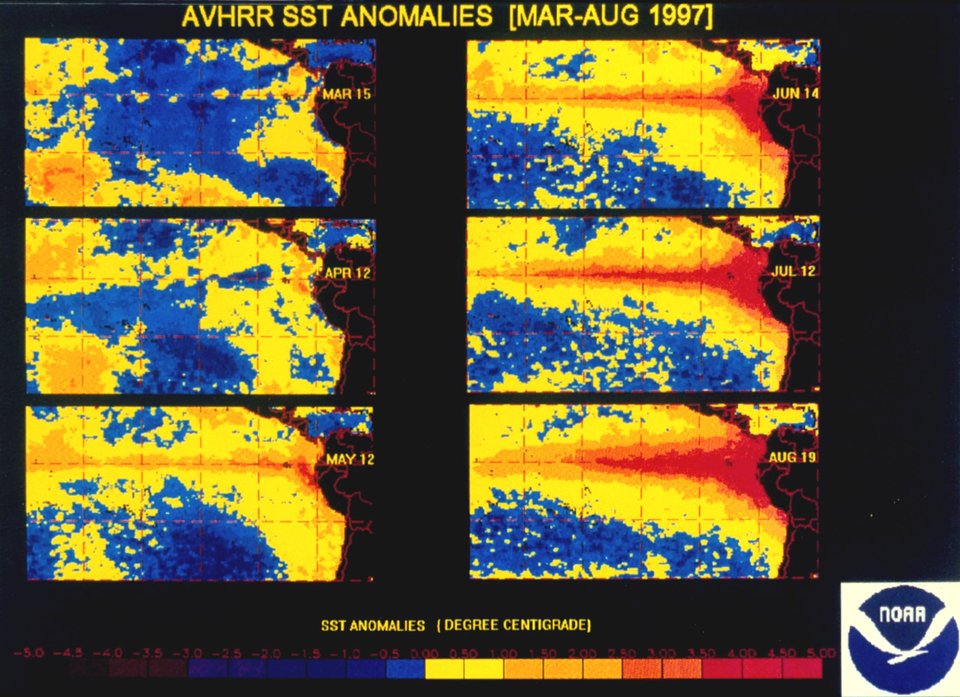
The odds of a Super El Niño specifically are estimated at roughly 50% — approximately double what earlier forecasts suggested. If realized, this would rank alongside the 2015–2016 and 1997–1998 events, the two strongest El Niños in modern records. Some analyses suggest it could be the most powerful since 1876–1878 — an event that triggered widespread famine and millions of deaths across Asia.
What El Niño Does to the Planet
El Niño is the warm phase of the El Niño–Southern Oscillation (ENSO), the dominant driver of year-to-year global climate variability. When the equatorial Pacific warms, the heat spreads through the atmosphere via altered atmospheric circulation patterns, affecting weather across every continent.
The typical impacts include:
- Temperature: El Niño adds roughly 0.1–0.2°C to global average temperatures, often pushing individual years to record levels. On top of a warming planet already 1.3°C above pre-industrial levels, this could push 2026 or 2027 past the 1.5°C threshold — at least temporarily — for the first time.
- Hurricanes: The Atlantic basin typically sees fewer hurricanes during El Niño due to increased vertical wind shear, while the Pacific basin sees more tropical activity.
- Precipitation patterns: The southern United States tends to get wetter in winter, while the northern US and Canada become warmer and drier. Southeast Asia, Australia, and parts of Africa see increased drought risk. Monsoon patterns across India can be disrupted.
- Wildfires: Drier conditions in Australia, Southeast Asia, and parts of the Amazon elevate fire risk.
- Agriculture: Growing seasons in key food-producing regions — particularly Australia, India, Southeast Asia, and southern Africa — can be severely disrupted, with cascading effects on food prices and food security.
Record Temperatures Ahead
Either 2026 or 2027 now stands a strong chance of displacing 2024 as the hottest year on record. The World Meteorological Organization has already confirmed that the first part of 2026 has seen extreme warmth: the contiguous United States just experienced its hottest March on record. When the full El Niño warming effect kicks in — typically strongest in the winter months following El Niño onset — the additional heat loading could push global average temperatures into ranges not seen in at least 125,000 years.
The comparison to 1876–1878, drawn by some climate scientists, is sobering. That El Niño, the most devastating of the 19th century, contributed to drought and famine that killed an estimated 5–10 million people across Asia, Africa, and South America — a death toll amplified by the fact that societies had no El Niño forecasting and no preparation time. Today’s forecasts provide months of warning, but the underlying vulnerability — water stress, agricultural dependence on predictable seasons, fragile supply chains — has not disappeared.
What Officials Are Urging
The WMO, NOAA, and national meteorological agencies across the Pacific Rim are coordinating messaging: prepare now. For governments, this means reviewing drought contingency plans, water resource management strategies, and emergency response frameworks for extreme weather events. For farmers, it means adjusting planting schedules and crop choices. For public health agencies, it means preparing for heatwaves, vector-borne disease outbreaks, and food insecurity.
The next NOAA CPC ENSO diagnostic discussion is scheduled for June 11, 2026 — which will either confirm or refine the emerging picture. The June update is historically significant, as spring forecasts have the highest predictive skill of any time of year — the so-called “spring predictability barrier” lifts in June, and the ENSO state for the rest of the year becomes increasingly clear.
The Caveat
El Niño forecasting is probabilistic by nature. An 82% chance means an 18% chance that the event does not materialize as expected. The strength forecasts carry even more uncertainty: predicting whether an El Niño will become “very strong” remains difficult at lead times of several months. The ocean-atmosphere system is chaotic, and mid-2026 is still early enough that the ultimate outcome could diverge from the current forecasts.
But the convergence of signals — CPC, IRI, WMO, multiple climate model ensembles — pointing in the same direction is unusual. When forecasts across independent centers agree this strongly this early, the probability of a significant event rises accordingly. The question is no longer whether an El Niño will develop, but how strong it will be.
Sources: NOAA Climate Prediction Center. ENSO Diagnostic Discussion. May 14, 2026. https://www.cpc.ncep.noaa.gov/products/analysis_monitoring/enso_disc_Jun2026/; World Meteorological Organization. El Niño/La Niña Update. June 2, 2026; IRI/CCSR ENSO Forecast Plume. May 2026. EarthSky, “Prepare for El Niño conditions, urge officials.” June 2, 2026.