

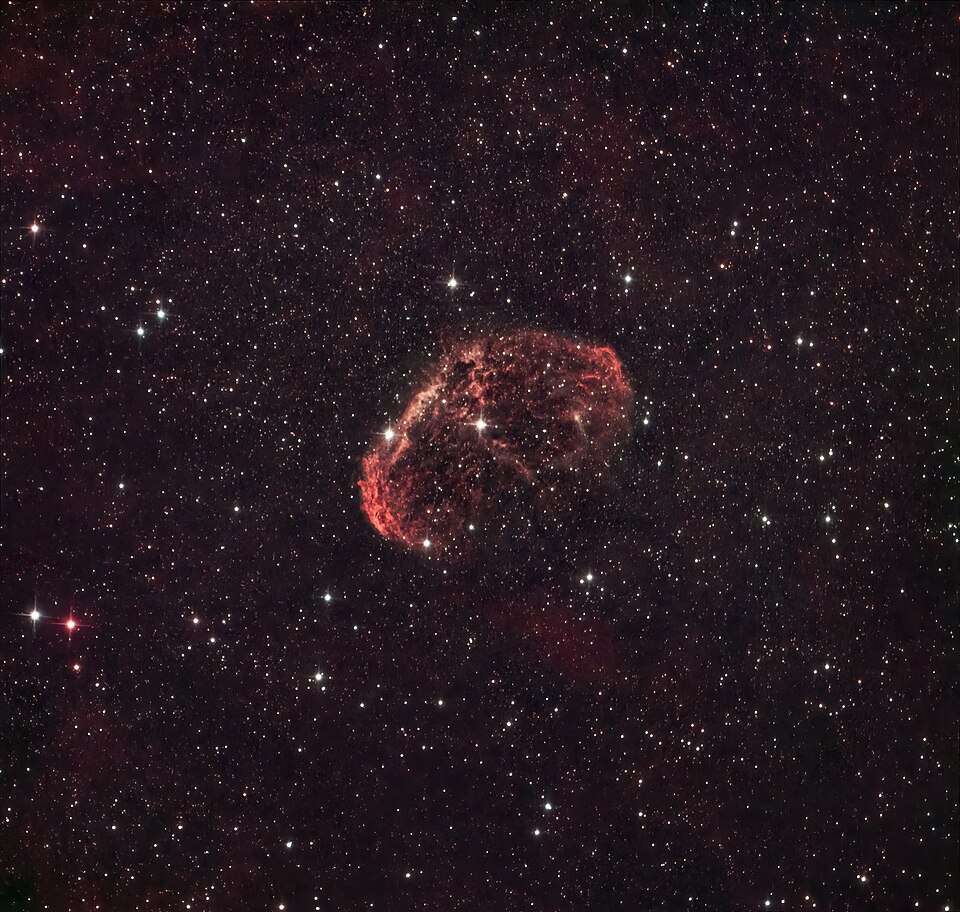
Published: June 02, 2026, 02:42 UTC
ToupTek ATR2600C Review: The Affordable APS-C Cooled Camera That Challenges ZWO’s Crown
Date: 2026-06-02
Featured image: ToupTek ATR2600C cooled CMOS astrophotography camera mounted on a telescope imaging train. [Credit: ToupTek Astro]
The ToupTek ATR2600C is a dedicated deep-sky cooled CMOS camera that delivers professional-grade image quality at a price that undercuts the category leader by a significant margin. Built around Sony’s back-illuminated IMX571 APS-C sensor — the same chip found in the ZWO ASI2600MC — it offers the critical trifecta for serious astrophotography: deep TEC cooling, ultra-low read noise, and high quantum efficiency, all for roughly $300–400 less than its closest competitor.
The Sensor at the Heart of It
The Sony IMX571 is arguably the most consequential astrophotography sensor of the past five years. This 26-megapixel APS-C format CMOS chip (6288 × 4164 pixels, 3.76 µm pixel pitch) has become the gold standard for enthusiast and semi-professional deep-sky imaging. Its back-illuminated architecture allows photons to hit the photodiodes directly rather than passing through metal wiring layers, boosting quantum efficiency to around 80% — a dramatic improvement over front-illuminated designs.
The APS-C format occupies what many imagers call the sweet spot. It offers a wider field of view than 1-inch sensors like the IMX183 or IMX533, making it easier to frame large objects like the Andromeda Galaxy, North America Nebula, or Rosette Nebula without expensive focal reducers. At the same time, it avoids the steep pricing, demanding optical requirements, and vignetting/coma challenges of full-frame sensors. An APS-C camera paired with an 80mm f/6 refractor or an 8-inch f/4 Newtonian delivers a field of view that covers most popular deep-sky targets comfortably.
Cooling That Makes the Difference
The defining feature of any dedicated astronomy camera is thermoelectric cooling, and the ATR2600C delivers here in spades. The built-in two-stage TEC (thermoelectric cooler) can drop the sensor temperature a full 35–40°C below ambient. In practice, that means running at -15°C to -20°C even on a mild summer night — or pushing to -25°C and beyond when the air is cooler.
Why does this matter? Dark current — the thermal noise generated by the sensor itself — doubles roughly every 5–6°C of temperature increase. An uncooled DSLR or mirrorless camera shooting in 20°C conditions produces enough dark current to overwhelm faint nebula detail in exposures longer than 30–60 seconds. The ATR2600C at -15°C reduces dark current to negligibly low levels — ToupTek quotes 0.002 e⁻/pixel/second — meaning you can take 5-, 10-, even 20-minute sub-exposures without significant thermal noise accumulation.
This has a powerful practical benefit: stable temperature means reusable dark frames. Shoot one dark library at -15°C and use it for weeks or months, rather than building a new calibration set every session. It streamlines the workflow and gets you processing data faster.
Read Noise and Dynamic Range
The ATR2600C’s read noise performance is competitive with the best in its class. At high gain settings (gain 100, equivalent to around 0.5 e⁻/ADU), read noise drops to approximately 1.0–1.2 e⁻ — low enough that the camera is effectively “read noise limited” in a single 60-second exposure under dark skies. This is critical for capturing faint emission nebulae, reflection nebulae, and the wispy IFN (Integrated Flux Nebula) that challenge even experienced imagers.
Dynamic range is equally impressive. The IMX571 offers 14-bit natively, and ToupTek’s electronics preserve that range cleanly. You get the shadow detail to stretch fainter structures without posterization, and the highlight headroom to keep star cores from blowing out in a single frame. For HDR-style composites — M42 or the Milky Way core — that dynamic range translates directly into smoother, more natural-looking final images.
Image Quality and Linear Data
One of the most important differences between a dedicated astronomy camera like the ATR2600C and a modified DSLR is the output format. The ATR2600C produces true 16-bit FITS files — fully linear, minimally processed raw data straight off the sensor. There is no in-camera noise reduction, sharpening, white balance, or gamma correction baked in, as there is with every consumer camera.
This linear data is what serious astrophotographers need. Post-processing in PixInsight, Siril, or Adobe Photoshop relies on preserving the linear relationship between photons detected and pixel values recorded. Non-linear processing applied by a DSLR before you ever see the file breaks the mathematics behind gradient removal, deconvolution, and many stretching algorithms. The ATR2600C — like all dedicated astronomy cameras — gives you a clean canvas to work from.
Build and Field Use
ToupTek has clearly been iterating on ergonomics and build quality. The ATR2600C features a compact, all-metal body with a standard M42 × 0.75 (T-thread) front connection, making it compatible with virtually any telescope, lens, or field flattener on the market. The 12V DC power input uses a standard 2.1mm barrel jack, and the USB 3.0 connection delivers fast downloads — a full 26-megapixel frame transfers in under a second.
The camera ships with a 1.25-inch nose piece and an integrated tilt-adjustment mechanism for the protective AR-coated window — a thoughtful inclusion that saves having to buy a separate tilt plate for sensor orthogonality adjustments.
For field operation, ToupTek’s ecosystem includes the StellaVita smart controller, a compact computer that runs the camera wirelessly. With StellaVita, you can control the ATR2600C from a tablet or phone over WiFi, eliminating the need to lug a laptop into the field. For those who prefer the traditional setup, the camera is fully compatible with ASCOM drivers, and it plays nicely with all the major capture software: SharpCap, N.I.N.A., Astrophotography Tool (APT), and even the ASI-native apps via direct SDK support.
How It Stacks Up Against the Competition
The ZWO ASI2600MC Pro retails for $1,499 — and has been the default recommendation in this space for years. The ToupTek ATR2600C, using the same sensor and offering comparable or better cooling performance, typically sells for $1,099 to $1,199. That’s a $300–400 savings for essentially the same imaging capability.
Damon Scotting, an experienced astrophotographer known for his thorough reviews, tested the ATR2600C on Scopetrader and came away impressed. He noted that the cooling performance was “strong” and image quality was “impressive for the price point,” calling it a serious alternative to the ASI2600 for budget-conscious imagers.
ToupTek’s customer support and driver maturity have been areas where the company lagged behind ZWO historically, but recent firmware and software updates have closed that gap considerably. The drivers are stable across Windows, macOS, and Linux, and the SDK is well-documented for those building custom automation rigs.
Who Should Buy the ATR2600C?
This camera is an excellent fit for three groups of imagers. First, DSLR users ready to take the step into dedicated astronomy cameras — the ATR2600C offers a night-and-day improvement at a price that won’t cause sticker shock compared to a mid-range astro-modified mirrorless. Second, existing mono camera users looking to add a high-quality one-shot-color camera for fast broadband imaging or as a travel rig. Third, imagers on a tight budget who have been considering the ZWO ASI2600MC but want to save the difference for a better mount or telescope — the priority that matters most in image quality.
Final Verdict
The ToupTek ATR2600C delivers everything that makes the IMX571 sensor legendary — exceptional quantum efficiency, vanishingly low dark current, and excellent read noise — in a well-built body with competitive cooling, at a price that undercuts the market leader by hundreds of dollars. It may lack the name recognition of ZWO’s ASI2600 series, but the images it produces are indistinguishable where it counts: on screen.
For the wide-field deep-sky imager who wants maximum quality for their dollar, the ATR2600C is one of the best-value cooled cameras available in 2026. It deserves a serious look.