

Published: June 02, 2026, 03:25 UTC
Webb Telescope Sniffs Methane from Interstellar Comet 3I/ATLAS — A Chemical First for a Visitor from Beyond the Solar System
Date: 2026-06-02
Featured image: Artist’s impression of Comet 3I/ATLAS as it streaks through the inner Solar System, with the Webb Space Telescope’s MIRI instrument analyzing its chemical composition. Credit: NASA, ESA, CSA, STScI, M. Belyakov (Caltech), I. Wong (STScI), Image Processing: A. Pagan (STScI) — CC BY 4.0
The James Webb Space Telescope has done it again. For the first time, astronomers have obtained a detailed chemical fingerprint of an interstellar object — and what they found inside Comet 3I/ATLAS is rewriting the rulebook on how alien worlds form.
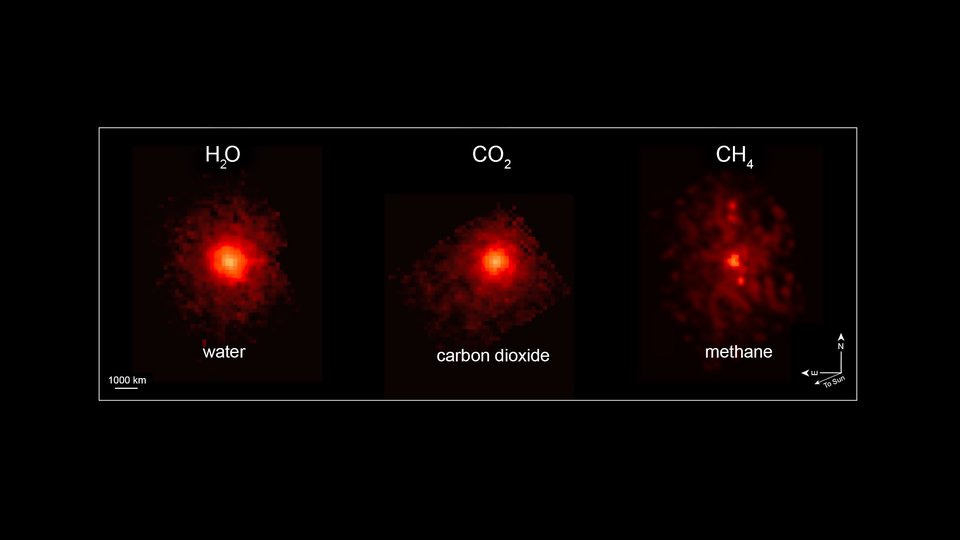
Using Webb’s Mid-Infrared Instrument (MIRI), an international team detected methane (CH₄) — a simple organic molecule — buried deep within the icy nucleus of 3I/ATLAS, the third interstellar object ever discovered and the first to arrive with enough brightness and proximity for a thorough spectroscopic analysis. The discovery, published today in The Astrophysical Journal Letters, marks a major milestone in comparative planetary science: we now have direct chemical data from another star system.
“Methane is a key tracer of how and where a comet formed,” said Dr. Michael Kelley, the study’s lead author from the University of Maryland. “What we’re seeing in 3I/ATLAS is fundamentally different from anything we’ve measured in our own comet population.”
A Comet from Another Star
Comet 3I/ATLAS was spotted in early 2026 by the Asteroid Terrestrial-impact Last Alert System (ATLAS) survey. Orbital calculations confirmed it arrived from interstellar space — likely ejected from its parent planetary system millions or billions of years ago. Unlike its predecessor 2I/Borisov — which appeared chemically similar to Solar System comets — 3I/ATLAS showed signs of something unusual almost immediately.
Webb’s MIRI Medium Resolution Spectrometer observed the comet across two windows: December 15–16, when it was about 330 million kilometers from the Sun (roughly 2.2 astronomical units), and again on December 27, when it had crossed 380 million kilometers on its journey back out into deep space. The first observation session caught the comet still warming from its close solar passage. The second captured it cooling.
The difference between those two observations told the story.
Buried Treasure: Methane Released by Solar Heat
The team found that methane was not present on the comet’s surface when Webb first looked. Instead, it was locked away beneath layers of refractory material — a crust of dust and organic residue left behind as the comet’s more volatile ices sublimated. But as solar heating penetrated deeper into the nucleus after the comet’s closest approach to the Sun, those subsurface layers warmed enough to release a burst of methane gas.
“It’s like peeling back layers of an onion,” said Dr. Ioana Wong of the Space Telescope Science Institute, a co-author on the study. “The heat wave propagates inward slowly, and when it hits a fresh pocket of primitive ice, you get this sudden release of volatiles that were trapped for eons.”
The methane-to-water ratio detected in this outgassing burst was surprisingly high — significantly greater than what is observed in typical Solar System comets. The team also confirmed an unusually abundant presence of carbon dioxide (CO₂), another volatile that appears enriched relative to water when compared with local comets.
Taken together, the chemical profile points to a formation environment that was colder, more carbon-rich, and chemically distinct from the region where our own comets aggregated some 4.6 billion years ago.
A Window into an Alien Planetary Nursery
Comets from the outer reaches of our own Solar System — the Kuiper Belt and the Oort Cloud — are considered pristine leftovers from the era of planet formation. They carry a chemical signature that reflects the composition of the solar nebula at the time and location where they condensed. By comparing that local baseline to the fingerprint of an interstellar interloper, scientists can begin to ask a profound question: how typical is the Solar System’s chemical recipe?
“Every star system builds its comets from the materials available in its protoplanetary disk,” explained Wong. “If the ingredients are different — more methane, more CO₂ — it tells us something about the carbon chemistry and temperature structure of that disk billions of years ago.”
The high methane abundance in 3I/ATLAS is especially intriguing. In the Solar System, methane ice is abundant in the outer reaches — on Pluto, Triton, and in the deeper layers of comets — but it typically appears as a minor constituent relative to water. The ratios seen in 3I/ATLAS suggest its parent disk had a different carbon-to-oxygen ratio, or a different thermal history that locked more carbon into methane rather than CO or CO₂.
Follow the Carbon
Carbon chemistry is of particular interest because it underpins the potential for prebiotic organic molecules. Comets are widely believed to have delivered a significant fraction of Earth’s water and organic material during the heavy bombardment period. If interstellar objects carry a different organic inventory, they could represent an alternative pathway for delivering the building blocks of life to exoplanets.
“We’re not saying this comet carries life,” Kelley cautioned. “But we are saying it carries organic chemistry that formed under different conditions than our own. That means the range of possible prebiotic chemistry in the galaxy is wider than what we see in our backyard.”
The research also raises the possibility that interstellar objects like 3I/ATLAS could serve as chemical messengers — allowing astronomers to sample exoplanetary systems without sending a probe. The comet’s trajectory is known to originate from the direction of the Lyra constellation, though its precise home star remains unidentified.
Webb’s Unique Capabilities
The detection was only possible thanks to Webb’s unprecedented sensitivity in the mid-infrared range — a wavelength regime where methane, CO₂, water, and other key molecules leave unambiguous spectral fingerprints. MIRI’s Medium Resolution Spectrometer (MRS) can resolve these features even in faint, fast-moving targets like interstellar comets.
“It’s one thing to see the comet. It’s another to taste it,” said Wong. “MIRI effectively let us taste 3I/ATLAS — and it tasted alien.”
The team plans additional follow-up observations, though the comet is now receding from the Sun and fading rapidly. Any future studies will require larger ground-based telescopes or, ideally, a dedicated space-based observatory capable of intercepting the next interstellar visitor.
What Comes Next
The Webb detection of methane on 3I/ATLAS opens a new chapter in interstellar astronomy. With the upcoming Rubin Observatory’s Legacy Survey of Space and Time (LSST) expected to discover dozens more interstellar objects per year, astronomers will soon have a statistical sample to compare against local comets — turning what was once a once-in-a-lifetime curiosity into a genuine comparative science.
For now, 3I/ATLAS continues its lonely journey back into the void, carrying with it the secrets of a distant star system — some of which, thanks to Webb, we can now read for the first time.