

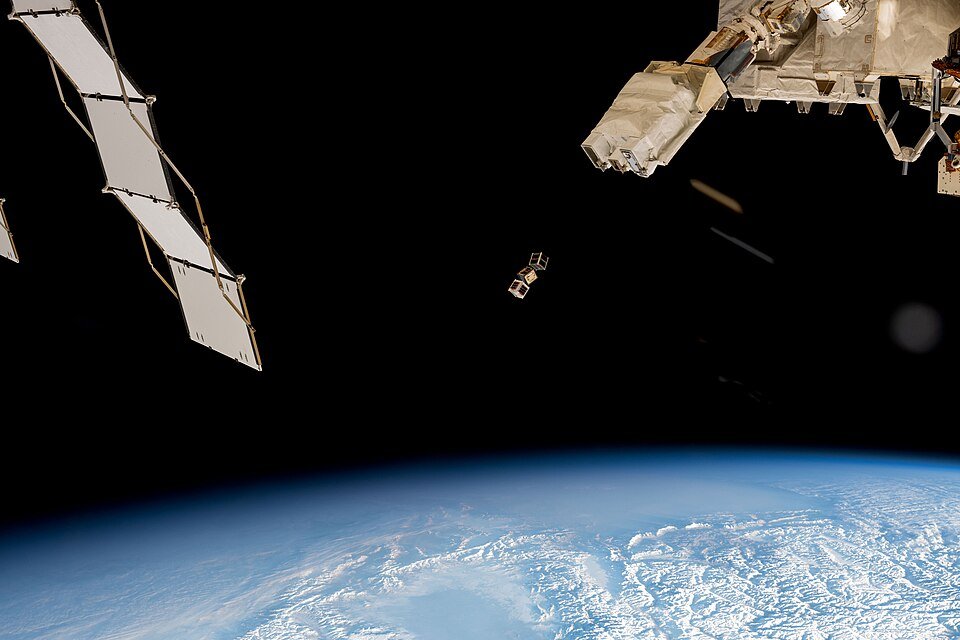
For years, small satellite manufacturers built their business plans around a single reliable premise: SpaceX could get their payloads to orbit. Through Falcon 9 Transporter and Bandwagon rideshare missions, the company offered frequent, low-cost access to space at roughly $7,000 per kilogram. But that pipeline is narrowing, and the industry is confronting a bottleneck that threatens satellite production timelines, constellation deployment schedules, and the economics of new space ventures.
At least nine SpaceX partners and customers have told SpaceNews that the company is no longer accepting Transporter reservations beyond late 2028 or early 2029. The manifest for the next two years is nearly full, and some customers expect that only three to five dedicated rideshare missions per year will be available going forward, down from six to eight in recent years.
“We’ve arrived at a point where launch has not achieved the cost nor the frequency the broader sector anticipated and has become a significant and dangerous bottleneck,” said Keith Masback, a space consultant and angel investor.
The core problem is straightforward: satellite production has outpaced launch availability. Many startups and established smallsat operators modeled their businesses on multiple annual rideshare flights at predictable prices. With manifest slots shrinking, those assumptions no longer hold.
SEOPS, a rideshare aggregator, purchased an entire Falcon 9 for a 2028 mission. The manifest filled within three weeks, and roughly 30 customers remain on a waitlist. Launch planning now requires a 36-month lead time rather than the 12-month window operators once counted on, with committed capital needed for early booking.
“There is now a huge demand for access to space and maybe not that much supply,” said Valentin Benoit, CEO of RIDE! Space. “There is a clear asymmetry between the timeline for which satellites need to be launched and what the market can provide. That could be lethal at some point.”
Rising costs, changing priorities
All executives interviewed by SpaceNews agreed that launch costs for small satellites are rising. SpaceX has incrementally increased rideshare pricing, with the current Transporter base rate at $350,000 for 50 kilograms, up from $325,000 at the time of Transporter-15 in late 2025.
But the issue goes beyond price. Customers are increasingly optimizing for orbit control, timing certainty, and execution risk rather than the lowest per-kilogram rate.
“We should all expect more a price increase than a price decrease,” Benoit said. “Better to launch at twice the rate than not at all.”
Robert Sproles, CEO of Exolaunch, noted that customers are showing a willingness to accept higher launch costs in exchange for schedule certainty and reliable orbit delivery.
Alternatives emerge, but none are easy
The gap left by SpaceX is creating openings for other launch providers, though no single alternative can yet match the cadence or pricing that Falcon 9 rideshare offered.
Arianespace has fully booked its Ariane 6 for 2026 and 2027 and is preparing additional capacity for 2029 and 2030 using its Multi-Launch System for secondary payloads. Exolaunch has purchased two Falcon 9 launches for late 2027 and 2028. RIDE! Space bought 1,000 kilograms on the SEOPS Waymaker 2028 mission for European customers.
A wave of small launch vehicle developers — including Rocket Factory Augsburg, Isar Aerospace, HyImpulse, PLD Space, Skyroot Aerospace, Gilmour Space, and others — hopes to fill part of the void. But many early flights are already claimed by commercial, civil, and military customers, and surging defense spending in Europe is further constraining available capacity.
“If you want to launch all the things that we have in mind by 2028, 2029 and 2030, it’s time now to industrialize,” said Josef Wiedemann, sales director at Isar Aerospace. “I cannot magically make rockets appear in one or two years.”
Medium and large rockets offer limited help. ULA’s Vulcan Centaur and India’s PSLV are sidelined by anomalies. Blue Origin’s New Glenn exploded during hotfire testing in late May. These vehicles were never expected to offer extensive rideshare capacity, and their manifests prioritize defense, institutional, megaconstellation, and legacy commercial customers first.
“For any launch provider, it’s always the same set of priorities: defense clients, institutional clients, megaconstellation or legacy commercial companies and then smallsat,” Benoit said.
The Starship question
Many in the industry had hoped that SpaceX’s Starship would eventually open vast amounts of new rideshare capacity. But analysts warn that commercial access to Starship is unlikely before the 2030s.
SpaceX’s S-1 filing for its initial public offering lists priorities including upgraded Starlink deployment, lunar transportation for Artemis 3, Martian missions, point-to-point delivery, and orbital data centers. Commercial rideshare is not mentioned.
“Once Starship flies, I fully expect that they are not going to offer that up for commercial use for at least a couple of years,” said Chris Quilty, co-CEO of Quilty Space. “Any company banking on Starship as the solution to their problem better be ready to wait until the 2030 timeframe.”
Some customers expect that SpaceX will extend Falcon 9 rideshare operations if Starship is delayed. But the company has not commented on the future of its rideshare program, and the current trajectory points to a tightening market.
What comes next
The bottleneck represents a structural shift for the small satellite industry. The era of predictable, low-cost rideshare access on near-term schedules is giving way to a more constrained environment where launch slots are scarce, lead times are measured in years, and prices are rising.
For smallsat operators, the calculus has changed. Business plans built around $7,000 per kilogram rideshare may no longer hold. The window for securing a ride to space is narrowing, and the industry must adapt — whether by booking years ahead, turning to smaller and unproven launchers, or paying more for certainty.
As Masback put it, the bottleneck is not just inconvenient. It is dangerous.