

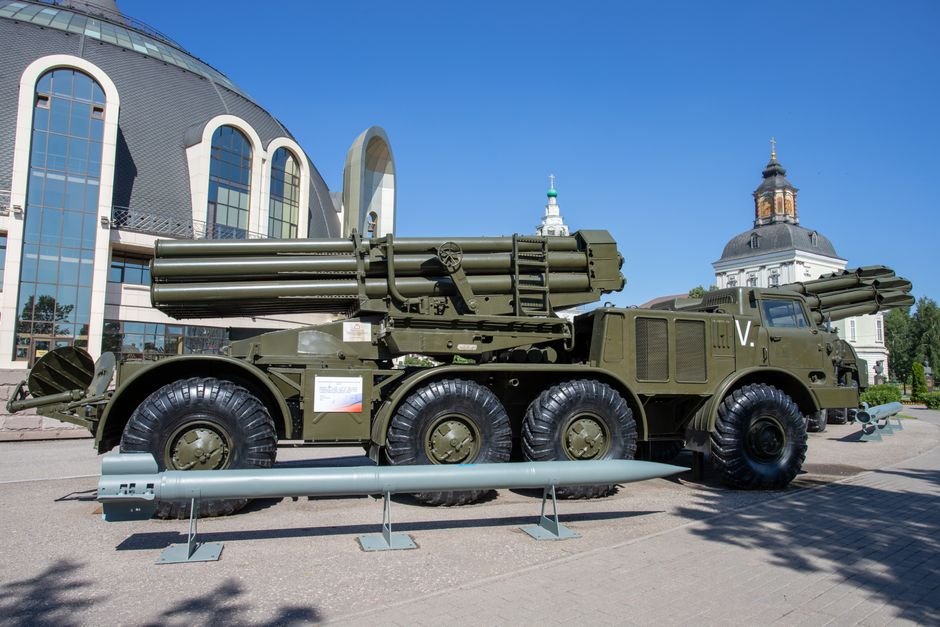
Kyiv’s military intelligence says a North Korean missile unit is taking up positions in western Russia, complete with launchers, missiles and the crews to fire them. The claim, if correct, marks the point where Pyongyang’s support for Moscow stops being a supply relationship and becomes a deployment.
The information comes from Andrii Cherniak of Ukraine’s military intelligence, who spoke to Reuters. The unit, he said, is believed to be in Voronezh Oblast, the Russian region bordering Ukraine’s Luhansk Oblast; it may field six launchers and as many as 120 ballistic missiles. The latest consignment alone has already put 40 of the missiles in Russian hands.
Ukraine is very short of high-end air defenses, and Russia has leaned on ballistic missiles precisely because they are hard to shoot down. North Korean models are effectively unstoppable for Ukraine except by the US-made Patriot system, and Ukraine’s supply of Patriot interceptors is running thin. On August 1, Ukrainian defenses brought down one of 27 incoming ballistic missiles; on August 5, none of 24 ballistic or hypersonic missiles were stopped.
North Korean missiles are not new to this war. Russia has fired scores of them at Ukraine since late 2023, and the first confirmed use came on January 2, 2024, in an attack on Kharkiv, where the debris was identified as North Korean. On July 30, a KN-23, the solid-fuel missile comparable to Russia’s own Iskander-M, hit the village of Radushne near Kryvyi Rih, the first use of North Korean missiles since August 2025. A second model, the KN-24, is roughly equivalent to the American ATACMS.
What is new is the manpower. Previous cooperation meant shipments of weapons; this deployment would put North Korean military personnel on Russian soil in an operational missile unit. North Korea has been one of Russia’s key military partners since the 2022 invasion, supplying ammunition, weapons and troops, and the pattern is broader than missiles. Roughly 12,000 North Korean soldiers fought in the Kursk campaign of 2024, and President Volodymyr Zelensky warned in late July that Moscow wants another 30,000 troops, with preparations under way in Voronezh Oblast since June, the same region where the missile unit is now taking up positions. The legal scaffolding has kept pace: a comprehensive strategic partnership treaty signed in June 2024 took effect that December, and a supplementary defense pact struck in April 2026 extends to 2031, binding the two sides to mutual military help, weapons transfers and combined operations against Ukraine.
The deployment also serves Pyongyang’s own education. Missile crews that have never fought in anger get live combat experience against a modern air defense network, and the results are studied closely in Seoul and Tokyo. For Moscow, the unit adds depth to an arsenal under strain; for Pyongyang, it is training, payment and leverage in a single package.
Taken together, the steps describe an alliance deepening by degrees: ammunition, then missiles, then missile crews, then armies. For Ukraine, the immediate problem is the Patriot shortage that the North Korean missiles are designed to exploit. For the wider region, the question is what Pyongyang asks in return for its soldiers, and where that bill comes due.