

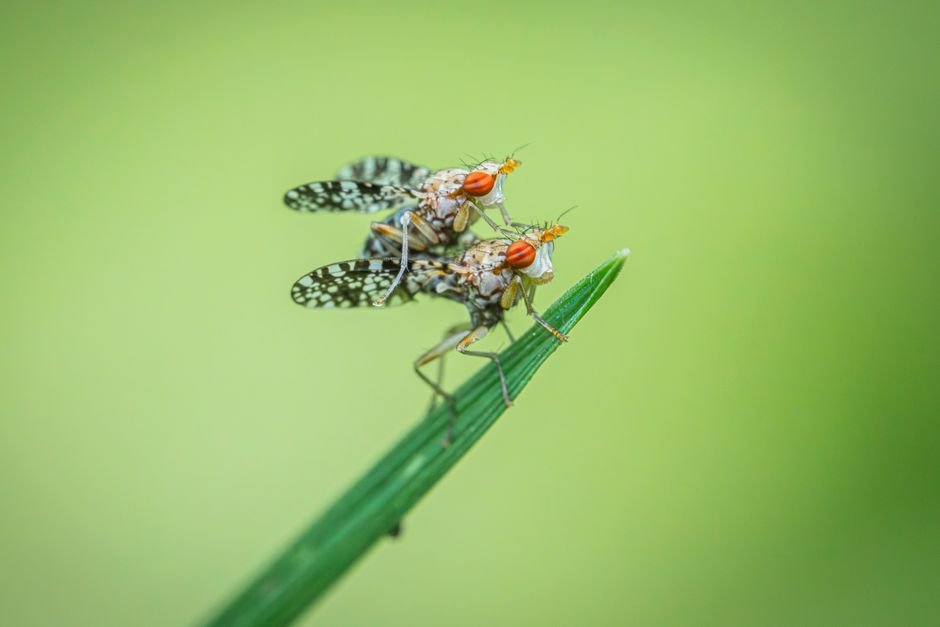
A fruit fly hunting the source of a pleasant smell behaves less like a bloodhound and more like an ant returning to its nest. It does not follow the scent’s gradient upward, nose to the wind, the way textbooks have described plume tracking for decades. Instead, it remembers the direction back to the edge of the smell and steers toward that remembered angle, updating the memory as the plume’s boundary shifts. The finding, published in Nature by a team at Rockefeller University and Columbia University, shows that even insects with a brain the size of a poppy seed can navigate an invisible chemical landscape using stored directional memories, borrowing a computational strategy previously associated with the great navigators of the insect world, ants and bees.
The prevailing model of plume tracking has been reflexive: when an insect smells something, it surges upwind; when it loses the scent, it casts crosswind in widening loops until it hits the plume again. This works well for continuous plumes, but real plumes are turbulent and intermittent, fragments of odor separated by long stretches of clean air that carry no information at all. For years, researchers have suspected that animals must bridge those gaps with memory, but the idea was difficult to test because odors are invisible and impossible to control in a natural setting. The Rockefeller group, led by Vanessa Ruta, built a virtual reality system that solved the problem: head-fixed flies walked on an air-supported foam ball, and their heading was yoked to the rotation of a nozzle delivering a constant airstream, so the fly steered its own fictive world. The wind was the only external directional cue, and the flies walked in complete darkness, tracking a corridor of apple cider vinegar odor 50 mm (2 inches) wide and 1,000 mm (39 inches) long.
The behavior that emerged was unexpected. Flies did not meander through the odor; they tracked along a single lateral edge, within about 10 mm (0.4 inches) of the boundary, entering the plume briefly, in bouts averaging just under five seconds, then exiting and returning. They crossed to the other side of the corridor in fewer than 4 percent of excursions. The returns were not random wanderings. Flies left the plume at shallow angles but came back almost perpendicular to the edge, along shorter, more direct paths, and their returns became more efficient with practice. Random-walk simulations built from the same run lengths and turn angles produced circuitous paths that reached the corridor much less often, showing that the straight-line returns could not emerge from the fly’s movement statistics alone.
The most telling experiments removed the cues a gradient-following animal would need. Flies tracked plumes with constant concentration, with increasing concentration, and with reversed concentration gradients equally well, so the longitudinal gradient was irrelevant; the sharp lateral boundary was the salient feature. They did not need bilateral comparison: when olfactory sensory neurons were activated optogenetically instead of by real odor, with near-synchronous delivery to both antennae, the flies performed the same edge tracking, relying on wind direction and steep lateral odor change. And when the plume was removed after ten minutes of tracking, the flies did not search the last place they smelled it, as an animal chasing a scent should. They held a direction.
That direction is stored in the central complex, the insect brain’s navigation hub. The team recorded from FC2 neurons, a columnar population known to encode a fly’s goal direction during menotaxis, the behavior of walking at a constant angle to a landmark, alongside EPG neurons that encode heading. During edge tracking, the FC2 signal began pointing toward the plume’s boundary several seconds before the fly turned that way, and silencing FC2 neurons with optogenetics impaired edge tracking, as did silencing the heading cells. The picture is of a vector-based computation: the fly stores the direction back to the plume’s boundary as an angular goal, not its distance or position, and continuously updates that goal as the boundary moves. This is why the flies could track plumes offset 45 or 90 degrees from the wind, walk perpendicular to the airflow without backtracking, and follow a plume that jumped 20 mm (0.8 inches) sideways every time they exited, a task that requires directional rather than positional memory.
The strategy scales to naturalistic plumes. Using a model of plume physics, the researchers showed that flies store an entry memory, the direction of the odor boundary they last crossed, and use it to re-enter efficiently. In simulations, trajectories with entry memory reached within 50 mm (2 inches) of the source far more often than those without; ten of twelve real flies tracked the naturalistic plume to the source region. The authors interpret the whole system as evidence that plume tracking engages a conserved navigational toolkit, in which directional memories, the same computations that let ants and bees find their nests, are deployed for a target that is dynamic and invisible. An odor plume, unlike a nest, cannot be stored as a fixed location; only its direction can be remembered.
The finding reframes how animals use smell. Odors carry no inherent directional information, so tracking one to its source requires integrating chemical cues with spatial signals, and this work shows that memory, not reflex, does the integration. The close evolutionary relationship between the insect central complex and the forebrain circuits of mammals, including the piriform and entorhinal cortices, suggests that the ability to bind odor experience to internal representations of space is ancient and shared. A fly walking in the dark, remembering the angle of a smell’s edge, is doing something recognizable to any animal that has ever found its way home.
References
Andrew F. Siliciano, Sun Minni, Chad Morton, Charles K. Dowell, Noelle B. Eghbali, Silas E. Busch, Juliana Y. Rhee, L. F. Abbott and Vanessa Ruta, A vector-based strategy for olfactory navigation in Drosophila. Nature (2026). DOI: 10.1038/s41586-026-10827-7.
Nature Research Briefing, How fruit flies track the edge of odor plumes. Nature, 29 July 2026. DOI: 10.1038/d41586-026-02325-7.