

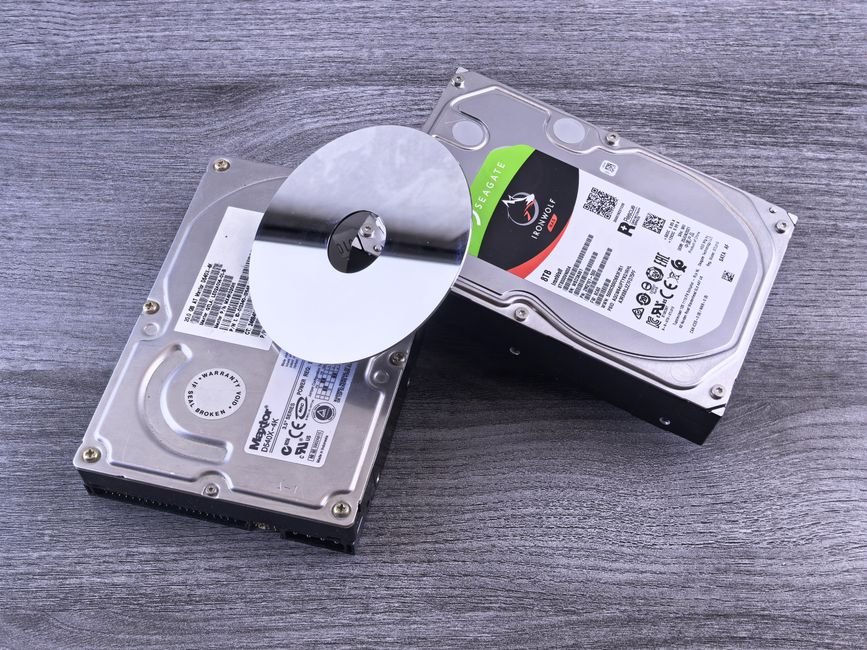
Seagate’s next-generation hard drives are on schedule, and already spoken for. The company confirmed on its fiscal fourth-quarter earnings call that the Mozaic 5+ platform, built on platters holding more than 5 terabytes each, remains on track for qualification shipments in late calendar 2027. Ten of those platters in a single 8.9-centimeter (3.5-inch) chassis is what produces the 50TB-class drives Seagate has promised for the better part of a decade. The customers lined up for them are data center operators, not consumers.
CFO Gianluca Romano said the company is on track to achieve storage density above 5TB per platter, with the first Mozaic 5+ drives expected to ship to customers for qualification later in 2027. CEO Dave Mosley added that the vast majority of nearline exabyte output is already allocated into calendar 2028 under long-term supply agreements, and that strategic customers are pushing their planning horizons toward 2029 and beyond.
The demand behind those contracts is unmistakably AI-driven. Seagate closed the June quarter with $3.6 billion in revenue, up 17 percent sequentially and 48 percent year over year, powered by AI hyperscalers and cloud providers using hard drives for the long tail of their workloads. Mosley described cold storage as essential for giving AI models and agentic systems persistent context across user interactions, tying storage procurement directly to the AI buildout. HAMR-based products now account for roughly 40 percent of the company’s exabyte shipments, with the share expected to reach 70 percent by early July 2027.
The current generation, Mozaic 4+, supports drives up to 44TB and is expected to make up half of Seagate’s HAMR exabytes shipped to select customers by the end of 2026. Mozaic 5, the third generation of the platform, is where the 50TB-class drives come from, with conventional magnetic recording for customers that want performance and versatility or shingled magnetic recording for those maximizing density.
Qualification is not the same as availability. Qualification shipments are engineering samples sent to OEM and hyperscaler customers to run their own validation; only after passing internal testing and the customers’ procedures do drives move to production. Seagate’s management flagged its own execution risk on the call, noting that moving from 3TB to 4TB and then to 5TB per disk requires more tool time and can slow manufacturing throughput, an unusually candid caveat to volunteer to analysts.
The roadmap has slipped before, which is one reason the new dates carry so much hedging. Public roadmap slides from late 2019 put 50TB HAMR drives in 2026, a target that survived rhetorically into 2023 when the company was pairing a delayed 30TB launch with a stated 50TB-by-2026 ambition. By mid-2025, when the first 40TB HAMR samples went out to data center customers, the roadmap had been restated as 44TB in 2027 and 50TB in 2028. The current plan adds roughly a year of qualification, testing, and validation on top of that.
For retail buyers, the timeline is sobering. The drives ship in 2028 under existing contracts, and a 50TB drive is unlikely to appear on a shelf, physical or virtual, until well after volume production begins around 2029. With most consumer PCs now shipping with SSDs and flash still considerably more expensive than disk at equivalent capacity, the buyers who need bulk storage and can tolerate slower access times are the ones waiting longest. Seagate’s roadmap suggests they will get their 50TB drive eventually. The company just does not expect to sell them one anytime soon.
Sources: Seagate reveals more on its 50TB HDD plans – but looks like we’ll still have a long wait to buy one (TechRadar, Jul 31, 2026); Seagate aims to launch 50TB HAMR hard drives in 2027 (TechSpot, Jul 30, 2026); Seagate To Begin Qualification Of 50TB HDDs In Late 2027 (Lowyat, Jul 31, 2026); Seagate to start qualifying record-setting 50TB HDDs in 2027 – most drives are sold out through 2028 (Tom’s Hardware, Jul 2026)