

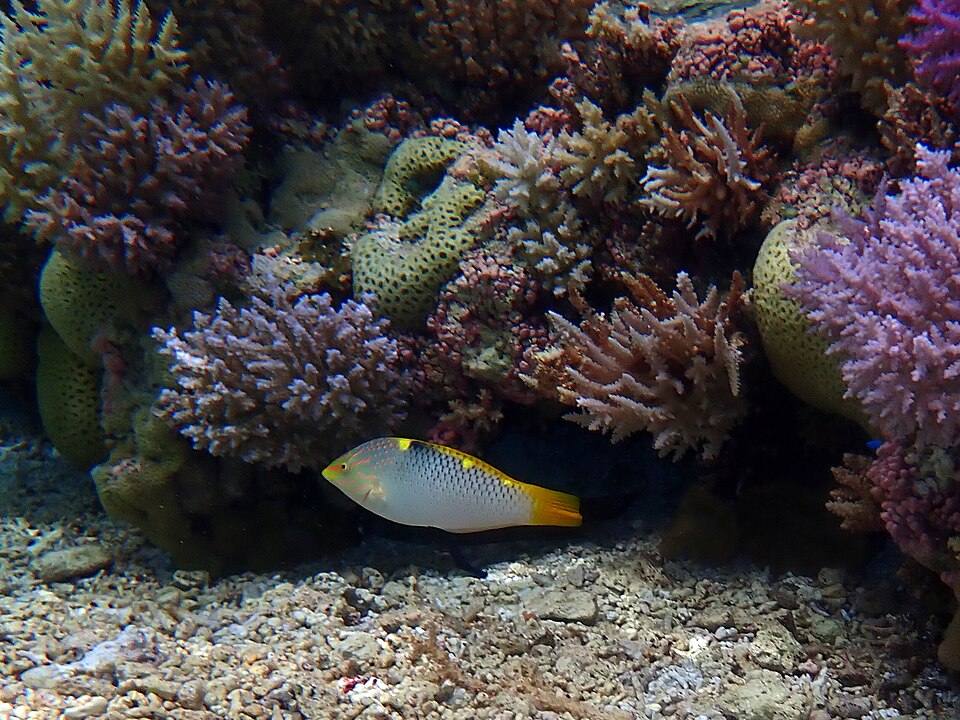
Artificial light at night not only keeps reef fish awake, it also inflicts DNA damage on their brain neurons, researchers at Bar-Ilan University and Harvard University report in Current Biology.
The study, led by Shachaf Ben-Ezra, is the first to directly link light-pollution-driven sleep disruption to neuronal genomic instability in a wild vertebrate, raising questions about the cellular consequences of sleep loss in the natural environment.
What they found
Working with damselfish (Chromis viridis) both in controlled laboratory conditions and on natural coral reefs, the team first established that these fish have clear, quantifiable sleep states. They then tested the effects of artificial light at night (ALAN), a pervasive pollutant in coastal marine ecosystems.
The results were striking across multiple behavioural measures:
- Sleep duration and consolidation both declined significantly under ALAN.
- Territorial occupancy and aggression increased.
- Fish spent more time feeding at night, further disrupting their rest.
When the researchers examined the brains of ALAN-exposed fish, they found elevated DNA damage in neurons of the dorsal pallium, a brain region implicated in sleep-dependent functions and homologous to mammalian cortex. The degree of DNA damage correlated with the severity of sleep disruption.
Why it matters
The findings establish a mechanistic link between environmental light pollution, sleep loss, and neuronal health at the cellular level. For coral reef ecosystems already under pressure from climate change and coastal development, chronic sleep disruption from artificial light may represent an additional, invisible stressor on fish populations.
More broadly, the study provides an ecological model for understanding how ALAN-driven sleep loss damages neurons, a connection that has implications far beyond marine biology.
Limits
The study is correlational: the observed DNA damage is associated with sleep disruption but not proven to be directly caused by it. The findings are specific to one fish species in one habitat, and the degree to which similar mechanisms operate in mammals, including humans, remains to be tested.
Bottom line
Light pollution does more than keep animals awake. In reef fish, sleep disruption from artificial light is linked to measurable DNA damage in the brain, suggesting that the cellular cost of lost sleep in the wild may be significant.
Source
Ben-Ezra S, et al. Artificial light pollution disrupts sleep and neuronal genomic stability in wild reef fish. Curr Biol. 2026 Jun 22:S0960-9822(26)00663-9. doi:10.1016/j.cub.2026.05.058. PMID: 42330941.