Expedition 74 Trio Returns to Earth After 241 Days in Orbit
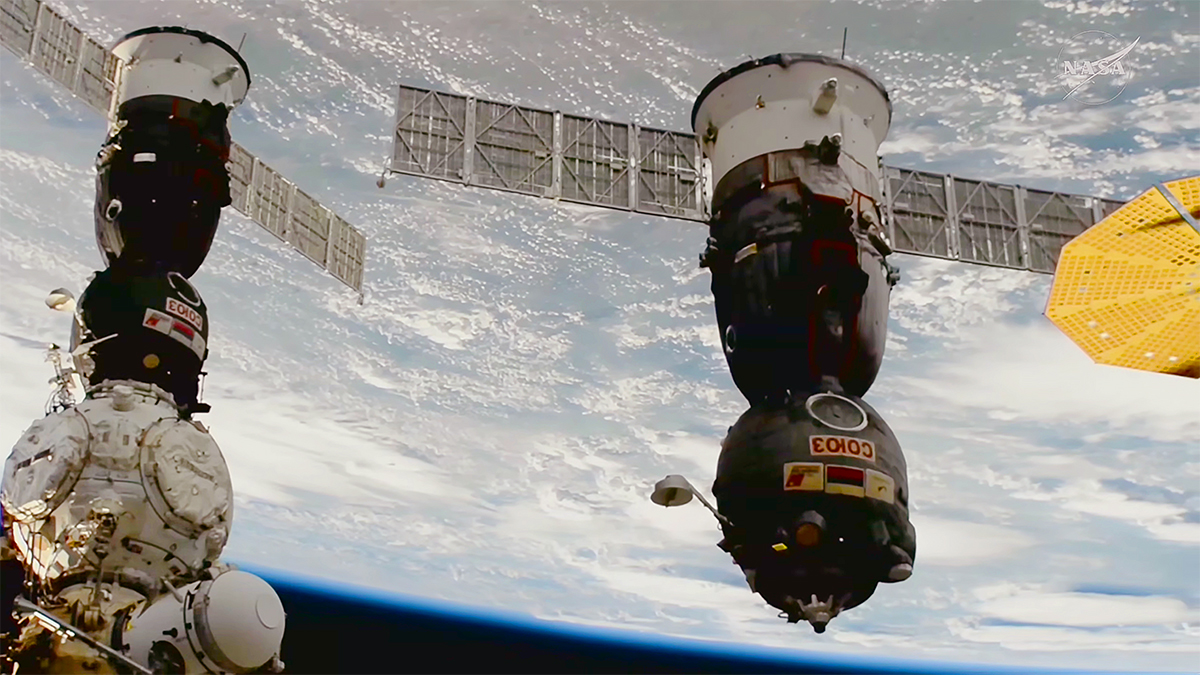
July 26, 2026—A Soyuz spacecraft carrying a NASA astronaut and two Russian cosmonauts touched down on the steppe of Kazakhstan early Sunday, wrapping up a 241-day research mission aboard the International Space Station.
The Soyuz MS-28 capsule landed at 10:27 UTC (3:27 p.m. local time) southeast of Dzhezkazgan, Kazakhstan, with its parachute system slowing the descent across the final kilometers before a soft impact kicked up clouds of dust on the open plain. Recovery teams reached the capsule within minutes to begin standard post-landing medical checks.
NASA astronaut Chris Williams and Roscosmos cosmonauts Sergey Kud-Sverchkov and Sergei Mikaev spent roughly eight months in orbit, circling Earth 3,856 times and traveling more than 164 million kilometers (102 million miles). The Soyuz MS-28 undocked from the station’s Rassvet module at 7:03 UTC (2:03 a.m. CDT), beginning the roughly three-and-a-half-hour trip home.
First Flights and a Seasoned Commander
The mission marked the first spaceflight for both Williams and Mikaev. Kud-Sverchkov, who served as Expedition 74 commander, completed his second orbital mission. The trio launched together from Baikonur Cosmodrome on November 27, 2025, and docked with the station the same day.
On July 25, Kud-Sverchkov formally handed over station command to NASA astronaut Jessica Meir during a traditional change-of-command ceremony aboard the orbiting laboratory. The departure of Soyuz MS-28 officially marks the beginning of Expedition 75.
Research and Spacewalk Highlights
During their stay, the crew conducted a range of scientific investigations. Work on advanced cancer treatment research continued aboard the station, along with experiments aimed at improving in-space manufacturing techniques for materials used in high-performance computers and electronics.
The crew also completed two spacewalks. In March 2026, Williams and Meir worked outside the station to install solar array modification kits as part of ongoing power system upgrades. In June, Williams and Meir conducted a seven-hour, 20-minute spacewalk to repair a malfunctioning wrist joint on the Canadarm2 robotic arm, a critical piece of station infrastructure used for capturing cargo spacecraft and performing external maintenance.
Kud-Sverchkov and Mikaev also conducted a Russian segment spacewalk in May, installing a solar radiation experiment and removing obsolete research hardware from the exterior of the station.
Journey Home
After landing, the crew was flown by helicopter to Karaganda, Kazakhstan, where recovery teams are based. From there, Williams will board a NASA aircraft bound for the agency’s Johnson Space Center in Houston. Kud-Sverchkov and Mikaev will travel to their training base in Star City, Russia, for post-flight rehabilitation and debriefing.
A Transition in Orbit
The station remains fully occupied. Three new crew members arrived aboard Soyuz MS-29 on July 14: Roscosmos cosmonauts Anna Kikina and Pyotr Dubrov, and NASA astronaut Anil Menon. They joined the station’s existing Expedition 74 crew, which includes NASA astronauts Jessica Meir and Jack Hathaway, ESA astronaut Sophie Adenot, and Roscosmos cosmonaut Andrey Fedyaev. With the departure of Soyuz MS-28, the station has transitioned fully to Expedition 75 operations.
The Soyuz MS-28 spacecraft will be inspected and serviced by Roscosmos teams in Kazakhstan before being shipped back to Moscow for post-flight analysis.
Images: