

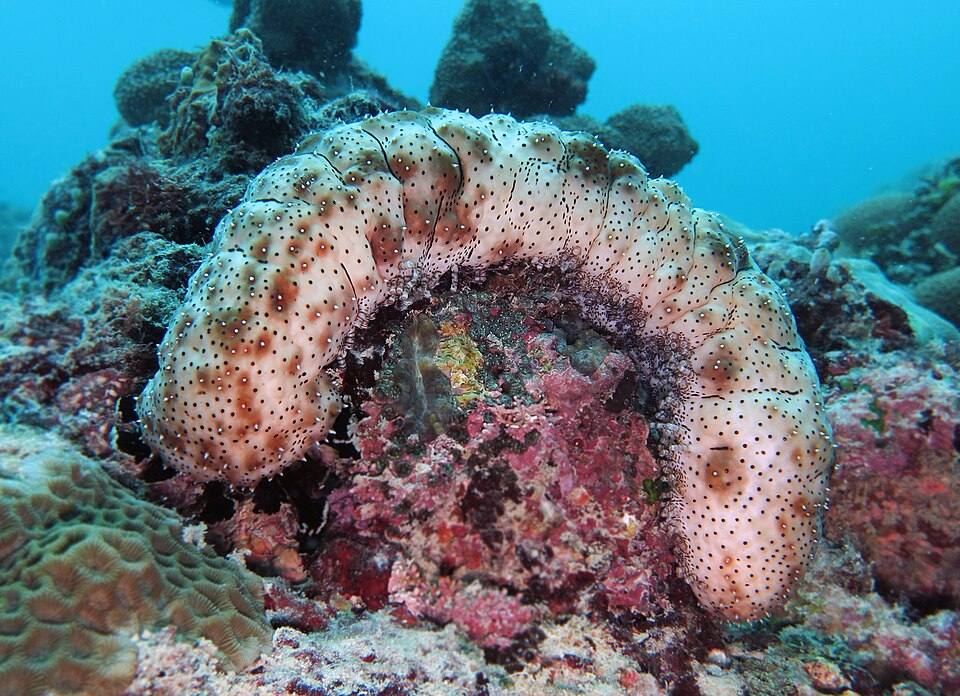
Amputated tissue fragments from a cold-water sea cucumber can survive, heal wounds, absorb nutrients, and continue dividing for over three years without any connection to a living organism. The discovery, published in Science Advances by a team led by Sara Jobson and Annie Mercier at Memorial University of Newfoundland, challenges fundamental assumptions about what it means for complex animal tissue to be alive.
The tissue fragments, which the researchers dubbed LiPfe (Living immortal Psolus fabricii explants), are amputated tube feet and tentacles from the scarlet sea cucumber Psolus fabricii, a dendrochirotid species native to the North Atlantic and Arctic. They persist in natural, non-sterile, flowing seawater, no supplements, no antibiotics, no controlled atmosphere, and show no signs of senescence after more than three years.
What zombie tissues do
The fragments heal their own wounds within days of being cut. Within the first week, coelomocytes, the sea cucumber’s immune cells, migrate from a neural plexus to the wound margin, and epithelial tissue curls inward to seal the exposed surface. By 30 to 60 days post-excision, the wound site becomes indistinguishable from surrounding tissue.
Cell division continues throughout this period. Mitosis and apoptosis operate in synchronized cycles of approximately 24 hours during the first week, concentrated at the wound margin. The two processes act in tandem to reshape the tissue, clearing damaged cells while generating new ones.
The tissues also feed themselves. Using 15N-labeled amino acids, the team showed that the explants absorb dissolved organic matter directly from seawater. At six days post-excision, amino acid uptake spiked significantly, confirming that the tissue establishes an independent nutrient acquisition strategy.
Over the course of a year, the internal structure shifts dramatically. Muscle tissue is gradually phagocytized by coelomocytes, the explant cannibalizes its own internal tissues as a nutrient reserve during healing. By day 180, all muscle is gone, consumed by the tissue’s own immune cells. Connective tissue expands from 46 percent of the cross-sectional area at day 6 to 74 percent at day 365. The explants shrink by roughly 23 percent in diameter over the first two months, then regrow to exceed their original size.
Not an organism, not dead
The fragments do not develop into a new sea cucumber. They have no mouth, no gut, and no reproductive capability. They do not show any signs of organization into a complete organism. But they are not dead by any standard definition: they metabolize, heal, respond to stimuli, and proliferate.
“They challenge our usual definitions,” Jobson said. “They are not clearly alive in the traditional sense, but they are not dead either.”
The phenomenon appears unique to this species. When the team tested sea stars, sea urchins, brittle stars, and other sea cucumber species, all showed tissue degradation within weeks to roughly 104 days. Only P. fabricii achieved indefinite survival.
Why it is not cancer
The tissue shows controlled proliferation and programmed cell death, not uncontrolled growth. It maintains organized tissue architecture and active immune function. The oscillating mitosis-apoptosis cycles are tightly regulated, and the tissue does not invade or metastasize. It is a model of organized, non-pathological indefinite tissue survival, not neoplasia.
The mechanisms that allow P. fabricii tissue to sustain this balance are unknown. The researchers are investigating the genetic and epigenetic programs that enable the tissue to resist senescence, maintain immune vigilance in microbe-rich seawater, and coordinate wound healing without a central nervous system.
Implications
The discovery provides a new model system for studying autonomous tissue healing and long-term survival outside an organism. The explants survive in microbially rich, non-sterile conditions without artificial media, making them far simpler and cheaper than conventional cell culture systems.
For tissue engineering, the LiPfe model could inform the development of self-sustaining scaffolds or grafts for transplant medicine. The tissue’s ability to resist infection in bacteria-laden seawater suggests potent innate immune mechanisms worth investigating.
For regenerative biology, the finding raises fundamental questions: what genetic program allows P. fabricii tissue to sustain itself indefinitely? Why did this ability evolve with no clear reproductive benefit? And can the mechanisms that control this remarkable tissue autonomy be understood well enough to apply elsewhere?
“It is like a lizard that loses its tail,” said co-author Rachel Sipler. “We are asking whether the tail can grow a new lizard.”
Source: Jobson, S., Montgomery, E.M., Hamel, J-F., Sipler, R.E., & Mercier, A. Natural tissue immortality: Indefinite survival of sea cucumber explants. Science Advances, 12(22) (2026). DOI: 10.1126/sciadv.aeb1394