

Commercial tracker detects subsatellite deployment at 593-kilometer altitude, extending a pattern of orbital secrecy
HELSINKI — China’s secretive reusable spaceplane has released an unidentified object into orbit during its fourth mission, commercial space surveillance firm LeoLabs reported Monday, adding another chapter to the enigmatic Shenlong program’s expanding orbital activity.
LeoLabs detected the unknown object in the vicinity of the Chinese Shenlong spaceplane at 0230 UTC on June 22 (10:30 p.m. Eastern on June 21). The object was first spotted by LeoLabs’ Kiwi Space Radar in New Zealand and did not correlate with any cataloged object in the company’s database. After additional observations across LeoLabs’ global radar network and analysis through the company’s Delta platform, the firm independently cataloged the object and assessed “with high confidence that it was released from the Chinese spaceplane.”
The object had not yet appeared in the U.S. Space Force’s Space-track catalog as of reporting time.
The spaceplane launched on its fourth orbital mission on February 7, 2026 (local time), riding a Long March 2F rocket from the Jiuquan Satellite Launch Center in the Gobi Desert. Following insertion into low Earth orbit, the spacecraft raised its altitude to a roughly circular orbit of approximately 593 kilometers (368 miles).
A Familiar Pattern
The deployment follows a now-established modus operandi for China’s orbital test vehicle. During its second and third missions, the spaceplane released subsatellites and subsequently conducted rendezvous and proximity operations (RPOs) with those objects, including what analysts described as potential capture-and-docking maneuvers.
Observers tracking the third mission documented a series of close approaches between the spaceplane and its released object (designated OBJECT G, 2023-195G) in June 2024, with maneuvers occurring on June 5-7, June 11-12, June 14, and June 15-16 of that year. These operations suggest Shenlong is testing technologies for on-orbit satellite servicing, inspection, and capture — capabilities with both civil and military applications.
China has released no official details about the latest object’s purpose or the spaceplane’s current activities, maintaining the tight operational secrecy that has surrounded the program since its inception.
The Shenlong Program
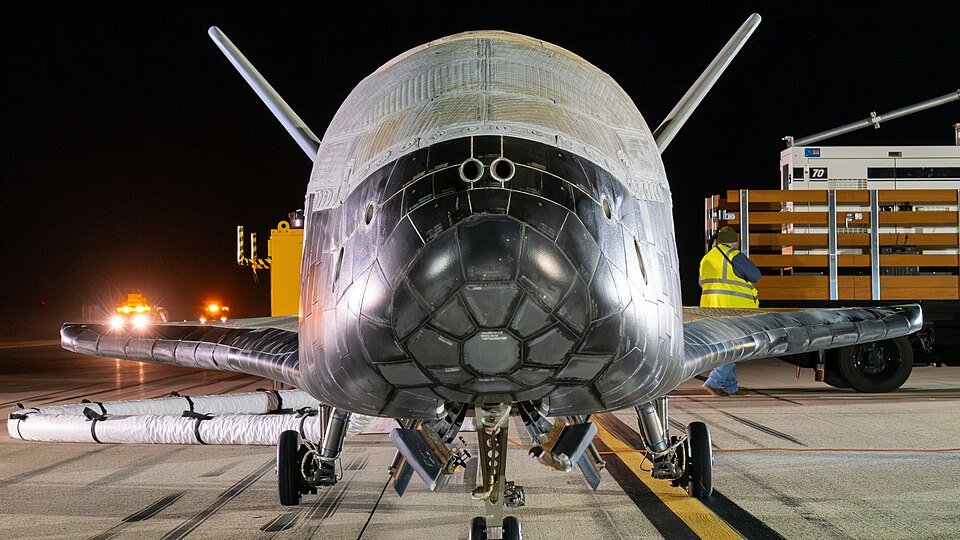
Dubbed “Shenlong” (Divine Dragon) by space enthusiasts and analysts, China’s reusable spaceplane is developed by the China Aerospace Science and Technology Corporation (CASC), with Chengdu Aircraft Industry Group reported as the lead designer. The program is often compared to the U.S. Space Force’s Boeing X-37B, though China has never officially confirmed the spacecraft’s name or disclosed technical specifications.
The vehicle’s orbital history tells a story of rapidly growing ambition:
- First mission (September 4-6, 2020): A brief two-day shakedown flight, China’s first reusable orbital spacecraft test.
- Second mission (August 4, 2022 – May 8, 2023): A 276-day endurance test that demonstrated sustained orbital operations and subsatellite deployment.
- Third mission (December 14, 2023 – September 5, 2024): A 268-day flight that included extensive proximity operations and possible recapture maneuvers with a released object.
- Fourth mission (February 7, 2026 – ongoing): Now past four months in orbit, with the June 22 object release adding to a growing pattern of on-orbit activity.
A Long March 2F payload fairing displayed at a school in Henan province — photographed and shared by the CNSA Watcher account — suggests the spacecraft has a wingspan exceeding the rocket’s 4.2-meter (13.8-foot) fairing diameter, providing one of the few physical clues to Shenlong’s dimensions. Amateur optical imagery captured by Austrian observer Felix Schoefbaenker has also documented the spacecraft in orbit.
Secrecy and Legal Questions
China has consistently framed the Shenlong program in the narrowest possible terms. The official Xinhua statement on the fourth mission described it as technology verification for reusable spacecraft, “providing technical support for the peaceful use of space.”
However, China has not registered Shenlong or any of its deployed subsatellites with the United Nations as required under the 1975 Registration Convention, a treaty Beijing ratified. This failure to comply with international space law has drawn criticism from transparency advocates and space security analysts who argue that unregistered objects complicate space traffic management and raise concerns about the program’s dual-use potential.
The Secure World Foundation, in a detailed fact sheet published in June 2025, assessed that Shenlong is likely “a technology demonstrator and experimental vehicle” used for testing reusable launch vehicle technologies, on-orbit sensor validation, and satellite hardware risk reduction. While the foundation concluded that Shenlong’s “practical utility as a kinetic weapon delivery system is negligible due to payload and orbital limitations,” it noted that the vehicle’s proximity operations, capture and docking capabilities, and propulsion systems “raise persistent questions about co-orbital applications.”
LeoLabs and the New Era of Commercial Surveillance
The detection underscores the growing role of commercial space surveillance in filling gaps left by government tracking systems. LeoLabs, headquartered in Menlo Park, California, operates a proliferated network of 11 multi-mission phased-array radars across seven global sites, including installations in New Zealand, Alaska, Texas, Arizona, Costa Rica, Australia, Portugal’s Azores, and Argentina. The company can track objects as small as 2 centimeters (0.8 inches) in low Earth orbit.
In a related development, LeoLabs announced on June 10 that it had deployed its first Scout-S transportable radar in the Indo-Pacific region — a system designed to fit inside a standard 20-foot shipping container. The company said the mobile radar is already tracking Chinese surveillance satellites and the Shenlong spaceplane, reflecting a broader shift in military space surveillance toward maintaining continuous awareness of maneuvering spacecraft.
Broader Chinese Reusability Push
The Shenlong program is one element of China’s broader drive toward space launch reusability. CASC has recently conducted debut launches of the Long March 12A and Long March 12B, both partially reusable rockets, and is preparing for the first flight of the Long March 10B with an expected first-stage recovery attempt at sea. Commercial firm Landspace is also making progress with its Zhuque-3 methalox rocket, while a separate Chinese reusable suborbital first stage — a vertical takeoff, horizontal landing demonstrator — completed its second test flight in August 2022.
The Shenlong spaceplane itself may eventually form one half of a fully reusable two-stage-to-orbit system, a goal that received national funding from China’s Natural Science Foundation in 2022.
As Shenlong’s fourth mission continues, the spaceflight community will be watching for further object releases, proximity maneuvers, and the eventual conclusion of a flight that is steadily expanding China’s orbital capabilities — mostly beyond the view of the public and, until commercial trackers like LeoLabs step in, beyond the reach of independent verification.