

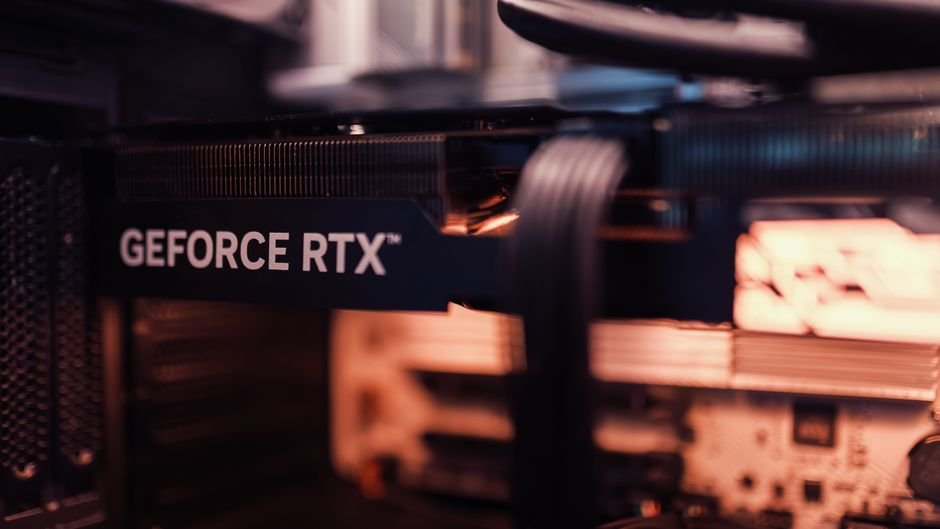
Nvidia killed SLI support years ago, but a $29 Steam utility called Lossless Scaling has effectively resurrected multi-GPU gaming through a back door, and a hardware enthusiast has demonstrated just how far the approach can go. By pairing a flagship RTX 3090 with an entry-level RTX 3050, the builder achieved 144 FPS at native 4K resolution, nearly doubling the 71 FPS the RTX 3090 could manage alone.
The trick works because Lossless Scaling does not split rendering work the way SLI or CrossFire did. Instead, the RTX 3090 handles all game rendering independently, while the RTX 3050 is dedicated exclusively to frame generation, using Lossless Scaling’s revamped LSFG 3 engine to interpolate new frames between the ones the 3090 produces. The result is doubled frame rates without the compatibility headaches that plagued traditional multi-GPU setups.
The tester’s build, posted July 24, paired the two Ampere-generation cards on an Asus X870e ProArt Creator motherboard with an Intel Core i9-9800X3D processor and 64 GB of DDR6 memory, both GPUs running over PCIe 4.0 x8 lanes. Adaptive, 2x, and 3x frame generation modes all worked without stuttering or resource conflicts.
Lossless Scaling’s LSFG 3 engine, a ground-up rewrite of the app’s interpolation architecture, cuts input latency by approximately 24% while improving visual quality by 40% over earlier versions, according to the developers. Unlike Nvidia’s DLSS frame generation, which is locked to RTX 40-series and newer GPUs, Lossless Scaling works with virtually any game and any GPU combination, including using an integrated graphics chip or a vintage card like a GTX 750 Ti as the secondary frame-generation processor.
The practical implication for gamers is straightforward: in a market where GPU prices remain inflated and memory costs continue to climb, a $29 software license plus a spare mid-range card can more than double gaming smoothness. The RTX 3090’s 24 GB of GDDR6X VRAM and 384-bit memory bus keep it viable for 4K gaming in 2026; the bottleneck for high refresh rates is often frame generation, not raw rendering power. Lossless Scaling lets a secondary card fill that gap.
Critics of frame generation point out that interpolated frames are artificial, they do not reflect actual user input or reduce perceived latency in the same way native frame rate does. The LSFG 3 latency improvements close that gap somewhat, but the technique remains a visual smoothing tool rather than a genuine responsiveness upgrade. For gamers on 144 Hz displays, though, the difference between 71 FPS and 144 FPS is visible, regardless of how some of those frames were created.
Sources: Nvidia RTX 3090 and RTX 3050 team up to hit 144 FPS at 4K (Tom’s Hardware, Jul 24, 2026); Dual GPU Trick: RTX 3090 paired with RTX 3050 hits 144 FPS (PCSofter, Jul 24, 2026)