

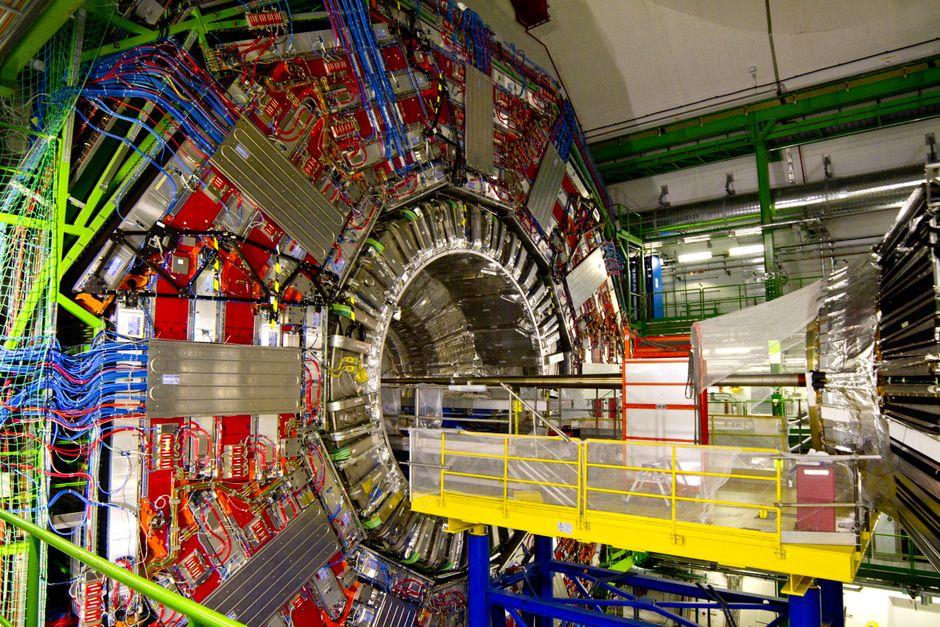
The quantum computers capable of this work will not look like the ones being built by Google, IBM, or Quantinuum. They will not be general-purpose machines. They will be architected from the ground up for a specific task, and that difference in philosophy may be the most important idea in quantum computing today.
The Classical Ceiling
Classical computers face a fundamental scaling problem. A quantum system of N particles requires a Hilbert space that grows as 2^N. Storing the full quantum state of 50 interacting particles takes petabytes of classical memory. For 100 particles, the requirements become astronomical. The problems particle physicists care about involve far more than 100 degrees of freedom.
Current approaches like lattice QCD discretize spacetime onto a grid and compute observables through massive Monte Carlo simulations. These methods have produced remarkable results, but they struggle with real-time dynamics, out-of-equilibrium processes, and phenomena that depend on the full quantum state. Quantum computers, operating on qubits governed by the same laws as the systems they simulate, avoid this exponential blowup. A 50-qubit machine can in principle represent a state that would require petabytes on a classical computer.
The General-Purpose Trap
The dominant narrative in quantum computing is one of universality: error-corrected, general-purpose processors that can run any quantum algorithm. It is a vision modeled on the classical computer. But the physics community is increasingly skeptical that this is the right path for their problems.
A general-purpose quantum computer requires thousands of physical qubits per logical qubit for error correction, universal gate sets, and extremely low error rates across all operations. Every generality added makes the machine harder to build. Jenkinson’s work suggests an alternative: design a quantum computer specifically for simulating causal quantum field theories. You can optimize for the symmetries and interactions of your target theory, accept a restricted gate set, and prioritize connectivity patterns matched to your problem.
This is the opposite of the AI paradigm, where bigger general models absorb all tasks. In quantum simulation for particle physics, scale is not enough. A larger general-purpose quantum computer may be worse than a smaller specialized one, because the mapping between the physics and the machine’s native operations introduces overhead from translation layers and circuit compilations never designed for the equations at hand.
Causality as a Design Principle
This is where Jenkinson’s causal formalism becomes directly relevant to hardware design. Standard quantum field theory is formulated in terms of Feynman diagrams and time-ordered perturbation theory, a framework that obscures causality in a thicket of mathematical machinery. Jenkinson’s approach works at the probability level rather than the amplitude level, and it naturally produces retarded propagators, mathematical objects that only allow influences to travel forward in time.
The connection to quantum computing is subtle but powerful. A manifestly causal formulation of a quantum field theory may map more naturally onto the operations of a quantum computer, because both the theory and the machine respect the same arrow of time. In a conventional formulation, simulating a particle scattering process requires constructing the full time evolution operator and then projecting onto final states. In the causal formalism, the computation is structured around the causal ordering of interactions, which is exactly how a quantum circuit works: operations happen in sequence, each gate acting on qubits, and information flows forward.
If this connection holds, it would mean that the structure of the physical theory and the structure of the simulating machine are aligned. That alignment is rare and valuable. It is the difference between translating a novel into a language that has no word for “time” and writing the novel in a language where causality is the grammar itself.
Jenkinson and his collaborators have already demonstrated that the causal formalism reproduces known results for particle scattering and the Unruh effect, the prediction that an accelerating observer will perceive empty space as a warm bath of particles. The next step is to identify which computational primitives the formalism requires, and then ask what a quantum processor that natively implements those primitives would look like.
Where Theory Meets Spacetime
One of the most ambitious applications of this approach lies at the boundary between quantum information theory and general relativity. For decades, physicists have struggled to understand what happens when quantum mechanics and gravity are forced to coexist. The most famous symptom of this tension is the black hole information paradox, which asks whether information is lost when matter falls into a black hole and the black hole subsequently evaporates through Hawking radiation.
Quantum information theory provides a language for posing these questions with mathematical precision. The concepts of entanglement entropy, mutual information, and quantum error correction have proven remarkably useful for understanding the structure of spacetime itself. The idea that spacetime may emerge from the entanglement structure of a more fundamental quantum system, known as the ER=EPR conjecture and its variants, is one of the most provocative ideas in modern theoretical physics.
Testing these ideas experimentally is nearly impossible. Black holes are far away, quantum gravity effects are tiny, and the energies required to probe the Planck scale are beyond any human-made accelerator. But a quantum computer that has been architected to simulate quantum field theories on curved spacetime, including the causal structure of black hole geometries, could function as a laboratory for ideas that would otherwise remain purely mathematical.
Jenkinson’s thesis already took a step in this direction, reviewing the response of particle detectors on various trajectories in the Schwarzschild metric, the simplest model of a non-rotating black hole. A purpose-built quantum simulator could extend this analysis far beyond what is analytically tractable, exploring the behavior of quantum fields in dynamical spacetimes, near singularities, and in the presence of horizons.
The Road Ahead
The vision of architecture-specific quantum computing for particle physics is still in its early stages. No one has built a quantum processor designed from the ground up around a causal quantum field theory. The gap between the mathematical formalism and the engineering reality is vast, spanning questions of qubit technology, error mitigation, gate fidelity, and the sheer number of degrees of freedom that need to be simulated.
But the direction is clear, and it represents a fundamental rethinking of what quantum computers are for. They are not simply faster classical computers. They are not universal problem solvers that will one day replace all existing hardware. They are physical systems that can be tuned to mimic other physical systems, and the most powerful quantum computer for a given problem is likely to be one whose architecture echoes the structure of that problem.
For particle physics, that means building machines that speak the language of causality, of particle interactions, of spacetime geometry. It means accepting that a quantum computer optimized for simulating quark confinement may be useless for running RSA encryption, and that is not a failure. It is a feature.
In the AI world, the mantra has been that general models, scaled up without bound, absorb all tasks into themselves. The quantum world tells a different story. Here, architecture is destiny. The machine that can finally simulate a proton from first principles will not be a universal oracle. It will be a finely tuned instrument, designed as carefully as the particle detectors at CERN, and its design will encode the physics it is meant to discover.