

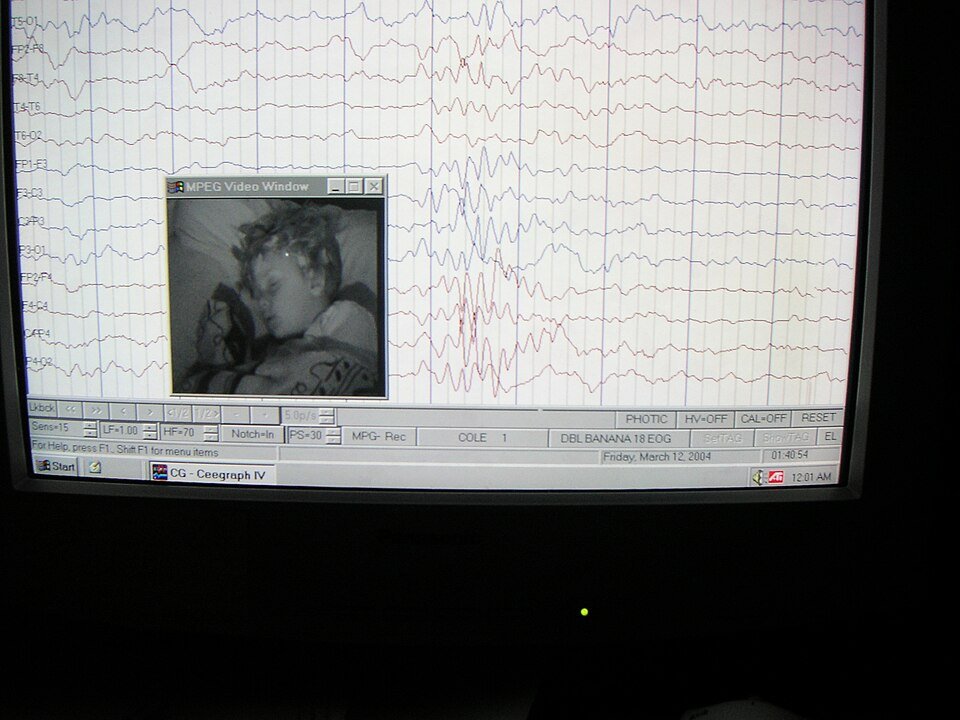
Theta-band brain activity in the two seconds before the onset of a sleep slow oscillation can predict both whether the oscillation will occur and how far it will propagate, researchers at the University of Chicago report.
Sleep slow oscillations (SOs, ~0.5-1.5 Hz) are a hallmark of deep NREM sleep and are known to play a critical role in memory consolidation. But the neural events that precede their emergence and determine their spatial extent have remained largely unknown, limiting the development of closed-loop neuromodulation strategies that could enhance or suppress these oscillations.
What They Found. Mahmoud Alipour and colleagues recorded high-density EEG from 29 healthy adults and analyzed neural activity in the two-second interval preceding the SO trough. They classified SOs into two subtypes: Global SOs, which propagate widely across the cortex, and Frontal SOs, which remain localized.
Theta-band power (4-8 Hz) emerged as the strongest individual predictor of SO initiation. Theta power exhibited a sustained rise beginning approximately 1.6 seconds before SO onset and differentiated SO subtypes with moderate-to-strong effect sizes (Cohen’s d = 0.45-0.77). Delta-band activity provided complementary predictive information.
Notably, spectral parameterization revealed that the pre-onset theta elevation primarily reflected broadband shifts in aperiodic background activity rather than a modulation of a discrete oscillatory component. This suggests the predictor signal is a general shift in neural state rather than a specific rhythm.
The researchers identified distinct mechanistic signatures for each SO subtype. Global SOs were preceded by enhanced delta-theta phase-amplitude coupling and broad low-frequency synchronization. Frontal SOs showed elevated theta/alpha-to-beta/low-gamma coupling, indicating locally enhanced coupling that restricts propagation.
A logistic regression classifier using pre-onset theta power achieved greater than 95% accuracy in distinguishing SOs from surrogate events and approximately 83% accuracy in differentiating Global from Frontal subtypes.
Why It Matters. The ability to predict SO emergence and spread from pre-onset neural activity opens a window for real-time closed-loop neuromodulation. If theta-band power can serve as a trigger signal for non-invasive stimulation, researchers may be able to selectively enhance Global SOs (which are associated with large-scale memory consolidation) or suppress Frontal SOs in clinical contexts where their localization is problematic.
Limits. The study was conducted in healthy adults during a single night of recording. Whether the predictive theta signal generalizes to clinical populations (insomnia, sleep apnea, aging) or across multiple nights remains to be tested. The classifier performance, while strong, was based on a single dataset and requires independent replication.
Bottom Line. Theta-band power in the seconds before a slow oscillation is a reliable predictor of both SO occurrence and subtype, with classification accuracy exceeding 95% for detection and 83% for subtype. These findings provide a potential neural target for closed-loop interventions aimed at enhancing the memory benefits of NREM sleep.
Source: Alipour M, et al. “Predictability of sleep slow oscillation emergence and spatial extent from pre-onset neural dynamics.” Scientific Reports. Published June 19, 2026. DOI: 10.1038/s41598-026-57532-z