

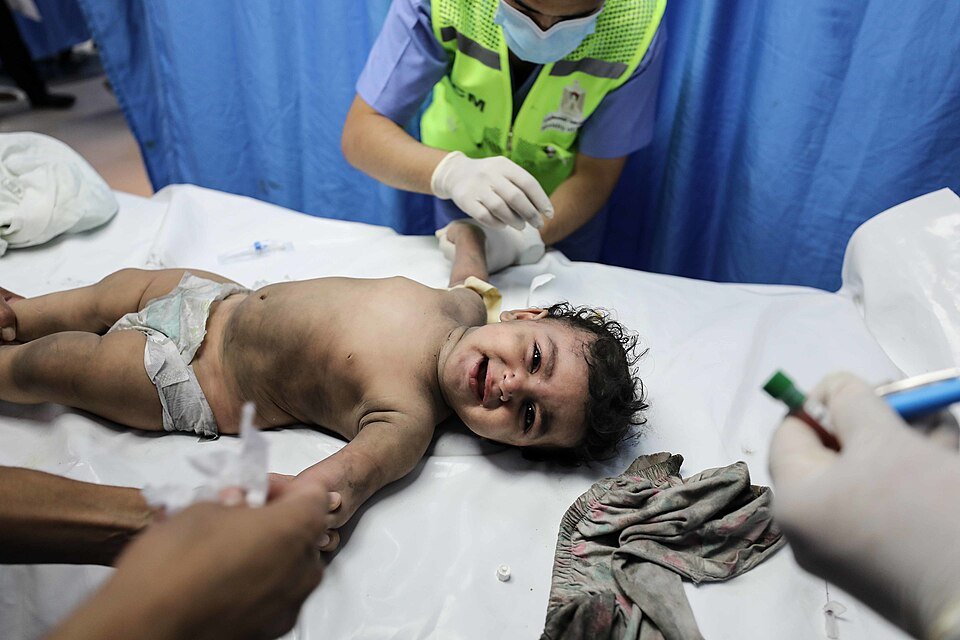
The children keep dying, and the world calls it a ceasefire
An Israeli strike hit a house in the Bureij refugee camp in central Gaza on Saturday. Among the dead were two children. Also killed was Ahmed Wishah, a cameraman for Al Jazeera. Wishah’s brother, Mohammed, also worked for the network. He was killed by Israeli shelling in April. On Saturday, the same military that killed one brother killed the other.
There is nothing new in this story. That is the point.
By Saturday evening, the total death toll from Israeli attacks that day had reached at least ten, according to Palestinian health officials. In a separate strike on a family home, four members of one family, including the parents and their two daughters, were killed. The youngest victim was two years old.
These killings did not happen during a war. They happened under a ceasefire.
The October 2025 truce between Israel and Hamas was supposed to stop the killing. It did not. Since that date, 265 Palestinian children have been killed in Gaza, according to UNICEF. One child every single day for more than eight months. UNICEF spokesperson James Elder put it bluntly: “The killing of children in Gaza is no longer a failure of the system, it has become the system.”
Let that sentence sit for a moment. A UN agency that usually measures its language in diplomatic fractions has concluded that child killing is now routine procedure. Not an accident. Not a mistake. The system.
The killing of journalists is also routine. Ahmed Wishah is the twelfth Al Jazeera media worker killed since the conflict began in October 2023. The Israel Defense Forces accused him of being a “Hamas sniper operative” the same claim the military has made about nearly every journalist it has killed and offered no evidence to support it. Reporters Without Borders says Israeli forces have killed more than 220 journalists since the war began.
The pattern is consistent. A journalist is killed. The military issues a statement, hours or days later, labeling the dead person a militant. The statement cites intelligence that is never made public. The news cycle moves on. Another journalist is killed. The cycle repeats.
There comes a point where the word “ceasefire” loses all meaning. If a ceasefire allows one child to be killed every day for eight months, it is not a ceasefire. It is a permission structure that lets the killing continue at a lower volume while the world declares the problem solved. The October 2025 truce did not end the violence in Gaza. It simply reduced it to a rate the international community could ignore.
And the West has obliged. There is no mass outrage over Gaza now, as there was in late 2023 and 2024. The war is over, the headlines say. But the killing continues, just below the threshold that would force another round of UN resolutions, emergency sessions, and condemnation.
Israel has made clear through its actions that it does not consider itself bound by the ceasefire. Near-daily attacks have killed more than 1,000 Palestinians since the truce was signed, according to Gaza’s Health Ministry. The Israeli military operates with complete impunity. The United States, which brokers ceasefires in the Middle East, does not enforce them.
This is where the question of self-defense becomes impossible to answer honestly. You cannot defend yourself against two-year-olds. You cannot defend yourself against cameramen. You cannot call it self-defense when the party with the overwhelming military advantage, the one that controls the airspace, the borders, the sea, and the electricity, kills civilians at a rate of one child per day and calls the rest a ceasefire.
What Israel is doing in Gaza right now is not self-defense. It never was, perhaps. But the pretense has worn thin. When a country kills journalists at the rate Israel has killed them, when it kills children as a matter of daily routine, when it violates its own ceasefire agreements with the casual confidence of a state that knows no one will stop it, it has stopped defending itself and started doing something else.
That something else has a long-term cost that Israeli strategists rarely discuss in public. Every child killed, every family destroyed, every journalist eliminated is a recruitment poster for the next generation of fighters. The anger does not disappear. It goes underground, it waits, and it comes back. The history of every occupation ever conducted on this planet tells the same story: the violence you plant today is the violence your children will harvest.
There is a French saying: those who sow the wind will reap the whirlwind. Israel is sowing the wind across Gaza every single day. The two children killed in Bureij on Saturday, the cameraman shot in his home, the 265 children dead since October these are not closed chapters in a concluded war. They are seeds. And the whirlwind is not a question of if, but of when.