

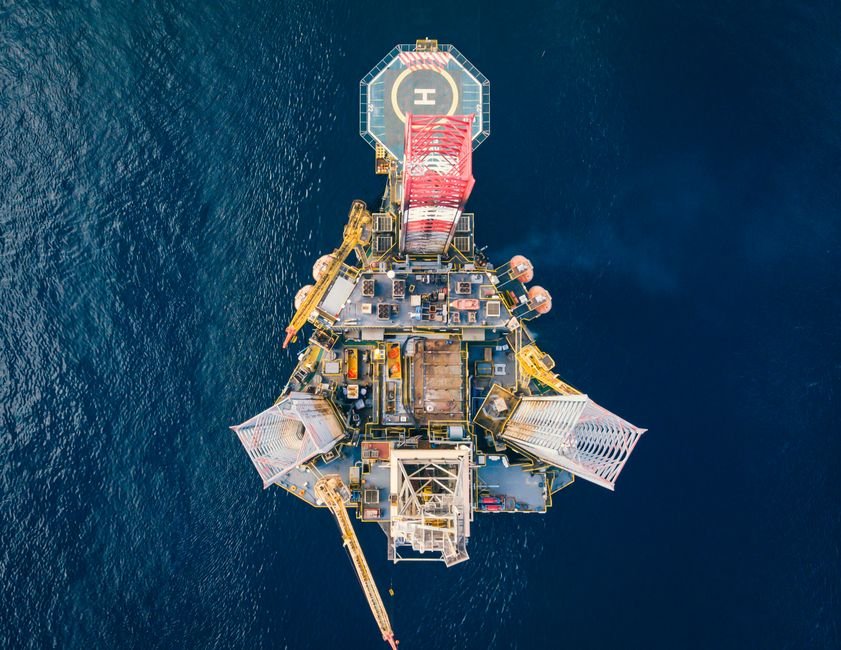
The global search for oil and gas is moving into deeper water. Deep offshore investments are expected to exceed $200 billion in 2026, double the average of the past decade, and cumulative spending could reach $2.5 trillion by 2035. The question posed by a new analysis in Nature is not whether this drilling is necessary, but whether it can be done safely enough to justify the ecological risk.
Over 70% of proven reserves discovered by the seven largest international oil companies in the past decade came from waters 400 meters (1,312 feet) or deeper. Deep-water reservoirs are, on average, 16 times larger than onshore discoveries. The cost of extracting them, roughly $43 per barrel on average, and as low as $30-40 in Brazilian fields, is competitive with or cheaper than many US shale operations.
“You can’t turn off the oil and gas overnight while you build out renewables,” said Yuxin Zhao, a senior scientist at CNPC’s Tubular Goods Research Institute in Xi’an, China, who authored the Nature Comment. “But that alone cannot justify biodiversity loss being an acceptable operating cost.”
The technology driving the push
Deep-sea drilling has been transformed by a suite of engineering advances. Floating production storage and offloading vessels, ships that can process and store oil at sea for years without docking, have become the standard. China’s Haikui No. 1, operating in the South China Sea, processes roughly 5,600 tonnes (6,173 tons) of oil per day and can operate for up to 15 years without returning to port.
Digital twins, physics simulations fed by real-time sensor data, allow operators to detect corrosion, fatigue, and potential leaks before they become failures. Remotely operated vehicles and autonomous underwater vessels inspect structures in conditions too deep or dangerous for crewed operations.
Perhaps the most significant advance is the ability to drill through ultra-shallow gas formations, pockets of gas less than 1,500 meters (4,921 feet) below the seabed that account for more than 20% of offshore blowouts. Seismic imaging and digital modeling now allow engineers to identify and preserve natural methane-hydrate caps while drilling through them, as demonstrated at the Lingshui 36-1 field in the South China Sea, described as the world’s first large-scale ultra-deep-water ultra-shallow gas field.
The risks are not solved
The 2010 Deepwater Horizon disaster remains the defining reference point for deep-sea risk. One failed well released more than 3 million barrels of oil over 87 days, fouling more than 1,600 kilometers (994 miles) of coastline. The industry has improved blowout preventer technology since then, but the conditions at extreme depths, high pressure, strong currents, poor visibility, remain challenging.
Methane emissions from offshore operations are persistently under-reported. Satellite data from instruments such as MethaneSAT and Sentinel-5P suggests that venting and flaring emissions from offshore platforms are on average 50% higher than official inventories. Zhao argues for independent verification linking satellite monitoring with aerial drones and ROVs to locate leaks early, and for penalties on projects that cannot demonstrate low, verifiable emissions.
The governance of deep-sea drilling is fragmented. Most projects fall within coastal states’ exclusive economic zones, where national regulations apply. Beyond those zones, international oversight is weak, and the legal framework for the ocean floor is increasingly contested.
An energy transition paradox
The surge in deep-sea investment reflects a fundamental tension. Natural gas is widely viewed as a bridge fuel, lower in carbon than coal, capable of filling the intermittency gaps of renewables, and increasingly needed to power AI data centers. But extracting it from the deep sea carries risks that are harder to manage than onshore drilling.
Zhao’s analysis calls for case-by-case justification of projects, with operators required to demonstrate that ecological harm can be avoided, emissions verified, failures contained, and responsibility maintained beyond the production lifetime. Whether the industry can meet those standards at the scale now planned, $2.5 trillion over the next decade, will determine whether the deep sea becomes a new energy frontier or an environmental liability.