

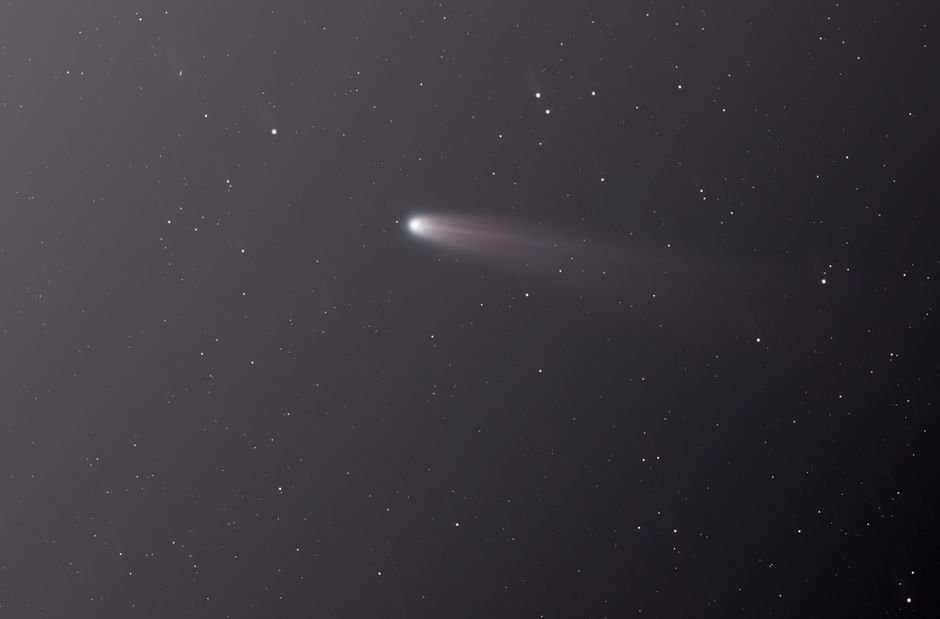
The Very Large Telescope has delivered the most detailed chemical portrait yet of 3I/ATLAS, only the third known interstellar object to pass through the solar system. Over 23 nights of high-resolution spectroscopy with the ESPRESSO instrument, astronomers tracked the comet’s gas emissions from before its closest approach to the Sun all the way out to 2.45 astronomical units beyond it.
The study, accepted for publication in Astronomy & Astrophysics, is the third in a series characterizing the interstellar visitor. Led by Baltasar Luco and Thomas H. Puzia, the team used ESPRESSO at a spectral resolving power of R approximately 140,000 to measure emission lines from multiple molecular species across the comet’s perihelion passage.
A CO2-Rich Comet That Shifts Near the Sun
The most striking finding is the comet’s changing chemical behavior. At large heliocentric distances, 3I/ATLAS presents a CO2-dominated coma. As it approached the Sun and temperatures rose, the chemistry shifted progressively toward water-driven outgassing.
The CO2/H2O proxy, a key indicator of a comet’s volatile composition, spanned a wide range from about 0.06 to 1.06 across the observation period. These values are comparable to those measured for the previous interstellar comet, 2I/Borisov, and consistent with observations from Subaru/HDS and the SPHEREx space telescope.
The team measured cyanogen (CN) production rates by fitting the B2Sigma+ – X2Sigma+ molecular band using a publicly released Python package called CometSpec. The pre-perihelion power-law index fell within the range observed for solar system comets, suggesting that 3I/ATLAS’s outgassing behavior is not fundamentally different from comets born in our own neighborhood.
Forbidden Oxygen and Delayed Sublimation
Forbidden oxygen emission lines, which arise from metastable atomic oxygen in the coma, revealed an unmistakable asymmetry. The green-to-red (G/R) flux ratio decreased from approximately 0.42 at 2.4 AU to about 0.114 near perihelion. A piecewise asymmetric oxygen fit was strongly preferred over a symmetric model, consistent with thermal inertia models that predict delayed water ice sublimation as the nucleus warms.
This delayed sublimation pattern is a known phenomenon in solar system comets and suggests that 3I/ATLAS’s nucleus, despite its interstellar origin, shares fundamental physical properties with local comets.
Iron, Nickel, and a Growing Chemical Inventory
The VLT/ESPRESSO observations also detected atomic nickel (NiI) and iron (FeI) in the comet’s coma, adding to the growing inventory of heavy elements identified in interstellar objects. Post-perihelion production rates were measured for C2 and CH, two additional carbon-bearing species that help constrain the comet’s overall carbon chemistry.
The authors note that the residuals in their CN measurements show substantial scatter, which could be due to systematic effects or physical drivers in the coma. The current observational cadence cannot disentangle the two possibilities, pointing to the need for even more frequent monitoring of future interstellar visitors.
A Framework for the Next Interstellar Object
Alongside the scientific results, the team released CometSpec, a publicly available Python package for flexible fluorescence modeling of cometary spectra. The reduced observational data are also publicly available, providing both an empirical reference and a methodological framework for future interstellar object monitoring campaigns.
With only three confirmed interstellar objects in history, every new data point is valuable. 3I/ATLAS, discovered in July 2025, has been studied intensively across the electromagnetic spectrum, from X-rays with Japan’s XRM satellite to radio with ALMA. The VLT/ESPRESSO observations add critical chemical detail that will inform the design of future monitoring campaigns, whether for the next interstellar comet or for a dedicated intercept mission.