

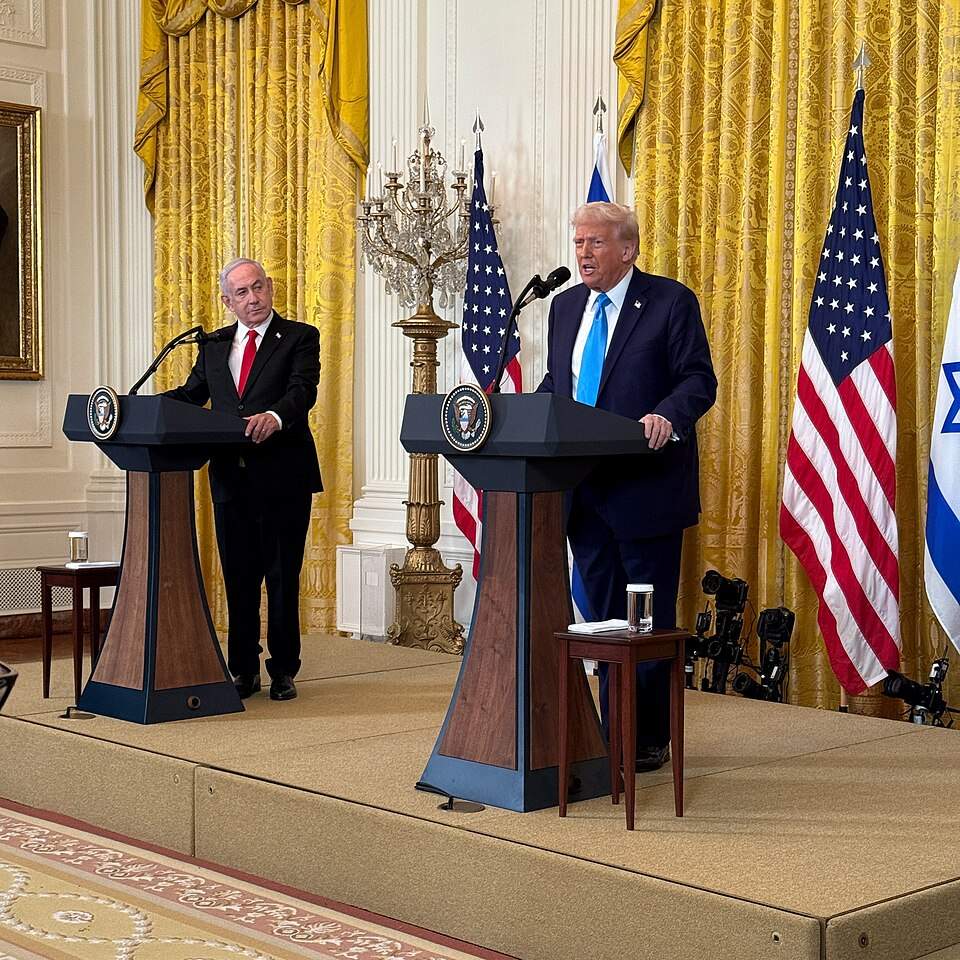
Benjamin Netanyahu is facing the worst political pressure he has seen in months. The cause is not a domestic scandal or a corruption indictment. It is the US-Iran agreement signed last week in Switzerland, a deal that cut Israel out of the process entirely and now threatens to force the Israeli prime minister to choose between his alliance with Donald Trump and his declared policy of indefinite military occupation in southern Lebanon.
The US-Iran framework, signed electronically on Sunday and set for formal ratification on Friday, makes no explicit mention of Israel’s military campaign against Hezbollah. But Iran has made clear that it considers the ceasefire indivisible. Iranian Foreign Minister Abbas Araghchi stated publicly that the agreement applies to “all fronts, with an emphasis on Lebanon.” In a post on X, he warned that “violation on one front is a violation of the ceasefire on all fronts,” and that the US and Israel are responsible for the consequences of any breach.
The message is unmistakable. If Israeli forces continue to strike southern Lebanon, occupy villages, and displace civilians, Iran considers that a violation of the deal Trump signed. And if that deal collapses, the Strait of Hormuz stays closed, Iranian oil stays blocked, and the economic relief Trump promised American voters disappears.
This puts Netanyahu in an impossible position.
He has spent months telling the Israeli public that the military campaign in Lebanon is necessary to destroy Hezbollah’s infrastructure and create a security buffer along the border. His defense minister, Israel Katz, said the military would not withdraw from the south. Netanyahu himself declared that Israel would “remain in the security zones for as long as necessary,” adding that “the struggle is not over and complete.”
But the US-Iran deal undercuts that position at every level. Trump has already publicly criticised Netanyahu’s tactics in Lebanon, saying the Israeli prime minister “has to be more responsible” and that “you don’t have to knock down a building every time somebody walks into it.” At the G7 summit, Trump sided with the European position on the need for a Lebanon ceasefire.
The domestic pressure in Israel is mounting. Israelis across the political spectrum reacted angrily to the news of the US-Iran deal, calling it a disaster for national security. The criticism is directed squarely at Netanyahu, who was informed of the negotiations but not included in them. His office tried to salvage the situation by releasing a statement saying Trump had given assurances that the final agreement would mandate the removal of Iran’s enriched uranium stockpile and the dismantling of enrichment infrastructure. But the interim framework contains no such language, and Iranian officials have rejected any discussion of giving up enrichment as a precondition.
Israel’s ambassador to India, Reuven Azar, insisted that Israel retains sovereignty and is not bound by the US-Iran deal. “Israel’s aim isn’t regime change,” he said. “We focus on dismantling existential threats.” But the gap between that rhetoric and the strategic reality is widening. Israel’s ability to continue its Lebanon campaign depends on US diplomatic cover, tacit approval, and the continued supply of American munitions. Trump has made clear he is not willing to provide that cover indefinitely.
Netanyahu is now caught between three forces he cannot reconcile. Iran demands a full ceasefire on all fronts, including Lebanon, as a condition of the deal’s survival. Trump wants the deal to hold and has publicly criticised Israel’s conduct. And his own domestic base expects him to reject a framework that sidelines Israel while leaving its main regional adversary economically and diplomatically rehabilitated.
The question is not whether Netanyahu can hold all three positions simultaneously. He cannot. The question is which one he will abandon first. And the answer may not be his to give. If Trump decides that the Iran deal is more important than Israel’s freedom of action in Lebanon, Netanyahu will have no choice but to adapt to a strategic landscape that no longer revolves around his priorities.