

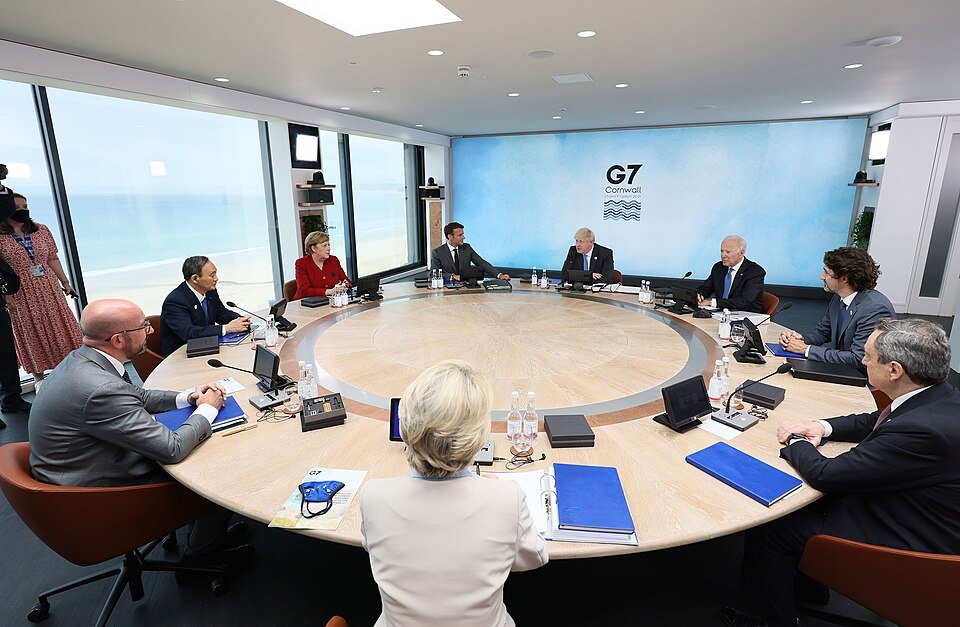
“I’m the boss,” Donald Trump said as he walked into the morning session of the G7 summit’s final day, the other leaders already seated around the table. It was a joke delivered with a grin, and the room laughed. But like most of Trump’s jokes, it carried the weight of a statement of fact.
The remark captured the dynamic that defined the three-day summit in Evian. Trump had arrived fresh from announcing a framework deal to end the war with Iran, celebrating his 80th birthday, and holding all the cards. The question hanging over the meeting was whether he would use that position to fracture the G7 or to deliver what his European hosts wanted: a unified front on Ukraine.
By the time the summit closed on Wednesday, the answer was clearer than most had expected. Trump signed a joint statement that committed the G7 to increasing military aid to Ukraine, tightening sanctions on Russia, and supporting Kyiv through the next winter. French officials, who had braced for the worst, were visibly relieved.
Emmanuel Macron, the summit’s host, called it a “moment of unity.”
“There was a turning point, there was definitely an Evian moment regarding Ukraine,” Macron said at his closing press conference. “This Evian summit represents a very profound shift in approach, a willingness on the part of the United States to work with the Europeans in support of Ukraine.”
The concrete commitments were laid out in the G7 leaders’ statement on geopolitical issues, published on Wednesday. The leaders agreed to “increase the delivery of air defense capacities, additional systems and interceptors, and long-range capabilities” for Ukraine. They also said they were ready to consider extending production licenses to Ukraine, allowing Kyiv’s growing arms industry to manufacture Western weapons systems domestically, including Patriot interceptors and long-range missiles.
“We are all currently producing too little, and this can be compensated for by granting licenses to companies that have these production capacities, including European and Ukrainian companies,” German Chancellor Friedrich Merz said.
On sanctions, the G7 committed to “strengthen our sanctions, including those on the oil and gas sectors.” The leaders described this as “the right moment to proceed with additional measures,” linking the decision explicitly to Trump’s success in securing the reopening of the Strait of Hormuz. The connection was deliberate: with energy prices expected to fall as Iranian oil returns to market, the economic cost of tightening sanctions on Russian energy exports becomes easier for Western governments to sell to their voters.
Trump’s shift on Ukraine was attributed by diplomats to several factors: his relief at the imminent end of the Iran war, which put him in an unusually cooperative mood; his two private meetings with Volodymyr Zelenskyy, who presented satellite imagery and battlefield data demonstrating Ukrainian gains; and a growing recognition within the US delegation that Russia is not in a position to dictate terms.
“President Trump, like all of us, simply acknowledged that there was no serious willingness on Russia’s part today to discuss peace,” Macron said.
Canadian Prime Minister Mark Carney went further, saying Trump had moved to “a more realistic understanding of how this war will develop.” He described it as a gamechanger.
But the unity came with edges. Trump’s closing press conference stretched more than an hour and was dominated by the Iran deal. He barely mentioned Ukraine, despite it being the issue European leaders had prioritized. When he did, he said both Putin and Zelenskyy “want to do something, they just don’t know how to do it” — a formulation that drew no moral distinction between the aggressor and the defender.
And the “I’m the boss” remark, while delivered as a joke, reflected a deeper truth. Trump signed the G7 statement because the statement served his interests, not because he had been persuaded by European arguments. The commitments on air defences and sanctions are real. But they rely on a US president who has shown repeatedly that his commitments are conditional on his mood, his political calculations, and the next deal that comes along.
Macron was asked directly whether Trump could be trusted to follow through on the sanctions pledges. “I have always trusted President Trump,” he replied. “When he has made commitments to us he has always done what he said he would do.”
The French president needs that to be true. He has staked his credibility on the idea that Trump can be managed, engaged, and brought into line through personal diplomacy and careful summitry. The Evian summit offered the strongest evidence yet that this approach can produce results. But it also demonstrated that those results depend on a single variable that no European leader can control: what kind of mood Trump is in when he walks through the door.