

Lead
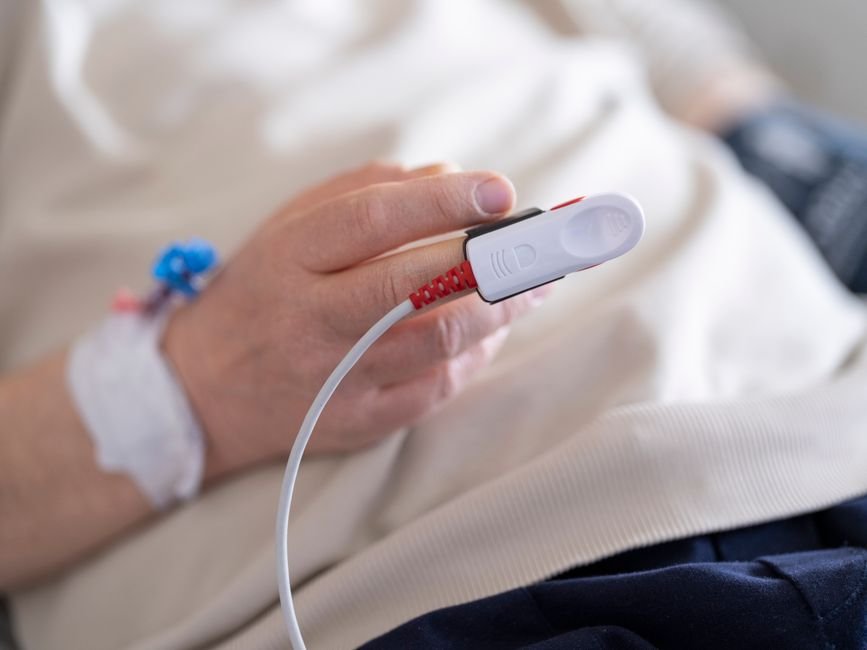
Every night in sleep labs around the world, a small plastic clip lights up red on a patient’s finger. That clip is a pulse oximeter, and the number it displays — blood oxygen saturation, or SpO2 — is one of the most important numbers in sleep medicine. It determines whether a patient has sleep apnea, how severe it is, and whether treatment is working. But what if that number depended on where the clip was placed?
A new study published in the Journal of Sleep Research suggests the answer is yes — and the differences are large enough to change a diagnosis. Researchers at the University of the Sunshine Coast in Queensland, Australia, compared oxygen readings taken simultaneously from the finger (the standard site), the forehead, and the toe during overnight sleep studies. They found statistically significant differences between all three sites, with implications for how sleep apnea is diagnosed and classified.
What They Found
The study, led by Kellie R. Strickland and colleagues, enrolled 41 patients undergoing Type 1 polysomnography — the gold standard, in-lab sleep study with full monitoring. Each patient wore pulse oximetry sensors on all three sites simultaneously throughout the night, allowing a direct head-to-head (and head-to-toe) comparison.
The results showed clear discrepancies. Mean SpO2 values differed significantly across sites (p < 0.01), as did the number of desaturations per hour (p < 0.01) and the total time spent below 95 percent oxygen saturation (p < 0.01).
The forehead sensor consistently recorded the highest mean SpO2 and the fewest desaturations. It also produced the cleanest data, with significantly fewer signal artifacts than the other two sites (p = 0.024). The finger sensor, by contrast, produced the most signal dropouts — periods where the device lost its reading entirely (p < 0.01). The toe sensor fell somewhere in between on most measures.
Despite these differences, there was strong convergence between certain sites for specific metrics. The correlation between finger and toe for desaturations per hour was r = 0.948, indicating very strong agreement on that particular measure. However, the absolute values still differed enough to potentially shift a patient from one severity category to another — say, from moderate to severe sleep apnea, or from no apnea to mild.
The study used Bland-Altman analysis, a statistical method designed to assess agreement between measurement techniques, and the results showed that the three sites cannot be used interchangeably without caution.
Why It Matters
This is not just an academic curiosity. Pulse oximetry is central to how sleep apnea is diagnosed and treated. The apnea-hypopnea index (AHI), which defines severity, is partly built on oxygen desaturation events. If the sensor site systematically overestimates or underestimates oxygenation, then the AHI changes, and the patient’s classification changes with it.
The forehead measurement is particularly interesting. Because the forehead is supplied by the internal carotid artery — part of the core circulation — it may reflect central oxygenation more faithfully than peripheral sites like the finger or toe. But that might actually be a problem in sleep medicine. In sleep apnea, the clinically relevant events are transient drops in oxygenation that reach the end organs most vulnerable to hypoxia, including the brain. However, the diagnostic thresholds used in sleep medicine were developed using finger oximetry. If the forehead gives systematically higher readings, it could miss desaturation events that the finger would catch, potentially underdiagnosing severity.
On the other hand, the finger’s higher rate of signal dropout is a known clinical frustration. When a patient moves, or when the finger gets cold, the oximeter can lose its signal for minutes at a time. This creates gaps in the data that can lead to missed events or unreliable AHI calculations. The toe, while not ideal for comfort and practicality, might offer a useful backup in certain populations — particularly patients with poor peripheral perfusion or those who cannot tolerate a finger sensor.
These findings are especially relevant for limited-channel sleep studies — home sleep tests and portable monitoring devices that rely heavily on oximetry without the full EEG, EOG, and EMG channels of in-lab polysomnography. In those settings, there is no backup measure of sleep staging or arousal. The oximetry channel carries more weight. If the sensor site introduces systematic bias, the risk of misclassification increases.
Limits
The study is relatively small at 41 participants, and it was conducted in a single sleep laboratory. The sample may not represent the full diversity of sleep apnea patients in terms of age, body mass index, comorbidities, or racial and ethnic background. Patients with certain conditions — such as peripheral vascular disease, Raynaud’s phenomenon, or diabetes with neuropathy — might show different patterns of peripheral oxygenation that could affect site comparisons.
The study also used a specific make and model of oximetry equipment. Different devices use different algorithms for motion artifact rejection, averaging time, and signal processing, which may interact differently with each measurement site. The results may not generalize to all commercial oximeters.
Finally, the study did not assess clinical outcomes. It shows that measurements differ, but it does not directly prove that using one site over another leads to worse patient outcomes. That kind of prospective, outcome-based research would be the next logical step.
Bottom Line
Measurement site matters for pulse oximetry during sleep studies. The finger, forehead, and toe produce statistically different readings for mean SpO2, desaturation frequency, and time spent below 95 percent oxygen saturation. The forehead offers cleaner data with fewer artifacts but may overestimate oxygenation relative to the peripheral sites where clinical thresholds were established. Clinicians and researchers should be aware of these differences, especially when interpreting home sleep tests and portable monitoring studies where oximetry is a primary data channel. Until guidelines are updated to account for site-specific differences, the safest approach is to document which site was used and interpret results with that context in mind.
Source
Kellie R Strickland, et al. “Does Measurement Site Matter? A Comparison Between Finger, Forehead, and Toe Pulse Oximetry Measurements in Polysomnography.” Journal of Sleep Research, 16 July 2026, e70400. DOI: 10.1111/jsr.70400. PMID: 42464067.