

Macron hosts Trump at Versailles as G7 closes with AI lunch, Iran deal and critical minerals pact
EVIAN-LES-BAINS, France — The 2026 G7 summit closed on June 17 with President Emmanuel Macron steering French domestic political risk and transatlantic optics into a single evening: a private dinner with U.S. President Donald Trump at the Palace of Versailles, hours after hosting OpenAI’s Sam Altman, Anthropic’s Dario Amodei and Mistral AI’s Arthur Mensch for a working lunch on artificial intelligence and social media regulation.
France held the rotating G7 presidency for 2026 and chose the Alpine lakeside town of Evian-les-Bains for the three-day summit that began June 15. The final day’s agenda was dominated by digital governance, but the geopolitical heft came from summit outcomes on Ukraine, the U.S.-Iran nuclear framework, and a new critical minerals alliance aimed squarely at reducing dependence on China.
Macron’s closing address struck a confident tone. “This Evian summit represents a very profound shift in approach on Ukraine,” he said, pointing to a joint statement that all seven leaders — including Trump — signed. The statement reaffirmed support for Ukraine’s sovereignty and territorial integrity, though Trump’s own closing press conference, which stretched past an hour, dwelled almost entirely on the Iran framework deal and barely mentioned Ukraine.
Trump met Ukrainian President Volodymyr Zelenskyy twice on the margins of the summit, a signal of continued engagement even as the U.S. president’s public focus has clearly rotated toward Tehran. The G7 joint statement endorsed the fledgling U.S.-Iran nuclear framework, which G7 leaders called a “historic opportunity.” They welcomed the deal and declared their readiness to contribute to its implementation, a clear effort to lock in multilateral buy-in before the architecture is fully finalized.
On China, the G7 statement did not name Beijing directly but left little ambiguity. Leaders called for coordinated action on global economic imbalances and urged countries with persistent current-account surpluses to strengthen domestic demand. The language tracks closely with longstanding U.S. and European complaints about Chinese industrial overcapacity and state-directed export strategy.
A new institutional deliverable emerged from the summit: the Critical Minerals Resilience and Production Alliance. The initiative sets a target of reducing reliance on any single supplier for rare earths below 60 percent by 2030, an explicit hedge against China’s near-monopoly on processing. Given that China controls roughly 90 percent of refined rare earth production today, the target amounts to a multiyear industrial policy push across the G7 bloc.
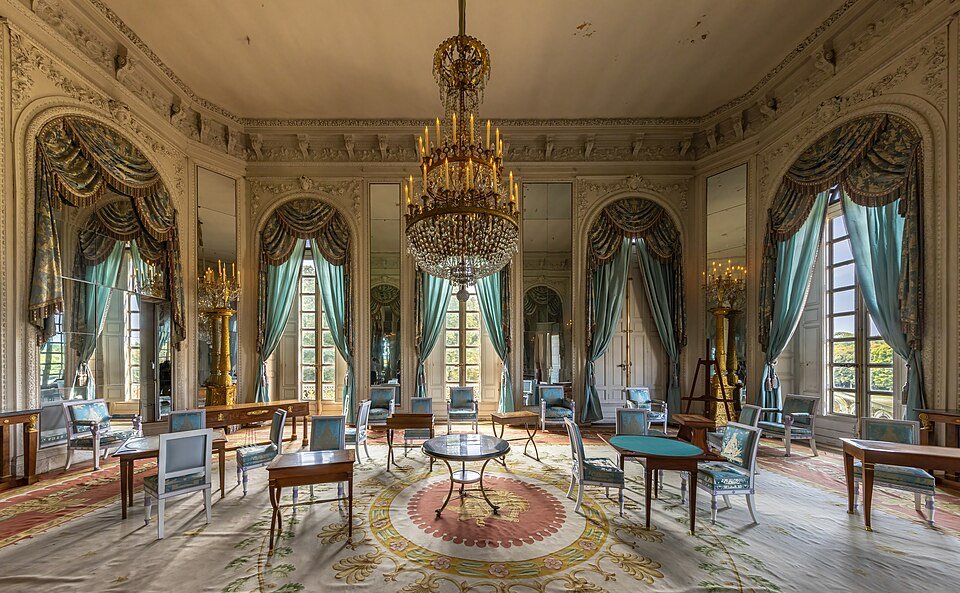
The summit’s closing image was not a joint communique, however. It was Macron and Trump dining at the Palace of Versailles, a venue freighted with history and political calculation. French officials expressed quiet relief that Trump stayed through the entire summit, a contrast to the 2025 G7 in Kananaskis, Canada, where he departed early. The optics of a Versailles dinner carried risks for Macron: domestic critics accused him of fawning over a president deeply unpopular with the French left and center. Macron pushed back sharply, insisting the dinner was not a “gala” but a private working meeting.
Trump, characteristically, offered a blunter appraisal. Surveying the Hall of Mirrors and the estate’s gilded interiors, he told hosts the palace was “not gold leaf but the real deal.”
The juxtaposition captured the summit’s dual character. By day, the G7 produced substantive agreements on Ukraine, Iran, China trade imbalances and critical mineral security. By night, the theater of Franco-American relations played out under chandeliers that have witnessed two centuries of diplomatic courtship and tension. The AI executives who lunched with the leaders during the day — Altman, Amodei and Mensch — represented the future-facing agenda of algorithmic regulation and platform accountability. Versailles represented the past, or at least the weight of it.
Whether the Versailles dinner advances Macron’s broader strategy remains an open question. The French president has tried to position himself as the European leader who can manage Trump, maintaining a channel of direct diplomacy that cooler heads in Berlin and Brussels have sometimes struggled to sustain. The price of that access is a domestic political cost that Macron’s opponents are already eager to exploit.
But for a summit that began with questions about whether Trump would show up at all — and that ended with him seated at a Versailles table rather than boarding an early flight home — French planners appeared to have gotten what they wanted.