

A machine now decides which targets to kill on the Ukrainian front. This is not science fiction. It is happening today. Ukraine is using drones equipped with artificial intelligence to hunt Russian supply convoys. The drones find the targets. The drones identify the targets. The drones strike the targets. The human being in the loop is shrinking. In some cases, the human being is gone.
This is what changed.
What Happened
Ukraine’s Defence Minister, Mykhailo Fedorov, announced this week what he calls a “logistics lockdown” strategy. The goal is simple: stop Russian troops from getting food, fuel, and ammunition. The method is new.
According to a BBC Verify investigation published on May 30, 2026, Ukrainian forces have destroyed at least 14 Russian supply convoys in the past week alone. BBC Verify analysed footage of burned-out trucks and military vehicles along critical routes connecting Russia to occupied Crimea and southern Ukraine. The vehicles were carrying food, fuel, and ammunition. They did not reach their destination.
The weapon is the Hornet drone. Nick Brown, a weapons expert at the defence intelligence company Janes, told the BBC that the Hornet carries an AI-targeting system trained on “thousands of hours of footage of Russian military targets” collected over four years of war. Brown said Ukraine “can launch hundreds of these loitering munitions towards a rough target area over 100 miles away, and then use AI to detail them on to Russian military targets as they find them.”
The drones use Starlink satellite connections to operate at long range and resist jamming. The system does not need a human operator to steer it to the final target. The AI decides.
Forbes defence writer David Kirichenko reported on May 12 and May 27 that Ukrainian drone units — including the 1st Azov Corps — have dramatically escalated attacks on Russian logistics corridors. The M-14 highway, a key supply route connecting Russia to occupied Crimea, has been partially closed because Ukrainian drones were destroying supply trucks at near-daily rates, according to BBC Verify and Ukrainian defence reporting.
Robert Tollast, a land warfare expert at the Royal United Services Institute (RUSI), told BBC Verify that some Russian brigades need up to 1,000 tonnes of fuel, food, ammunition, and other supplies every day. Ukraine’s earlier long-range strike campaign against Russian ammunition depots and fuel stores had already caused problems. The AI-drone campaign is now hitting the supply lines that carry what remains.
Ukraine’s Military Intelligence (HUR) said on May 29 that sections of the highway between occupied Berdiansk, Melitopol and Dzhankoi are now under Ukrainian fire control, according to NV.ua.
The Romania Angle
On the night of May 28-29, 2026, a drone hit an apartment building in the Romanian city of Galati. The building is a block of flats. Two people were injured. Romania is a NATO member. NATO invoked Article 5 for the first time after the September 11 attacks in 2001. This was not Article 5. But it was close.
Romania said the drone was Russian. NATO said the drone was Russian. The EU said the drone was Russian. The drone had been part of a Russian attack on Ukrainian infrastructure near the border, NATO confirmed.
Romanian President Nicusor Dan declared the Russian consul in Constanta persona non grata and said the Russian consulate in the Black Sea port city would be closed, Euronews reported.
Putin denied responsibility. On May 30, he said it was “too early to determine” whether the drone was Russian. He suggested it might be Ukrainian, according to Al Jazeera. This is the standard Kremlin response to every drone incident on NATO territory. In March 2025, a Russian drone entered Polish airspace and later crashed. Russia said it was not theirs. In 2024, Russian drones landed in Romania, Croatia, Latvia. Russia said none of them were theirs.
BBC correspondent Sarah Rainsford spoke to residents in Galati. One man, Adrian, told her: “No-one feels safe now.” Another resident said: “I will sleep with fear.” These are the words of civilians in a NATO country who have just learned that the war can come to their bedroom through the roof.
European Pravda reported that Moldova’s President Maia Sandu said Russia was a “danger to all.” Moldova has also seen drone debris fall on its territory.
Why It Matters
This is not just a new weapon. It is a new kind of warfare. The AI in the Hornet drone makes a decision that used to be made by a soldier. It looks at a truck on a road. It matches that truck against a library of images of Russian military vehicles. If the match is good enough, it strikes.
The human being is still somewhere in the chain. Someone decides the target area. Someone launches the loitering munitions. But the final decision — that specific truck, that specific moment — is made by software.
This is a threshold. Nations have debated for years whether autonomous weapons should exist. The United Nations has held meetings. Campaign groups have warned about “killer robots.” Academics have written papers. These debates are still happening. But the technology is already on the battlefield.
Nick Brown of Janes described the system to the BBC. He did not say “autonomous weapons system.” He said “AI to detail them onto Russian military targets.” That is the same thing. The drone finds the target. The drone hits the target. The machine decides.
Context
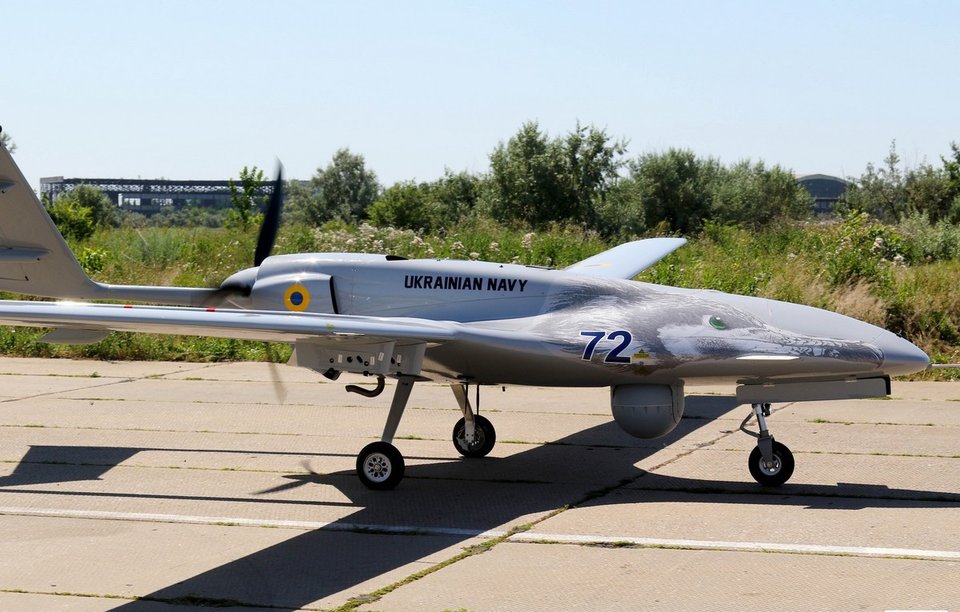
Drone warfare in Ukraine has evolved rapidly. In 2022, the Turkish-made Bayraktar TB2 was the star. It was slow, visible, and effective mainly against static targets. By late 2022, cheap FPV (first-person-view) drones became the dominant tool. Human operators flew them by video feed into targets. By 2023, both sides were producing tens of thousands of FPV drones per month.
In 2024, Russia began using Iranian-designed Shahed drones to strike Ukrainian cities and infrastructure. Ukraine developed drone-on-drone interceptors. AI-assisted terminal guidance appeared — the drone flew itself for the last few hundred metres.
By 2025, Ukraine’s drone industry was producing specialised systems at scale. The BBC reported in October 2025 that Ukrainian troops were using AI-based software to lock drones onto targets for autonomous terminal flight.
Now, in May 2026, the AI is not just guiding the drone at the end. The AI is finding the target, identifying it, and deciding to strike. That is a step change.
According to the Centre for European Policy Analysis (CEPA), the land bridge to Crimea has become a “highway to hell” for Russian logistics. Asia Times reported on May 8 that Ukraine’s 1st Azov Corps drone units had returned to Mariupol from the air, flying reconnaissance and strike missions over the occupied city.
Bottom Line
The AI-drone campaign against Russian supply convoys is not going to end the war overnight. Russia still holds roughly 20% of Ukraine’s territory. It still launches massive drone and missile attacks — on the night of May 24 alone, the Ukrainian Air Force reported 163 Russian drones launched against Ukraine.
But the campaign is changing the mathematics of the war. If a Russian brigade cannot get fuel, its tanks do not move. If it cannot get food, its soldiers do not fight. If it cannot get ammunition, its guns fall silent. Ukraine is now using AI to enforce that deprivation at a range of 160 kilometers (100 miles) or more.
The question that follows is not about Ukraine. It is about everyone else. The Hornet is a Ukrainian system, but the technology is not secret. The AI training method is not classified. The combination of loitering munitions, satellite links, and image-recognition software is available to any country with an engineering budget. The threshold that Ukraine crossed this week — a machine making a kill decision — is a threshold that others will cross too.
For now, the burned-out trucks lie on roads across southern Ukraine. The residents of Galati look at the hole in their neighbour’s roof. And somewhere above a highway in occupied territory, a drone is watching, waiting, and deciding for itself.
Image: Bayraktar TB2 drone of the Ukrainian Navy. Credit: Ukrainian Navy (CC BY 4.0)