

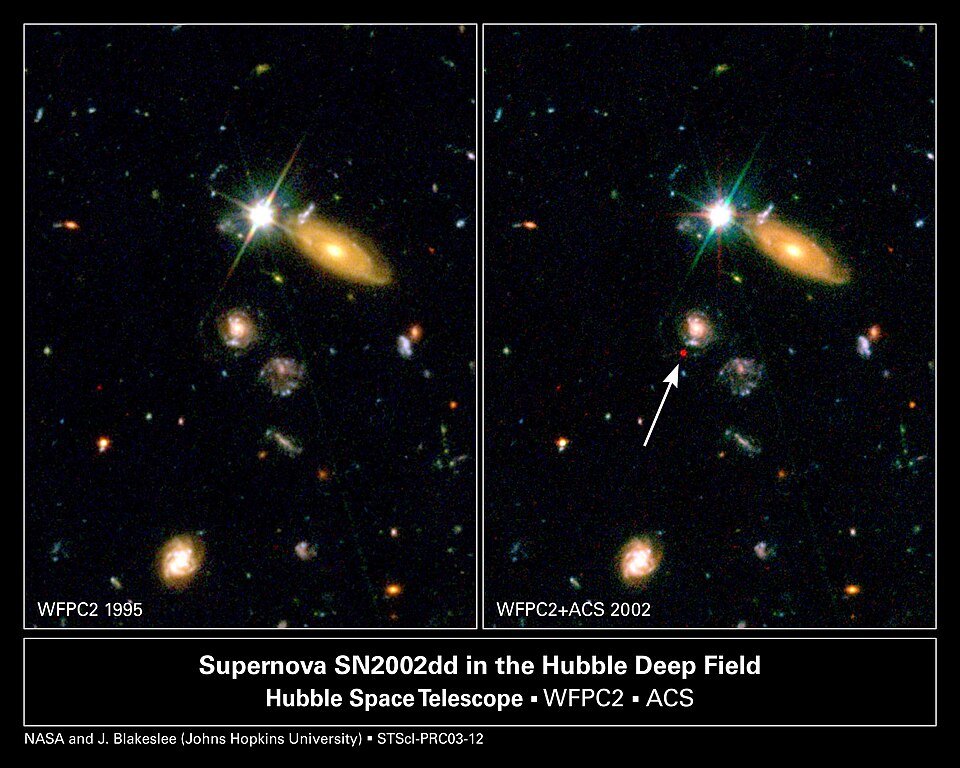
In November 2025, a team from Yonsei University in South Korea published a paper in the Monthly Notices of the Royal Astronomical Society that sent ripples through cosmology. They claimed that after correcting for an overlooked bias, the age of the stars in the galaxies that host Type Ia supernovae, the data no longer supported an accelerating universe. The universe, they argued, may already have entered a decelerating phase, and dark energy might not be the cosmological constant but something that evolves rapidly over time.
The paper was taken seriously. It passed peer review. Its lead author, Junhyuk Son, had published a respected earlier paper establishing the progenitor-age bias itself. The claim of a 5.5σ signal, well beyond the threshold for a discovery, suggested that one of the pillars of modern cosmology, the accelerating universe, might be built on sand.
Six months later, that challenge has been decisively overturned.
The Challenge
The Yonsei team’s argument was intricate but boiled down to three claims. First, Type Ia supernovae are not as standard as assumed: those from younger stellar populations are systematically fainter than those from older populations, even after the usual brightness corrections. Second, when you correct for this age effect, the data shift: the universe’s expansion, rather than accelerating, appears to be decelerating today. Third, combining their age-corrected supernova data with DESI BAO measurements and Planck CMB data produces a roughly 9σ tension with the standard ΛCDM model, the model that includes dark energy as a cosmological constant (w = ,1).
The dark energy equation of state from their analysis was w₀ ≈ ,0.43, wₐ ≈ ,1.70, far from the ,1 value predicted by ΛCDM. The present-day deceleration parameter q₀ was positive, meaning the universe’s expansion would be slowing, not speeding up.
The Refutation
The new study, led by Dr Phil Wiseman at the University of Southampton and published in the same journal, includes two Nobel laureates among its 17 authors, Adam Riess and Brian Schmidt, who shared the 2011 Nobel Prize in Physics for the original discovery of cosmic acceleration. The team re-analyzed the Yonsei data and found three errors:
1. An omitted standard correction. The most important discrepancy is also the simplest. The Yonsei team omitted the standard host-galaxy stellar mass correction, a well-established adjustment that accounts for the fact that more massive galaxies tend to host brighter supernovae. This correction is routinely applied in supernova cosmology and captures environmental dependencies that correlate strongly with stellar age. When Wiseman’s team applied it, the apparent age dependence of supernova brightness disappeared entirely.
2. Predicted redshift evolution not observed. If the age-bias explanation were correct, the effect should grow stronger at higher redshifts (where galaxies are younger). The Dark Energy Survey (DES) supernova data, spanning 5 years of observations, measured the evolution of the host-mass effect as ,0.028 ± 0.034 magnitude per unit redshift, consistent with zero. Including this negligible correction changes the dark energy equation-of-state parameter w by less than 0.01.
3. Progenitor age difference overstated. The Yonsei team claimed a roughly 5-billion-year age difference between nearby and distant supernova progenitors. This conflates the age of the host galaxy’s stellar population with the age of the supernova progenitor itself, two very different quantities. The actual difference is much smaller.
What This Means
The standard picture of an accelerating universe driven by dark energy survives intact. The “crisis” that briefly dominated cosmological headlines was not a genuine observational contradiction, it was a correctable analytical error.
That does not mean everything is settled. The DESI DR2 results, published in March 2025, continue to show hints that dark energy may be evolving (w deviating from ,1) at up to 4.2σ significance, intriguing but not yet at the 5σ threshold that would constitute a formal discovery. The Wiseman refutation does not rule out evolving dark energy entirely; it only shows that this particular challenge was based on a flawed analysis.
What the episode demonstrates is how science is supposed to work: a provocative claim was published, tested by independent researchers, and found to be based on a methodological error. Within six months, the challenge was answered. The universe is still accelerating. Dark energy, whatever it is, remains the best explanation for why.
Sources:
1. Son, J., Lee, Y.-W., Chung, C., Park, S. & Cho, H. “Strong progenitor age bias in supernova cosmology, II. Alignment with DESI BAO and signs of a non-accelerating universe.” Monthly Notices of the Royal Astronomical Society 544, 975,987 (2025). DOI: 10.1093/mnras/staf1685
2. Wiseman, P., Popovic, B., Sullivan, M., Riess, A. G., Schmidt, B. et al. “Still Accelerating: type Ia supernova cosmology is robust to host galaxy age evolution.” Monthly Notices of the Royal Astronomical Society 549 (2026). DOI: 10.1093/mnras/stag797. arXiv: 2601.13785
3. SciTechDaily. “Astronomers Confirm Dark Energy After Shock Challenge Rocked Cosmology.” June 16, 2026. https://scitechdaily.com/astronomers-confirm-dark-energy-after-shock-challenge-rocked-cosmology/
4. DESI Collaboration. DESI DR2 results, March 2025.