

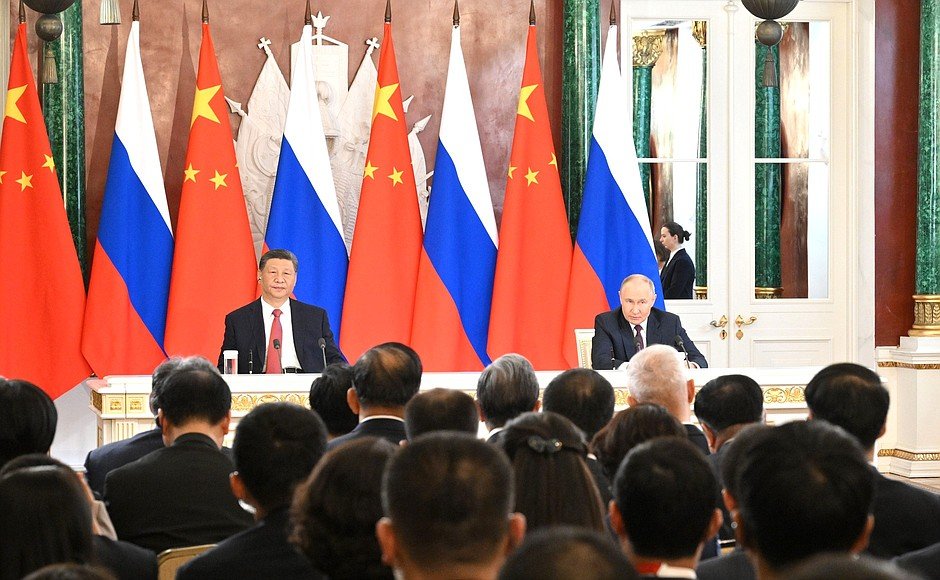
Putin is not at the G7 summit in Canada this week. He does not need to be. Through direct phone calls with Donald Trump, a relentless BRICS economic counter-narrative, and the spectacle of the St. Petersburg International Economic Forum, the Kremlin is running an influence operation from outside the room that European leaders say is already working. The question at the G7 is no longer whether Putin can sway Trump, but how far that sway extends.
Vladimir Putin did not receive a G7 invitation. He does not appear to need one. As the leaders of the world’s seven largest advanced economies gather in Canada to discuss Ukraine, energy security, and the rules-based international order, the Russian president is conducting a parallel diplomacy that cuts straight to the most unpredictable variable in the room: Donald Trump.
The most direct channel is the least disputed. On June 14, Trump confirmed that he and Putin have spoken by phone multiple times, calling their conversations “two very good talks.” According to a report in The Guardian, Trump told Putin during those calls that he was prepared to help end the war in Ukraine. The content of those discussions has not been fully disclosed, but the mere fact that they are happening while Trump sits at a G7 table supposedly united on Ukraine has sent alarms through European delegations.
European leaders did not need to read the transcript. They saw the pattern. A U.S. president holding private bilateral conversations with a pariah head of state, on the most consequential issue on the summit agenda, without coordinating with allies first, is the diplomatic equivalent of a signal flare. It tells every other G7 member that the American position may already be compromised before the plenary sessions even begin.
Putin is reinforcing that pipeline with a broader narrative designed to reach Trump by another route. Speaking at the St. Petersburg International Economic Forum, Putin argued that BRICS has overtaken the G7 as the world’s primary economic engine. He pointed to figures his government has pushed consistently: BRICS nations now account for 49 percent of global GDP growth, against the G7’s 18 percent. Intra-BRICS trade has surpassed $1 trillion annually. The argument is tailored for an audience of one. Trump, who has long treated alliances as transactional cost centers rather than strategic assets, is the G7 leader most receptive to the idea that the bloc he is sitting in is economically obsolete.
The SPIEF itself was designed as a visual counter-argument to the G7. More than 20,000 attendees from 130 countries gathered in St. Petersburg this month, a turnout the Kremlin billed as proof that Russia is not isolated. Conference halls were full. Trade delegations from China, India, the United Arab Emirates, and dozens of other nations moved through the corridors. The image projected to the world, and to Trump specifically, was of a Russia that has found alternatives to the West and is thriving without it.
“That is a message calibrated for one person in particular,” said a senior European diplomat quoted in the Franceinfo report on the summit dynamics. “Trump hears ‘G7 is the past, BRICS is the future,’ and it resonates with his worldview. The danger is that he starts acting on it.”
That danger is the central fear running through this year’s G7. European capitals worry that Trump will bypass the multilateral framework entirely and strike a bilateral deal with Putin that carves up Ukrainian territory and leaves European security architecture in tatters. They have seen the playbook before. During his first term, Trump withdrew from the Iran nuclear deal that European allies had spent years negotiating, recognized Israeli sovereignty over the Golan Heights without consultation, and pulled out of the Paris climate accord against the advice of every major ally. The concern now is that Ukraine will become the next unilateral move.
Putin does not need to make a case inside the G7. He has Trump’s ear on the phone. He has BRICS economic data that feeds Trump’s instinct to frame alliances in terms of return on investment. And he has a summit in St. Petersburg that proves Russia has global partners willing to engage. All of it converges on one goal: convincing Trump that the better deal lies outside the G7 framework, not within it.
The irony is not lost on European diplomats. The G7 was founded to coordinate the Western response to global crises and to demonstrate the strength of liberal democratic capitalism. It is now hosting a U.S. president who, by his own admission, is in regular contact with the man the bloc is supposed to be containing. Putin may be absent from the summit table, but he is very much in the room.