

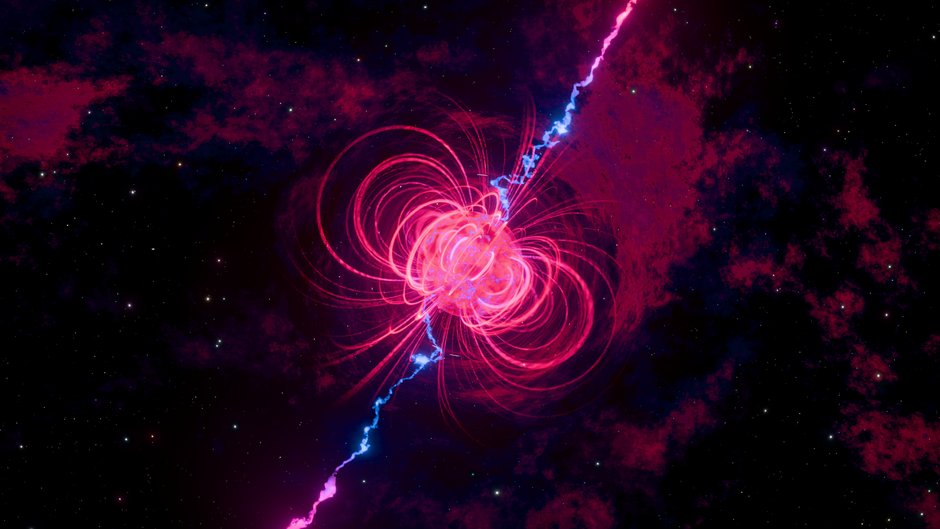
For the first time, astronomers have directly mapped the magnetic field around a racing pulsar, confirming a long-standing theory about how these dead stars inject high-energy particles into the Milky Way.
Using NASA’s Imaging X-ray Polarimetry Explorer (IXPE), scientists measured the magnetic field of pulsar PSR J1101-6101, the rapidly spinning neutron star at the heart of the so-called “Lighthouse Nebula.” The results, published July 9 in The Astrophysical Journal, show that the most energetic particles escaping the pulsar flow along the galaxy’s magnetic field lines like ships following a channel.
A Supersonic Stellar Corpse
Pulsars are the ultra-dense remnants of massive stars that exploded as supernovae. The core left behind, a neutron star, packs more mass than the Sun into a sphere the size of a city and spins at staggering rates. PSR J1101-6101 rotates about 16 times per second. Its powerful magnetic field sweeps beams of radiation across the cosmos like a lighthouse beacon, giving the nebula its name.
This particular pulsar is moving supersonically through interstellar space, having been kicked by its asymmetrical supernova explosion. As it tears through the galactic medium, high-energy particles streaming from the pulsar collide with ambient gas, creating a bow shock similar to the wave that builds at the prow of a speeding boat.
Most of those particles get trapped behind the bow shock, forming a turbulent tail. NASA’s Chandra X-ray Observatory previously captured that tail extending more than 37 light-years, making it the longest jet from any object seen in the Milky Way at the time.
But a narrow X-ray offshoot known as the “filament” stretches even farther from the pulsar. Since 2008, researchers have hypothesized that this filament forms when the highest-energy particles punch through the bow shock and escape into interstellar space, riding the galaxy’s magnetic field lines.
The Smoking Gun
Jack Dinsmore, an undergraduate student at Stanford University who led the study, wanted to put that hypothesis to the test.
“We wanted to test that theory,” Dinsmore said. “The ‘smoking gun’ would come by measuring the polarization of the light, which indicates the magnetic field direction. If the magnetic field points along the filament, that confirms that the filament’s particles are flowing along the field.”
IXPE spent nearly 18 days in June 2025 trained on the Lighthouse Nebula. Measuring polarization from a nebula this faint required the team to develop new analysis techniques that extracted every bit of information from the data.
It worked. The IXPE measurements showed with greater than 99% confidence that the magnetic field in the filament runs parallel to the particle flow.
Unexpected Order
The data also revealed a surprise. The polarization degree, a measure of how aligned the light waves are, was unexpectedly high, indicating a smooth, orderly magnetic structure far less turbulent than theoretical models had predicted.
“Many of the models for filaments assume strong magnetic turbulence,” said Roger Romani of Stanford University. “The high polarization degree we measured indicates lower turbulence than such models require.”
The findings challenge current models of how pulsar wind nebulae work and suggest that the mechanisms accelerating particles in these extreme environments may be more organized than previously thought.
Two Different Magnetic Worlds
Another striking result emerged when the team compared X-ray and radio observations of the same system. While IXPE showed the X-ray-emitting region’s magnetic field aligned parallel to the filament, radio observations revealed a magnetic field pointing almost exactly perpendicular.
This divergence provides the first clear evidence that particles of different energies occupy distinct physical regions within the system, hinting at multiple acceleration mechanisms operating simultaneously.
“The striking divergence in magnetic field orientations observed between radio and X-ray wavelengths provides compelling evidence for the highly structured nature of these objects,” said Niccolò Bucciantini of the Italian National Institute for Astrophysics, a co-author of the study. “This marks the first clear indication that particles of different energies occupy distinct regions within the system, hinting at the presence of multiple, and potentially very different, acceleration mechanisms at work.”
Why It Matters
The discovery sheds light on a fundamental astrophysical process: how pulsars, the whirling corpses of dead stars, seed the galaxy with energetic particles and magnetic fields. Understanding this process is key to deciphering the broader circulation of matter and energy in the Milky Way.
IXPE, a joint NASA and Italian Space Agency mission with partners in 12 countries, continues to provide unprecedented X-ray polarimetry data. Led by NASA’s Marshall Space Flight Center in Huntsville, Alabama, the observatory is opening a new window on some of the most extreme objects in the universe.
For the Lighthouse pulsar, the trail it blazes through the galaxy is no longer just a streak of light. It is a magnetic roadmap, charting how stars that died long ago continue to shape the cosmos around them.