

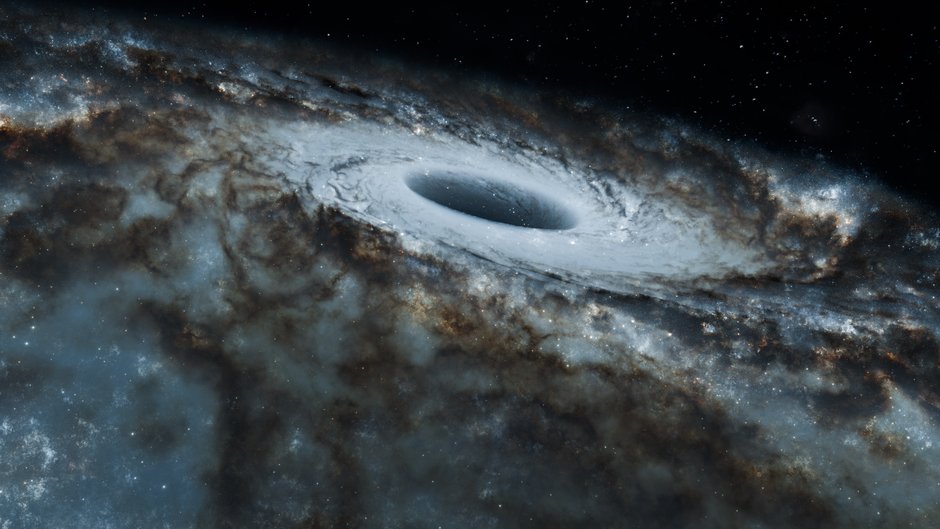
The Nancy Grace Roman Space Telescope, set to launch Aug. 30, 2026, will detect supermassive black holes that existed up to 11 billion years ago by capturing the flashes produced when black holes shred entire stars.
New research published July 14 in The Astrophysical Journal predicts Roman’s High-Latitude Time-Domain Survey will detect roughly 100 tidal disruption events (TDEs) per year at vastly greater distances than any previous observatory. This capability will allow astronomers to probe the early universe’s population of supermassive black holes and test competing theories about how these cosmic behemoths first formed.
“Thanks to Roman’s high sensitivity, we can find multiple tidal disruption events out to greater distances and earlier cosmic times than ever before,” said lead author Mitchell Karmen, a graduate student at Johns Hopkins University and NSF Graduate Research Fellow.
How Tidal Disruption Events Work
Tidal disruption events occur when a star wanders too close to a supermassive black hole. Rather than being swallowed whole, the star is torn apart by the black hole’s immense gravitational tidal forces, creating a brilliant flare of light that can outshine the star’s entire host galaxy.
This phenomenon is unique to lighter supermassive black holes, those in the range of 100,000 to 100 million solar masses. Heftier black holes exceeding 1 billion solar masses simply swallow stars whole, producing no such beacon. The shredded material forms a bright, hot accretion disk that peaks over a few weeks and then gradually fades, giving astronomers a window into otherwise invisible black hole populations.
Roman’s Infrared Advantage
Roman’s near-infrared observing capability is ideally suited for detecting TDEs from the early universe. As the universe expands, light from distant objects is stretched to longer wavelengths, a phenomenon known as cosmological redshift. Light traveling 8 to 11 billion years to reach us arrives in the near-infrared band where Roman’s instruments are optimized.
The telescope’s High-Latitude Time-Domain Survey will cover approximately 18 square degrees of sky, an area equivalent to about 90 full moons, revisiting the same regions at regular cadence to catch transient events as they occur.
Roman’s role complements the Vera C. Rubin Observatory, which will detect thousands to tens of thousands of TDEs per year but primarily at closer distances in visible light. Together, the two observatories will provide a complete picture from nearby to the farthest reaches of the cosmos.
“Just like Webb has transformed our understanding of distant, high-redshift galaxies, Roman is poised to transform our understanding of high-redshift transients,” said co-author Suvi Gezari of the University of Maryland.
Probing Black Hole Origins
Karmen and his colleagues modeled how the TDE rate changes across cosmic time, accounting for evolving factors such as galaxy merger rates, stellar density in galactic cores, and the masses of black holes.
The team forecasts that the TDE rate will increase with distance until reaching “cosmic noon”, roughly 11 to 12 billion years ago, when star formation across the universe peaked, and then decline at even greater distances.
Counting TDEs at different redshifts will allow astronomers to distinguish between two leading theories for the origin of supermassive black holes:
Light seed theory holds that black holes began as stellar-mass remnants from the deaths of massive stars (up to a few hundred solar masses) and grew through mergers and rapid gas consumption. This model predicts nearly every young galaxy hosts a central black hole.
Heavy seed theory proposes that some black holes were born large, up to a million solar masses, through direct collapse of gas clouds. This scenario predicts supermassive black holes would be rarer in early galaxies.
“Tidal disruption events help us probe the population of light supermassive black holes, which can help us discriminate between these models,” Karmen said.
A New Frontier in Transient Science
Roman’s High-Latitude Time-Domain Survey is one of three core community surveys that will define the telescope’s primary mission. Once Roman and Rubin begin full operations, teams will immediately begin comparing predictions to actual detections, using the combined data to map the distribution of black holes across cosmic time.
“Just by counting the number of TDEs as a function of redshift, you can put meaningful constraints on the population of million-solar-mass black holes,” Gezari said. “Roman will be transformative in that it can probe tidal disruption events out to greater distances, so you can look at how the rate of TDEs evolves over time.”
The Nancy Grace Roman Space Telescope is managed by NASA’s Goddard Space Flight Center, with key contributions from JPL, Caltech/IPAC, the Space Telescope Science Institute, BAE Systems, L3Harris, and Teledyne.