

TEL AVIV — They are men dragged from their homes. Doctors arrested at hospital gates. Teachers taken while fleeing through humanitarian corridors with their children. Journalists who reported on a war that is now consuming them. Every single one is being held in an Israeli prison without being told what they are accused of.
The number, according to human rights groups cited by NPR, is around 1,200 Palestinians from Gaza currently in Israeli custody. They are held under Israel’s 2002 “Imprisonment of Illegal Combatants Law” — a designation that strips them of the right to know the evidence against them, the right to a charge, and the right to a trial. They are held indefinitely, on secret evidence.
This is not justice. It is imprisonment without trial.
What Has Happened
On May 30, 2026, NPR reporter Itay Stern published a report from Tel Aviv documenting this system. Human rights organizations estimate that approximately 1,200 Palestinians from Gaza remain in Israeli detention. Most are classified as “unlawful combatants” — a legal category borrowed from post-9/11 America, as Israeli lawyer Daniel Shneer told NPR.
“It’s not a new law,” Shneer said. “And unfortunately, it is based on an American precedent that was set by the then-Bush administration.”
The law allows the state to hold people with no charge, no public evidence, and no defined release date. The detainee appears before a judge every six months, but the judge sees secret evidence that the detainee never gets to see. “So nobody knows what exactly is the basis of their holding in prison,” Shneer said.
According to B’Tselem, at the end of December 2025 the Israel Prison Service was holding 9,128 Palestinians on “security” grounds, including 1,477 from Gaza. Of those, 3,329 were in administrative detention — held without charge or trial. Addameer reported in April 2026 that the total had passed 9,600.
But the “unlawful combatants” category has no time limit and offers no path to trial or acquittal. Lawyer Nadia Daqqa, who has represented dozens of detainees, told NPR that “people were being held in order to extract information from them whenever it might be later requested… Their detention is not limited in time.”
Among those held: Dr. Hussam Abu Safiya, director of Kamal Adwan Hospital, arrested in December 2024. His son Ilyas told NPR: “My father is like all those in prison now categorized as unlawful combatants, as a pretext to keeping them detained in Israeli prisons without any charge.”
The same day Stern’s report was published, another doctor was killed. On May 30, 2026, an Israeli drone strike near the Al-Aqsa Martyrs Hospital in Deir al-Balah killed Dr. Jamal Abu Aboun, head of the anesthesia department at Al-Yafa Medical Hospital, according to Al Jazeera and the Anadolu news agency. A child was among the injured.
These two facts — detention without charge and killing on the ground — belong to the same story.
Why It Matters
Administrative detention is not a niche legal technicality. It is the suspension of one of the most basic principles of any legal system: that a person has the right to know what they are accused of and to face their accuser.
Under international law, the Fourth Geneva Convention (Article 78) allows an occupying power to intern civilians only for “imperative reasons of security.” The International Committee of the Red Cross has stated that the term “unlawful combatant” does not appear in any international agreement. Amnesty International holds that administrative detention breaches Article 9 of the International Covenant on Civil and Political Rights, which says no one shall be subjected to arbitrary detention.
Israel defends the practice. The prison service told NPR it denied charges of torture and starvation. Pnina Sharvit Baruch, a former senior Israeli military prosecutor, argued to NPR that the law is permitted: “It’s also acknowledged… that you can kill — OK? — members of organized armed groups in an armed conflict situation. So if you can kill them, clearly you can detain them instead of killing them.”
But the question is not whether Israel can kill or detain fighters. The question is whether it is detaining fighters — or civilians it calls fighters to avoid the trouble of a trial.
Daqqa told NPR that many detainees are not fighters at all. They are doctors, teachers, journalists, aid workers. Some were arrested while fleeing through humanitarian corridors. They are civilians held under a label designed for militants, with no way to prove otherwise, because the state will not show them the evidence.
The UN reports that since October 7, 2023, at least 93 Palestinians have died in Israeli detention. Around 65 were classified as unlawful combatants. The Red Cross is not allowed access. Daqqa told NPR that in some cases “it was clear that there was a connection between the policy of starvation and the death.”
The Other Side
Israel’s argument is straightforward. The government says the “unlawful combatants” law is necessary for security. After the October 7, 2023 attacks — in which Hamas and other armed groups killed about 1,200 people in Israel, mostly civilians — Israel says it needs to detain people who pose a security threat but cannot be tried through normal criminal procedures during active hostilities.
Pnina Sharvit Baruch told NPR that “criminal trials are often not possible during active fighting because evidence can’t be collected.” The law, she argued, “equalizes the ability to hold the members of non-state actors or of organized armed groups and to equalize them to prisoners of war.”
But the people being held are not, by any evidence made public, Hamas fighters who crossed into Israel on October 7. “Unlawful combatant” status is applied to people picked up across Gaza — in hospitals, in homes, at checkpoints, in humanitarian zones. Daqqa told NPR many have no connection to the October 7 attacks.
And the system has no end state. Prisoners of war are released when hostilities end. Criminal defendants can be acquitted or serve a sentence. Those held as “unlawful combatants” simply wait. As Shneer put it: “This unlucky group of people who are stuck in prison now are just waiting for a further stage, maybe in the negotiation process.”
They are hostages of a legal category, not prisoners of a justice system.
The Broader Picture
The detention story does not exist in isolation. It is part of a war that has now been running for 31 months.
According to Palestinian figures cited by Al Jazeera, at least 72,000 Palestinians have been killed and over 172,000 injured since October 2023. The Gaza Health Ministry, whose figures are accepted by the United Nations, reports these numbers. A peer-reviewed analysis in The Lancet estimated that the true death toll from traumatic injury by June 2024 was 64,260 — 41% higher than the official count at that time. By May 2025, a comparable estimate reached 93,000 deaths.
In October 2025, Israel and Hamas agreed to a ceasefire. Israel released thousands of detainees but kept over a thousand. Since the ceasefire, according to the Gaza Media Office, at least 922 Palestinians have been killed and 2,786 injured in continued attacks.
On May 30, 2026 — the day the NPR report was published — an Israeli drone strike killed Dr. Jamal Abu Aboun. Israeli artillery shelled areas east and south of Khan Younis. An Israeli drone strike hit near Firas Market, one of Gaza City’s busiest commercial areas, killing another Palestinian. Israeli forces demolished homes east of Beit Lahiya. In the occupied West Bank, Israeli settlers attacked homes in Beita and farmland in Masafer Yatta.
Israeli soldiers who served in Gaza between October 2025 and January 2026 told the Associated Press that troops routinely opened fire on Palestinians approaching the “Yellow Line” — an often poorly marked boundary. “After the ceasefire, the order was: If someone crosses the line, you shoot them,” one soldier said. Another said commanders emphasized holding territory “at all costs.” “There was a general feeling that human lives are not valuable,” he said.
This is the environment in which the detention system operates. A war in which human life — Palestinian life — is given a low price. A “ceasefire” in which killing continues. A detention system in which people are locked away without charge, without evidence, without end.
According to the Palestinian Prisoners Society, Israeli forces have detained nearly 23,000 people in the West Bank alone since October 2023. The war has killed 1,168 Palestinians in the West Bank and displaced about 33,000.
The Bottom Line
There are over a thousand people from Gaza sitting in Israeli prisons right now. They have not been charged. They have not been tried. They have not been told why they are there. Some are doctors, teachers, journalists, aid workers. Some were arrested while fleeing for their lives.
Israel calls them “unlawful combatants.” International law does not recognize that term. Human rights organizations call it arbitrary detention. The families call it a disappearance.
The Israeli government says the system is necessary for security. But a system that locks up doctors without charge, starves prisoners and does not investigate their deaths, and hides evidence from detainees and the public is not a security system. It answers to no one.
The war will end someday. The ceasefire will either hold or collapse. But for over a thousand men in cells, not knowing what crime they are supposed to have committed or when they will go home, the war is not the only thing that has stolen their freedom. The law has done that too.
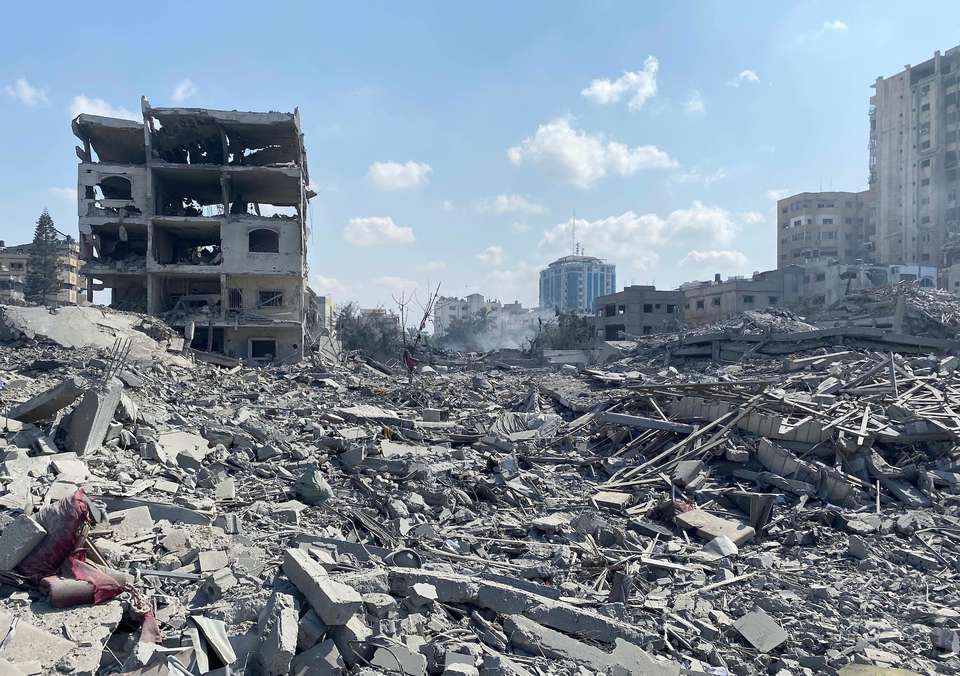
Image: Damage in Gaza Strip, October 2023. Credit: Wikimedia Commons (CC BY-SA 3.0)
Sources: NPR (Itay Stern, May 30, 2026), Al Jazeera (May 30, 2026), B’Tselem, Addameer, The Lancet (January 2025)