

Published: June 02, 2026, 17:08 UTC
Your Brain Decides to Approach Someone Before You Do — Zebrafish Reveal the Neural Precursors of Social Choice
In the early 1980s, Benjamin Libet conducted a famous experiment: he asked participants to flex their wrist whenever they felt the urge, while measuring their brain activity. He found that a readiness potential appeared in the brain about 300 milliseconds before participants reported being consciously aware of their decision to move. The result sparked a decades-long debate about free will that continues today.
A new study published April 9 in Nature Communications extends this finding into the domain of social decision-making — and reveals that the pattern operates not just on millisecond timescales, but over several seconds before a social choice is made.
Led by researchers at the Hebrew University of Jerusalem’s Edmond & Lily Safra Center for Brain Sciences (ELSC), the team developed a novel experimental setup that allowed them to watch an animal’s brain activity at single-cell resolution as it made a social decision — and then predict the outcome before it moved.
Watching Decisions Form
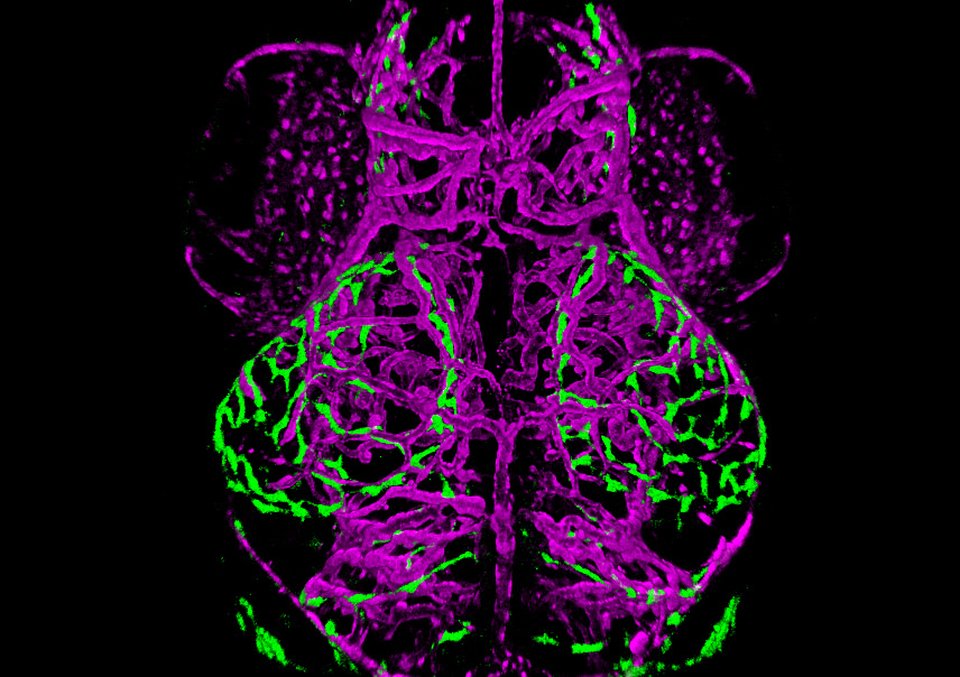
The study, led by Imri Lifshitz and Dr. Lilach Avitan, used larval zebrafish — small, translucent vertebrates whose brains can be imaged in their entirety using volumetric two-photon microscopy. The team created a social assay: a head-fixed zebrafish (the “focal fish”) watched a freely swimming conspecific through a transparent barrier. The focal fish could choose to swim toward the other fish or not.
This setup captures the most fundamental social decision in the animal kingdom: approach or avoid. Every social interaction — from courtship to cooperation to conflict — begins with the choice to move toward another individual.
The researchers recorded whole-brain activity at single-cell resolution during hundreds of approach events, then analyzed the neural dynamics leading up to each decision.
The Brain-Wide Signature
They found a distinctive, coordinated pattern across the brain:
- The pallium — the zebrafish homolog of the mammalian cortex — showed a sharp increase in neural activity beginning several seconds before the fish approached. The pallium appears to be the “central engine” of social approach behavior.
- The midbrain and hindbrain — evolutionarily older regions involved in arousal, motor control, and reflexive behaviors — showed a simultaneous decrease in activity.
This creates a push-pull balance: a brain-wide signature in which the pallium ramps up while older regions quiet down. The pattern was so robust that the researchers could predict, seconds in advance, whether the fish would approach the other.
“The decision to engage socially is not a single moment of choice,” says Avitan. “It emerges from a coordinated reconfiguration of activity across the entire brain — and that reconfiguration begins well before any visible behavior.”
The Pallium as Social Engine
The study identified the pallium as necessary for normal social approach. When pallial activity was disrupted, the fish stopped approaching. This is significant because the pallium is the evolutionary precursor of the mammalian cortex — including the regions in humans involved in social cognition, theory of mind, and decision-making.
The zebrafish is a simpler animal, and the social decision being studied is correspondingly simple — approach versus avoidance — but the underlying principle may be conserved. The pallium’s role in integrating sensory information, evaluating social cues, and initiating goal-directed movement appears to be a fundamental feature of vertebrate brain architecture.
The midbrain and hindbrain inhibition, meanwhile, may reflect the suppression of competing behavioral programs — freezing, fleeing, or other defensive responses — that would interfere with social engagement. The brain is not just activating the “go” circuit; it is actively silencing the “don’t go” circuits.
Implications for Free Will and Social Cognition
The zebrafish finding parallels the Libet paradigm in an important way: in both cases, neural activity precedes the conscious decision. But the zebrafish operates on a different timescale — seconds rather than milliseconds — and in a social context rather than a simple motor task.
This does not directly tell us about human free will. But it does suggest that the temporal precedence of neural activity over social action is a fundamental feature of vertebrate brain organization, not a peculiarity of human introspection.
The study also has implications for understanding social motivation deficits — a core feature of conditions such as autism spectrum disorder. If the pallium (or its mammalian equivalent, the prefrontal and cingulate cortices) is the central node for initiating social approach, then understanding how this circuit functions — and what can go wrong — could illuminate the neural basis of social motivation.
“By understanding how the healthy brain initiates social behavior, we gain a framework for understanding what breaks down when social motivation is impaired,” says Avitan.
Reference: Lifshitz, I., Prag, A., Livneh, N., Moshkovitz, M., Karmi, A., & Avitan, L. (2026). Distinct distributed neural dynamics predict pallium-dependent social approach. Nature Communications. DOI: 10.1038/s41467-026-71666-8.