

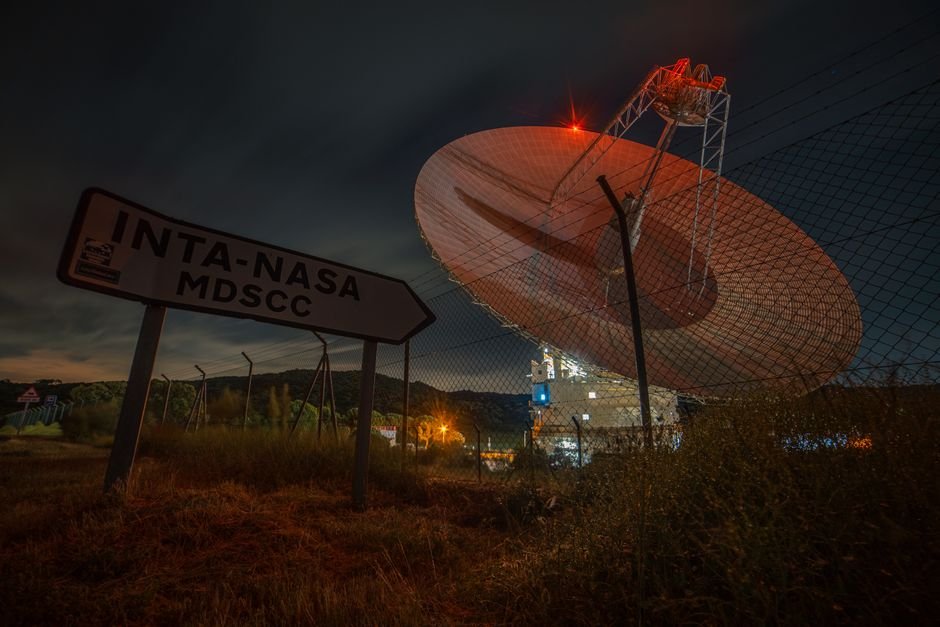
A fast-moving wildfire swept through NASA’s Madrid Deep Space Communications Complex (MDSCC) in Robledo de Chavela, Spain, on Friday, July 24, forcing the complete evacuation of the facility and temporarily knocking one of the agency’s three global deep-space communications nodes offline.
All 90 personnel at the site, located about 65 kilometers (37 miles) west of central Madrid, were safely evacuated as the blaze advanced through the compound. NASA confirmed that the fire has passed through the MDSCC grounds, but any assessment of damage to antennas, control buildings, and sensitive communications equipment will have to wait until authorities deem it safe for crews to re-enter the area.
In the meantime, the agency’s Space Communications and Navigation (SCaN) program has shifted all mission support to the Goldstone Deep Space Communications Complex in California. NASA said the transition was seamless and that spacecraft communications continue without interruption.
The Madrid station is one of three geographically distributed ground complexes that make up NASA’s Deep Space Network, or DSN. Together with Goldstone in California and Canberra in Australia, the three sites are spaced roughly 120 degrees apart around the globe, ensuring that at least one station has a line of sight to any spacecraft beyond low-Earth orbit at all times. The DSN communicates with missions ranging from the Artemis campaign around the Moon to the James Webb Space Telescope in deep space and the Voyager probes, both of which have traveled beyond the heliosphere into interstellar space.
The loss of Madrid, even temporarily, adds strain to a network that was already heavily oversubscribed. The DSN schedules antenna time months in advance, and demand regularly outstrips supply. With Madrid offline, there will be periods when certain spacecraft are out of contact that would otherwise have been reachable, a particular concern for distant probes such as Voyager 1 and Voyager 2 that require large antennas and significant arraying power to downlink their faint signals.
The evacuation comes at a time of already heightened pressure on the DSN. In September 2025, Goldstone’s DSS-14 antenna, one of the largest steerable parabolic dishes in the world, suffered an over-rotation mishap while tracking the Juno spacecraft and sustained millions of dollars in damage that took months to fully resolve.
Spain has been grappling with a severe wildfire crisis. More than 25,000 people have been evacuated across the country, with tens of thousands more under lockdown orders as emergency crews battle multiple blazes. Spanish officials described the situation at the Robledo de Chavela complex as critical as flames advanced through the Sierra Oeste region west of Madrid. The entire town of Robledo de Chavela was evacuated alongside the NASA facility.
The MDSCC has been operational since 1965 and has served as a vital link for nearly every NASA deep-space mission flown over the past six decades. Its antennas include a 70-meter (230-foot) dish and several 34-meter (112-foot) dishes that work together to communicate with spacecraft across the solar system.
NASA’s SCaN program is coordinating with local Spanish authorities, emergency services, and the U.S. Embassy in Madrid. The agency said it will provide updates as conditions evolve and as damage assessments become possible.
Images: