

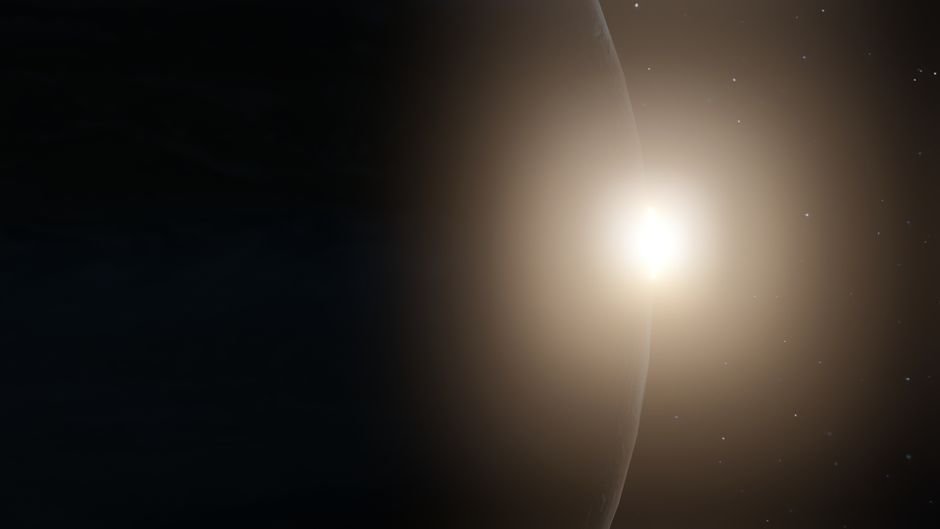
Astronomers have, for the first time, detected a heavy water molecule in the atmosphere of an exoplanet, opening a new window into how distant worlds form and evolve.
Using the James Webb Space Telescope to observe the hot Jupiter WASP-39b, a team led by researchers at LMU Munich identified the deuterated water isotopologue HDO, in which one of the hydrogen atoms is replaced by the heavier isotope deuterium. The result was published on arXiv on July 21.
Water’s Fingerprint
HDO is a rare variant of ordinary water, and its abundance relative to normal water encodes information about where a planet’s water came from and what processes have shaped it. In the solar system, the deuterium-to-hydrogen ratio varies dramatically: Earth’s oceans sit at about 1.6 x 10^-4, Jupiter and Saturn are lower still, while comets and asteroids show higher ratios that trace back to the conditions in the early solar nebula.
On WASP-39b, the team measured a D/H ratio in water of 4.0 x 10^-3, approximately 25 times higher than Earth’s oceans and significantly above all the solar system gas giants. The value overlaps with ratios measured in some protostellar environments and inner solar system bodies.
What It Means
The elevated ratio could reflect either of two scenarios, or a combination of both. WASP-39b may have accreted deuterium-enriched ices and rocks from beyond its system’s snow line during formation, material that later became mixed into its observable atmosphere. Alternatively, ongoing atmospheric processes including vertical transport, photochemistry, and hydrogen escape may have concentrated deuterium in the upper layers that JWST observes.
“This is the first isotopic ratio measurement for water in an exoplanet atmosphere,” the team wrote. The detection demonstrates that JWST has the sensitivity to identify rare isotopologues, subtle chemical variants of common molecules that carry the imprint of a planet’s formation history.
WASP-39b, a hot Jupiter about 700 light-years from Earth, has become something of a benchmark world for exoplanet atmospheric science. JWST previously detected carbon dioxide, sulfur dioxide, and other molecules in its atmosphere. The HDO detection adds a new dimension to what has become the most thoroughly characterized exoplanet beyond the solar system.