

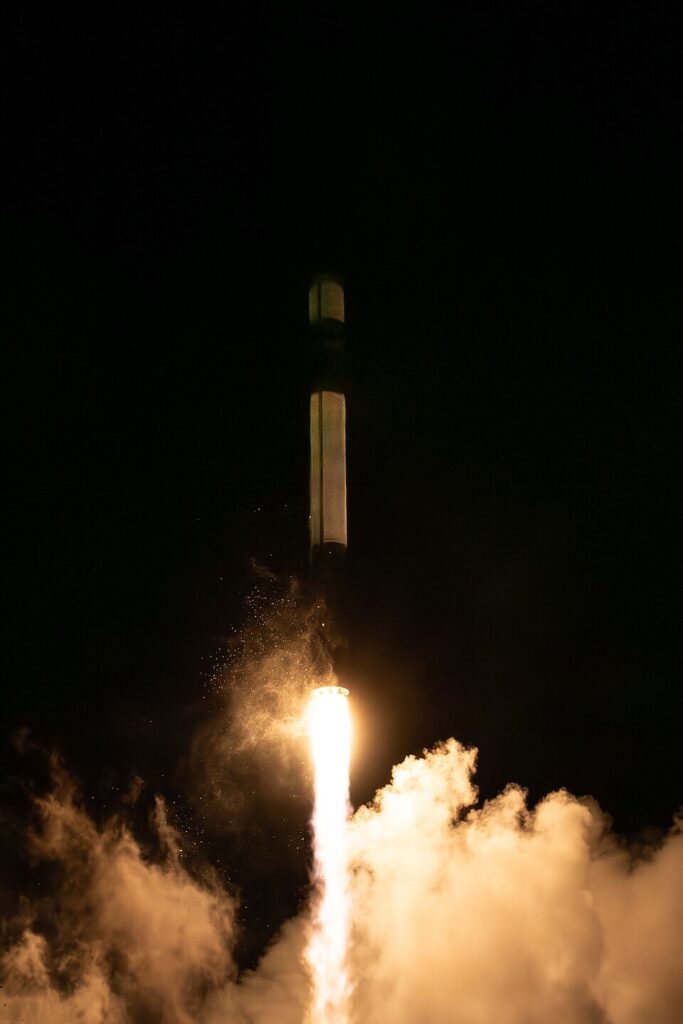
Rocket Lab quietly launched a small satellite from New Zealand on Friday in a high-flying military exercise to test the US Space Force’s ability to rapidly respond to a crisis in low-Earth orbit — and in doing so shattered the record for the fastest responsive space mission ever flown.
The launch was scarcely announced in advance. The only public indication of an impending launch was a warning for pilots and sailors to steer clear of the rocket’s flight path. Rocket Lab did not provide a livestream, as it does for most of its missions. As of Monday morning, officials from Rocket Lab and the Space Force had not acknowledged the launch in any official public statements.
But the US military’s catalog of space objects was updated over the weekend to reflect the launch. A new satellite, designated Victus Haze Puma, appeared in the catalog with a launch date of Friday from Rocket Lab’s privately run spaceport at Mahia Peninsula in New Zealand. The Space Force cataloged the spacecraft in a polar orbit ranging between 347 and 461 kilometers (215 to 286 miles), with an inclination of about 97.5 degrees from the equator.
The mission, called Victus Haze, is part of the Space Force’s broader Tactically Responsive Space (TacRS) program, overseen by the Space Safari program office under Space Systems Command. Rocket Lab launched the satellite just 16 hours and 42 minutes after receiving the call-up order from the Space Force — the fastest responsive space mission on record, beating the previous TacRS record set by the Victus Nox mission in 2023, when Firefly Aerospace launched a Millennium Space Systems satellite within 27 hours of call-up.
Rocket Lab’s Electron rocket lifted off from Launch Complex 1 at 10:20 UTC (6:20 a.m. EDT) on June 19, carrying the company’s own Pioneer spacecraft. Unique to this TacRS mission, Rocket Lab both built the spacecraft and conducted the launch, serving as a single prime contractor for the entire mission package — spacecraft design, launch, and on-orbit operations.
The Space Force announced plans for the Victus Haze mission in 2024 when it selected Rocket Lab and True Anomaly to build and launch two satellites into low-Earth orbit under contracts totaling about $32 million for Rocket Lab. At a high level, the concept called for launching a small satellite built by True Anomaly first, posing as a satellite from a potential adversary. Rocket Lab was to have a satellite on standby, ready to go up and inspect True Anomaly’s spacecraft on short notice once military officials gave the order.
That is apparently what happened last week. Rocket Lab had another launch on its schedule for a commercial customer, but the company announced a postponement last Tuesday “to conduct additional checkouts,” without offering additional details. Safety notices began to appear on aviation and maritime websites a couple of days later, just hours before the launch window for Victus Haze opened on Friday.
The launch time was set to coincide with the passage of the orbit of one of True Anomaly’s satellites over New Zealand. True Anomaly’s Jackal-0004 satellite launched from California on May 3 on a SpaceX Falcon 9 rideshare mission — a last-minute pivot after Firefly Aerospace’s Alpha rocket was grounded for nearly a year following two mishaps in 2025.
Publicly available orbit data indicated Rocket Lab’s Victus Haze Puma satellite approached within 100 kilometers (60 miles) of the Jackal satellite just eight hours after launch, according to Jonathan McDowell, an astrophysicist who tracks space activity using open-source data.
The Victus Haze mission will unfold with additional maneuvers to bring Rocket Lab’s Puma satellite closer to True Anomaly’s Jackal. Eventually, the satellites are expected to switch roles, with Jackal serving as the inspector and Puma acting as the target. The tests include tracking other objects in space using narrow- and wide-field cameras, validating moving-object detection and tracking algorithms, and confirming the ability to execute closed-loop tracking of maneuvering targets during simultaneous vehicle maneuvers.
“This demonstration will ultimately prepare the United States Space Force to provide future forces to combatant commands to conduct rapid operations in response to adversary on-orbit aggression,” Space Systems Command said in a statement when announcing the Victus Haze mission in 2024.
Col. Bryon McClain, acting portfolio acquisition executive for space combat power, described the mission as a stress test of the entire commercial pipeline. “Adapting to those anomalies is just as good as everything going perfectly,” McClain said.
The total cost of Victus Haze, borne by a mix of government funding and private capital, totaled about $92 million. The mission follows the Space Force’s successful Victus Nox responsive space mission in 2023 and the more recent Victus Diem exercise earlier in 2026, which involved Lockheed Martin and Firefly Aerospace.
Space Force officials have long pursued responsive launch initiatives to cut the time required for fielding new satellites from years to weeks, days, or hours. Three additional Victus missions are planned through 2027 as the service moves toward operational, rather than experimental, responsive space capability.
For Rocket Lab, the mission validates the company’s strategy of vertical integration as a competitive advantage in the responsive space market. The company’s ability to launch from two pads in New Zealand and its in-house spacecraft manufacturing give it a structural edge over rivals that rely on third-party suppliers. Rocket Lab previously demonstrated rapid launch capability in 2024 by launching two Electron missions from two hemispheres within 24 hours.
As the TacRS program matures, public visibility into these missions is expected to diminish. “We’re learning publicly, just to emphasize the capability that’s out there,” McClain said. “But like all of our continuous operational systems, once we start getting into an operational case, it’ll probably get a lot more quiet.”