

Published: June 02, 2026, 23:39 UTC
A Shot Across the Bow — The Sixth Ship
The US fires a Hellfire missile into an unladen tanker heading for Kharg Island. The blockade of Iran is winning tactically. Strategically, the question is whether it breaks Tehran or hardens it.
The warnings came for twenty-four hours. A Botswana-flagged tanker called the M/T Lexie, carrying no cargo, was steaming through international waters toward Kharg Island — the rocky speck off Iran’s coast that handles nearly all of the country’s crude oil exports. US aircraft circled overhead. They radioed. They ordered the vessel to change course. They did this multiple times.
The crew kept going.
On June 2, an American aircraft fired an AGM-114 Hellfire missile into the ship’s engine room. The explosion tore through the machinery. The Lexie stopped dead in the water. It will not reach Kharg Island. It will not reach anywhere under its own power.
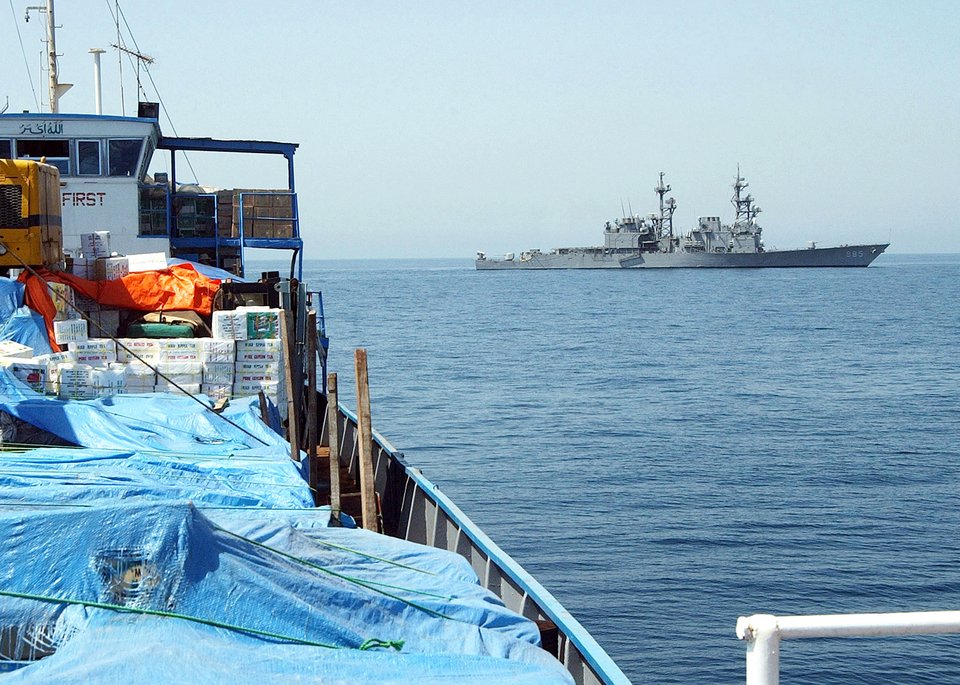
This is the sixth commercial vessel disabled since the United States began enforcing a naval blockade of all maritime traffic entering and exiting Iranian ports on April 13. CENTCOM says 122 other ships have been turned back or redirected. Six were shot. The message is clear: the Strait of Hormuz is closed to anyone doing business with Iran, and the US Navy intends to keep it that way.
The Lexie was empty — no oil, no contraband, no weapons. It was sailing unladen, which is to say it was testing the blockade. The question it was asking was simple: does the blockade actually mean anything, or is it a line drawn on a map with nothing behind it? The Hellfire missile answered that question. The blockade means something. It means a missile through your engine room if you ignore twenty warnings.
The blockade itself began as a consequence of failure. On April 8, a ceasefire between the US and Iran took effect, brokered by Pakistan after weeks of open conflict that began with US and Israeli strikes on Iran on February 28. The ceasefire was supposed to create space for negotiations. Talks were held in Islamabad. They went on for twenty-one hours. They produced nothing. Iran would not abandon its nuclear program on the terms Washington demanded, and Washington would not ease sanctions or lift military pressure on the terms Tehran required. The talks collapsed. On April 12, Trump announced the blockade. On April 13, the US Navy began enforcing it.
The ceasefire, technically, is still in effect. So is the blockade. This is a peculiar kind of peace — one in which the world’s most powerful navy systematically intercepts every vessel attempting to reach an adversary’s coastline, and the adversary watches from shore, unable or unwilling to break the cordon. Iran has not directly challenged the blockade with naval forces. It has not fired on US ships. It has, however, suspended talks with the United States in protest over Israeli operations in Lebanon — operations that have seen Israeli forces capture Beaufort Castle and push deeper into southern Lebanon despite a separate partial ceasefire with Hezbollah.
Trump says talks are continuing. They are not, in any meaningful sense. Iran is not at the table. Pakistan’s mediators are still shuttling between capitals, but the diplomatic channel has gone cold. The Islamabad framework — imperfect as it was — is the only structure that ever held any promise of ending this conflict, and it is now a skeleton.
Which brings us back to Kharg Island.
Kharg Island sits fifteen miles off Iran’s coast in the northern Persian Gulf. It is not much to look at — a flat strip of rock and sand with deepwater berths and a sprawling oil terminal. But it handles roughly ninety per cent of Iran’s crude oil exports. Without Kharg, Iran cannot sell its oil. Without oil revenue, Iran’s economy — already battered by years of sanctions, internal unrest, and the cost of a multi-front war — cannot function.
The blockade is designed to strangle that revenue stream. Every tanker turned back is money Iran does not earn. Every vessel disabled is a signal that the cost of breaking the blockade is not merely inconvenience but destruction. The numbers tell the story: 122 ships diverted, six ships shot, two months of near-total interdiction. The US Navy has, in purely operational terms, shut down Iran’s maritime oil exports.
But there is a difference between shutting down exports and winning a war.
The question no one can answer yet is whether economic strangulation brings Iran to the negotiating table on American terms, or whether it hardens the regime’s conviction that it has nothing to gain from diplomacy. The history of blockades — from the British naval campaign against Napoleonic France to the American embargo against Iraq in the 1990s — offers no easy answer. Sometimes pressure works. Sometimes it produces a siege mentality that makes compromise impossible.
Iran has options, even if its tanker fleet cannot sail. It can retaliate asymmetrically through its proxies in Yemen, Syria, and Lebanon. It can accelerate whatever remains of its nuclear program — and there have been persistent but unconfirmed reports of activity at Fordow and Natanz that suggest Tehran has not abandoned that path. It can wait, betting that American domestic politics will eventually shift, that the military commitment required to sustain a blockade indefinitely will wear down a White House that promised to end wars, not start them.
The ceasefire, such as it is, holds by inertia. Neither side has formally renounced it. Neither side is observing its spirit. The blockade is unilateral American enforcement of a deal Iran never signed. The suspension of talks is Iranian protest over an American ally’s military campaign that operates under a separate but overlapping ceasefire. Every party is technically compliant with some agreement and substantively violating the conditions that made any agreement possible.
There is a particular cruelty to the precision of the strike. A Hellfire missile costs somewhere in the region of a hundred thousand dollars. It was fired from an aircraft that costs tens of millions, operating as part of a carrier strike group that costs billions. It hit a single ship — not a naval vessel, not an armed patrol boat, but an unladen commercial tanker whose crew were merchant mariners, not soldiers. The asymmetry is the point. The technological capacity to disable a specific engine room from the air, after twenty-four hours of warnings, is a demonstration of control so absolute that it borders on performative. The US Navy is not just enforcing a blockade. It is demonstrating that it can reach out, at any moment, and stop any ship it chooses.
The M/T Lexie is now disabled in the Arabian Gulf, its engine room a tangle of shattered metal, its crew likely picked up by US or allied forces, its owners — whoever they turn out to be — facing the practical question of whether to salvage the vessel or write it off. It is the sixth ship. It will not be the last. The blockade continues as long as the ceasefire fails to produce real negotiations, and real negotiations show no sign of resuming.
The Hellfire through the engine room was not an act of war in the technical sense — the ceasefire is still nominally in force, and the blockade is an American policy, not a new declaration of hostilities. But it was a shot across the bow in a broader sense, aimed less at the tanker than at anyone watching from Tehran. The message: this is what happens when you ignore the blockade. The subtext: this is what happens when you refuse to negotiate.
Whether that message lands as deterrence or as provocation is the question the next weeks will answer. The blockade is winning tactically. Strategically, the score is not yet settled.