

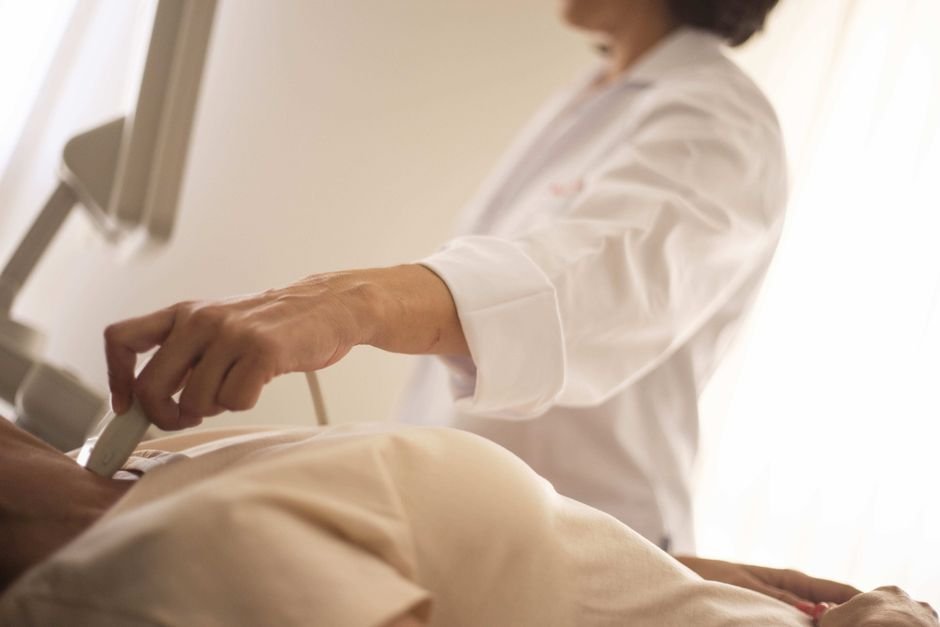
A team from National Taiwan University Hospital has shown that a machine-held ultrasound device can flag moderate to severe obstructive sleep apnea in people who have no idea they have it. In a prospective study of 1,101 adults attending a routine health check-up, the scan identified cases of sleep apnea in individuals with normal body mass indexes, low daytime sleepiness scores, and no snoring complaints. Many of these individuals had what the authors call subclinical OSA: physiological airway collapse severe enough to produce abnormal apnea-hypopnea index scores but mild enough that the person never sought help for it.
What they found
The study recruited participants between May 2020 and November 2022 from the Health Management Center of National Taiwan University Hospital. Each person underwent a standardized submental ultrasound scan using a machine-held transducer guided by a laser beam to align head position. The device, cleared by the U.S. Food and Drug Administration, performed an automated 30-degree sector scan of the retropalatal, oropharyngeal, and retroglossal regions. Software measured the observability of the upper airway and the width of the visible airway lumen during tidal breathing and under the negative pressure of a Mueller maneuver.
Of the 1,101 participants (52% men), the ultrasound classified 323 as high risk, 277 as medium risk, and 501 as low risk for moderate to severe OSA. Among the high-risk group, 97 underwent overnight polysomnography for confirmation. The positive predictive value for any OSA (AHI of 5 or higher) was 94.8%. For moderate to severe OSA (AHI of 15 or higher), the PPV was 72.2%. When the analysis focused on supine AHI, the PPV for supine AHI of 15 or higher reached 82.5%.
A subgroup analysis of the confirmed OSA patients told a more striking story. Among 44 participants with OSA but a BMI below 27, the median AHI was 22.4 and the median supine AHI was 30.9. Nearly half of these non-obese participants had severe OSA. Their oxygen desaturation levels did not differ significantly from the 48 obese participants, meaning the non-obese group was clinically just as compromised. They were, however, older (median 59 vs. 55 years) and had smaller neck circumferences.
Crucially, the entire cohort had low Epworth Sleepiness Scale scores. The mean ESS in the high-risk group was 4.0 plus or minus 4.0, far below the threshold that typically triggers a sleep clinic referral. These were not people complaining of fatigue. They were showing up for a standard annual check-up with no sleep complaint on their mind.
Why it matters
Most screening protocols for sleep apnea rely on obesity and daytime sleepiness as entry criteria. STOP-BANG and the Epworth scale are sensitive but not specific: they catch most cases but also generate many false positives. More importantly, they miss the patient who is thin, well rested, and quietly hypoxic through the night. The present study suggests that subclinical OSA may be more common in the general population than previously assumed, especially in Asian populations where sleep apnea tends to develop at lower BMIs than in Western cohorts.
The ultrasound device adds an anatomical evaluation layer that questionnaires cannot provide. By directly imaging whether the upper airway is observable and how much it narrows under negative pressure, the test provides an objective basis for risk stratification. The authors position the tool as a first-line screening modality that could sit alongside or immediately after questionnaire-based screening in health management centers, flagging individuals who would otherwise be sent home reassured.
Limits
The study enrolled only Asian participants, and the BMI cutoffs used (overweight at 24, obesity at 27) reflect Taiwan’s national health authority definitions. These thresholds differ from World Health Organization standards for White, Hispanic, and Black populations. The medium-risk group was small (only 8 of 277 received PSG), and no low-risk participant underwent confirmatory testing, introducing selection bias. The Mueller maneuver performed in an awake patient is an imperfect proxy for sleep-related airway collapse. The authors also note that the device assesses static anatomy, not the dynamic physiology of nocturnal breathing, and therefore complements rather than replaces polysomnography or drug-induced sleep endoscopy.
Bottom line
Ultrasound-based upper airway screening can detect moderate to severe sleep apnea in asymptomatic, non-obese individuals who standard screening tools would miss. For health management centers that already conduct annual check-ups, adding a five-minute ultrasound scan could identify a hidden population at risk.
Source
Hsieh DL, Tseng PH, Chiu HM, Lee PL, Chen A, Hsu WC. Efficacy of Upper Airway Ultrasonography in Detecting Obstructive Sleep Apnea in the General Population. Respir Med. 2026 Jul 25:109042. DOI: 10.1016/j.rmed.2026.109042. PMID: 42501873.