

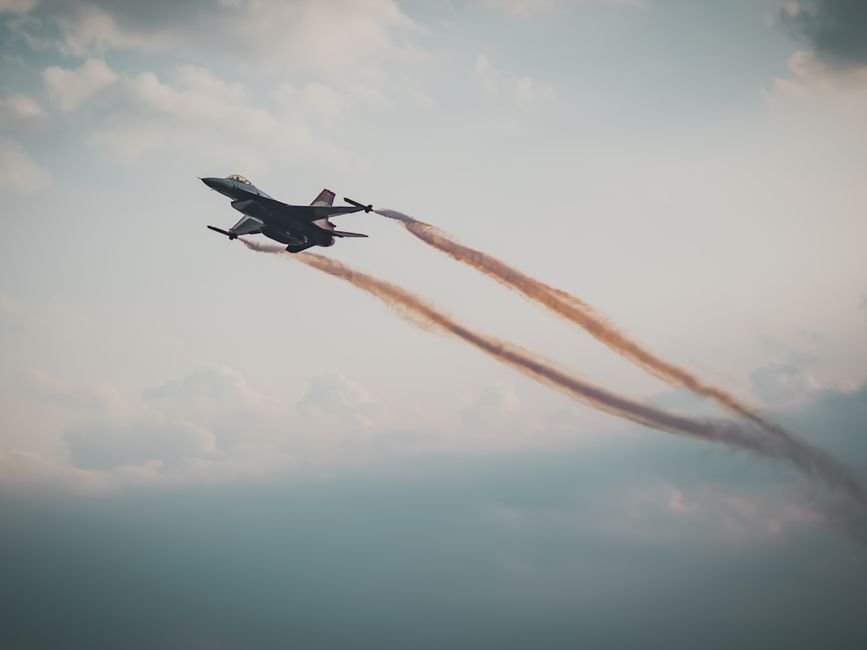
A Ukrainian F-16 has shot down a Russian Su-35 fighter jet in air-to-air combat, the first confirmed aerial victory by a Western-supplied aircraft since they arrived in Ukraine two years ago.
The confirmation came not from Kyiv, but from Washington. General Dan Caine, Chairman of the US Joint Chiefs of Staff, told the Senate Appropriations Committee on July 21 that “a Ukrainian F-16 shot down a Russian fighter” in what he called the first air-to-air engagement of its kind.
“We recently witnessed the first air-to-air engagement in which a Ukrainian F-16 shot down a Russian fighter,” Caine said. “Their ability to scale their layered defense has come a long way over the past couple of years.”
What happened, and when
The engagement took place on July 8, 2026, on the eastern front. The exact location remains classified.
According to the Russian Telegram channel “Fighter-Bomber,” which has ties to frontline Russian Aerospace Forces units and has reliably reported Russian losses before, the Su-35 was drawn into a trap. Three Ukrainian aircraft, two F-16s and a third unidentified plane, were involved, operating in coordination with a Patriot air defense battery.
The Russian Su-35 pilot, flying alone, attempted to intercept what appeared to be a Ukrainian aircraft simulating a glide-bomb attack. Instead, he flew into a kill box. The F-16s, flying at very low altitude to stay below Russian radar coverage, engaged with what is believed to have been an AIM-120 AMRAAM missile.
Fighter-Bomber acknowledged the loss, unusual for a channel that usually celebrates Russian successes, and suggested the Russian pilot survived and was rescued. Drone footage later posted by open-source intelligence accounts showed the Su-35’s wreckage on the ground, the airframe clearly identifiable.
Why this matters
Until now, Ukrainian F-16s were used almost exclusively for air defense, intercepting Shahed drones and cruise missiles, and for stand-off ground strikes. They operated under tight restrictions, partly because of the risk of losing a valuable asset, partly because Russian air defenses made the airspace over the front line extremely dangerous.
This kill changes that calculation.
The Su-35 is Russia’s most advanced operational fighter, a fourth-generation-plus airframe with supermaneuverability and a powerful radar. It has been the Russian air force’s primary swing-role asset, conducting both air-to-air and suppression-of-air-defense missions. Losing one to a Ukrainian F-16, a 1980s American design flown by a pilot trained in France and operating with NATO-standard missiles, is an embarrassment for Moscow and a morale boost for Kyiv.
It also validates the tactical concept Ukraine has been developing: using low-altitude F-16s in conjunction with ground-based air defense to create engagement zones that Russian pilots cannot safely enter. The Patriot battery, according to reports, provided the radar picture while the F-16s executed the shoot.
The long road to this moment
Ukraine spent nearly two years lobbying for F-16s before the first aircraft arrived in August 2024, supplied by Belgium, Denmark, the Netherlands, and Norway. Pilots trained in the United States and Europe, including in France. The aircraft themselves are older models, most built between 1982 and 1990 and upgraded between 2000 and 2015, but they carry modern weapons: AIM-120 AMRAAM radar-guided missiles, AIM-9X and IRIS-T infrared missiles, and precision munitions for ground attack.
Ukraine is expected to receive roughly 100 F-16s in total. Each one has been painstakingly repaired, modernized, and delivered in batches. This kill is the first return on that investment.
The Russian version
Russian propaganda channels initially claimed the Su-35 was shot down by a Patriot battery, not an F-16. The logic was strategic: losing a Su-35 to a surface-to-air missile is bad but understandable; losing one to a Ukrainian-flown F-16 in a dogfight is a different category of failure entirely. Caine’s Senate testimony directly contradicts that narrative.
Fighter-Bomber’s own account supports the F-16 version. The channel described a coordinated ambush in which the Russian pilot “acted in a predictable manner” while the Ukrainians did not, adding that “our fighter jet was hesitant to engage two F-16s on its own.”
“Everyone is alive and well,” the channel concluded. “‘Kanatovo’ will face consequences”, a reference to the pilot’s home base, suggesting command action is expected.
What comes next
One kill does not transform the air war. Russia still has a quantitative advantage in combat aircraft and operates surface-to-air missile systems that keep Ukrainian fighters from operating freely. The F-16 fleet is small, and missile stocks, particularly AIM-120 AMRAAMs, are limited.
But the psychological and tactical barrier has been broken. Russian pilots who previously considered the airspace over eastern Ukraine their domain now know there is something on the other side that can kill them.