

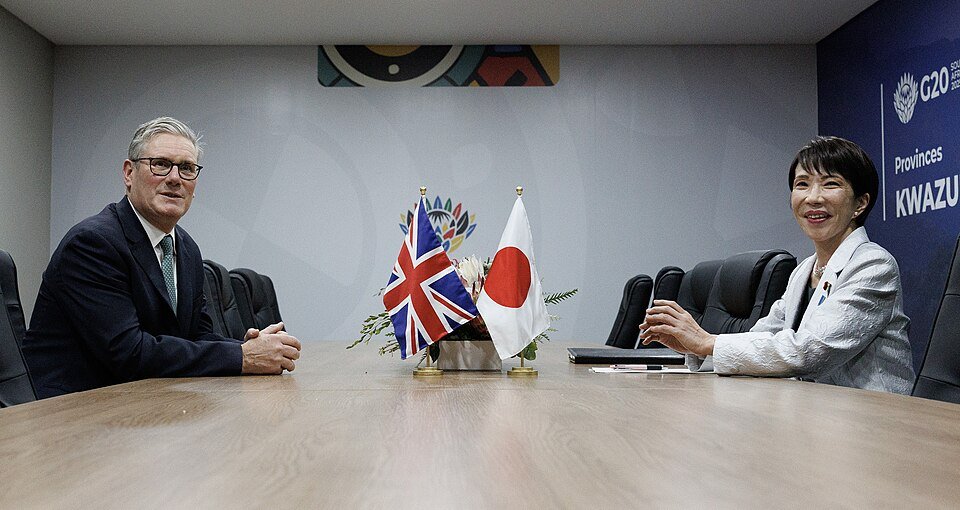
London and Tokyo lock in a record £18 billion ($24 billion) package anchoring Japan deeper into Britain’s post-Brexit economic architecture and reinforcing a shared bet on the Indo-Pacific as the world’s defining strategic theater.
British Prime Minister Keir Starmer hosted Japanese Prime Minister Sanae Takaichi in London on June 13-14 for a summit that produced the largest bilateral investment deal in UK history. The agreement, valued at £18 billion ($24 billion), spans clean energy, frontier technology, defense, and civil nuclear cooperation, marking the most concrete expression yet of the UK’s post-Brexit pivot toward the Indo-Pacific.
“This is about building a new era of cooperation between two of the world’s most innovative economies,” Starmer said at a joint press conference with Takaichi. “It will create tens of thousands of high-skilled jobs across the United Kingdom and deepen the ties that keep our people safe and prosperous.”
Floating offshore wind dominates the headline number. Up to £9 billion of the total is earmarked for 5.9 gigawatts of floating offshore wind capacity in UK waters, enough to power an estimated 8 million British homes. The projects will be led by a consortium of Japanese energy giants including JERA, Mitsubishi Corporation, and Sumitomo Corporation, paired with British developers. Floating wind technology, still nascent at commercial scale, allows turbines to be sited in deeper waters off the UK’s northern and western coasts where fixed-bottom foundations are infeasible. The UK government has set a target of 50 GW of offshore wind by 2030, and Japanese capital and engineering expertise are now central to reaching it.
The UK-Japan Frontier Tech Partnership is the strategic centerpiece of the deal. The two governments committed to joint programs in artificial intelligence, quantum computing, civil nuclear power, and defense innovation. On nuclear, the agreement includes cooperation on small modular reactors (SMRs) and advanced nuclear fuels, with Japanese firms expected to invest in British nuclear sites being developed by Rolls-Royce SMR and other UK entities. In AI and quantum, the partnership establishes a joint research fund, reciprocal access to national supercomputing facilities, and shared standards for AI safety and governance.
Defense cooperation received a significant upgrade. The two countries agreed to expand joint research under the Global Combat Air Program (GCAP), the trilateral Tempest fighter jet project that also includes Italy. A new defense innovation accord will streamline technology transfers, co-development of undersea warfare capabilities, and joint cyber defense exercises. Britain and Japan already signed a Reciprocal Access Agreement in 2023 that allows mutual deployment of armed forces, and the new investment layer adds industrial depth to that military framework.
Economic and geopolitical logic. For the UK, the deal is a tangible deliverable of Starmer’s promised “reset” with global partners after the turbulence of Brexit. Britain has been systematically rebuilding trade and investment ties outside the European Union, and Japan is its most important Asian economic partner outside China. The deal also bolsters the UK’s application to join the Comprehensive and Progressive Agreement for Trans-Pacific Partnership (CPTPP), which London formally acceded to in late 2024. Close economic alignment with Japan signals that Britain is serious about being a rule-setting power in the Indo-Pacific, not just a free-rider on US security guarantees.
For Japan, the calculus is equally strategic. Prime Minister Takaichi’s government is pursuing a policy of “economic security through diversification,” reducing reliance on China for supply chains and energy technology while strengthening ties with like-minded democracies. The UK offers Japan a gateway to European markets, access to world-class research universities, and a reliable partner in a G7 framework that Tokyo worries is fraying under geopolitical strain. Japan is also hedging against uncertainty in the US alliance, deepening ties with other major economies regardless of the outcome of the 2026 US midterm elections.
Jobs and domestic politics. Starmer’s government has framed the deal as a direct creator of “tens of thousands” of UK jobs, concentrated in Scotland (offshore wind manufacturing and installation), the North East of England (advanced manufacturing and nuclear), and the South East (AI and quantum research). The Treasury projects the wind component alone will sustain 8,000 direct jobs and 15,000 in the supply chain. Union leaders have broadly welcomed the deal, though some have called for guarantees on domestic content and worker protections.
Takaichi, for her part, faces a domestic audience wary of capital outflows. She argued that Japanese companies gain preferential access to British energy markets and a regulatory environment designed to fast-track major infrastructure projects. “This is not a one-way street,” she said. “Japanese firms will be competitive and profitable in the UK, and the ties we build here will strengthen our own energy security and technological edge at home.”
Broader G7 context. The deal comes as the G7 struggles to present a unified front on trade, climate finance, and technology governance. The UK-Japan bilateral offers a template for minilateral cooperation within the club: narrower, deeper, and more transactional than G7-wide frameworks, but potentially more durable. It also reflects a broader realignment in which middle and major powers are building “strategic autonomy” through targeted partnerships rather than relying on multilateral institutions that have struggled to deliver.
The £18 billion figure, while substantial, is phased over 10 to 15 years and subject to commercial negotiations. But the political signal is immediate. Britain and Japan, two island democracies on opposite sides of the world, are tying their economic futures together with increasing urgency as the liberal international order faces its most serious tests since 1945.