

Britain has begun subsidizing air conditioning without calling it that. Since April, homeowners in England and Wales can claim 2,500 pounds toward a reversible air-air heat pump, a machine that warms a home in winter and cools it in summer. It is, in all but name, the country’s first cooling subsidy, yet it is badged as a heat pump, worth only a third of the 7,500 pounds available for a heating-only model, and closed to social housing and new builds. In its first month, roughly 45 households claimed it, against thousands for the heating version. The exclusion matters because of where the heat lands: the most deprived neighborhoods are more than seven times as likely as the wealthiest to be badly exposed to extreme temperatures, and the people who live in them are precisely the ones the grant cannot reach.
The stakes were set by the summer just passed. During the May heatwave, a national record for the month fell in west London at 35.1 C (95 F), a benchmark that had stood since 1944. In June, temperatures reached 37 C (99 F) in East Anglia, breaking a June record from 1976, and the UK Health Security Agency issued its second-ever red heat-health alert. A rapid attribution analysis by Imperial College London, the Met Office, and the London School of Hygiene and Tropical Medicine estimates that more than 2,700 people died from heat-related causes across the two events in England and Wales, and that roughly 42 percent of those deaths would not have occurred without the extra warming caused by human activity. Daytime maxima are now about 3 to 4 C (5 to 7 F) hotter than in a world without climate change. Tellingly, the Midlands recorded a similar death rate per million people as the hotter south, evidence that populations least accustomed to dangerous heat are disproportionately vulnerable. People over 85 account for about 60 percent of heat deaths. Meanwhile, only about 5 percent of English homes have any cooling unit at all.
The housing stock explains part of the exposure. British homes were built to trap warmth: solid brick walls absorb heat by day and radiate it back into rooms that never fully cool, and the urban heat island keeps city centers up to 7 C (13 F) warmer at night than the surrounding countryside, exactly when bodies need cool air most. Researchers at the University of Birmingham estimated that the heat island effect alone accounted for roughly half of 130 heat-related deaths in a previous West Midlands heatwave. At the top of the exposure gradient sit flats like the one Keisha occupies in Woolwich, south London, where indoor temperatures reached 43 C (109 F) during a heatwave. She and about twenty neighbors are taking their landlord to court over homes they consider unfit to live in. As a social tenant, Keisha is barred from the state’s new cooling grant, even though her flat is a case study for what the grant was nominally designed to address.
The policy’s namelessness is not an accident. For years, official guidance held that passive cooling, shade, ventilation and good design should come first and mechanical cooling second. Some London councils, following a planning hierarchy that prioritizes low-energy measures, have in a handful of cases ordered property owners to remove air conditioners, drawing accusations of miserabilism from opposition politicians. But this summer the Climate Change Committee, the government’s statutory adviser, reversed course. Its report A Well-Adapted UK, published in May as the first heatwave struck, identifies cooling as one of the country’s highest adaptation priorities and recommends installing air conditioning in hospitals and care homes within ten years and in schools within twenty-five. The government has not yet responded, and the House of Commons Library notes there is still no single overarching plan for adapting to heatwaves, though a national cooling plan is expected by the end of the year.
The asymmetry runs deeper than the subsidy. Under the Climate Change Act, the mitigation half of the committee’s work issues legally binding carbon budgets that ministers must meet and that are scored every year. Adaptation has no such teeth: the government writes its own risk assessments and its own plans, and the committee’s job is to check whether the government did what its own essay said it would do, not whether the actions were any good. Julia King, the engineer who chairs the adaptation committee, has described nearly twenty years of frustration with this arrangement. Her committee’s modeling found that cooling support for the 30 percent most vulnerable homes, together with air conditioning in hospitals and preventive care visits, would cut 40 percent of the increase in heat-related deaths predicted for 2050. The imbalance is global too: in 2023, roughly 1.8 trillion dollars went to cutting emissions worldwide while adaptation received about 65 billion, less than 5 percent of that sum.
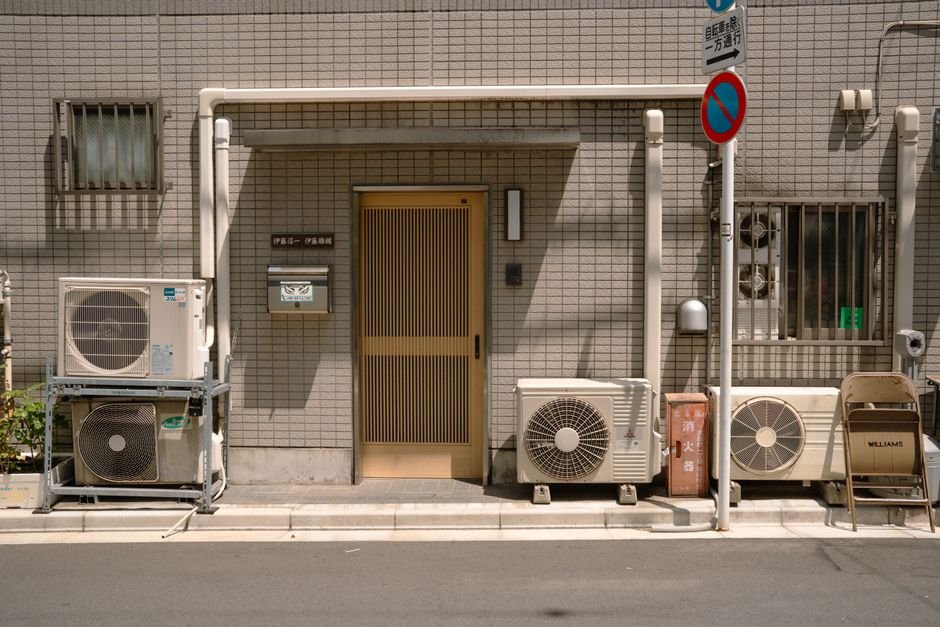
There is a physics to the divide as well as a policy. Air conditioning does not destroy heat; it moves it, out of the flat and into the street, where it warms the air neighbors breathe and drives up demand for still more cooling. In studies of Sydney, Mat Santamouris of the University of New South Wales, the world’s most-cited researcher on urban overheating, found this feedback raises neighborhood cooling demand by about a third. In Tokyo, the waste heat from air conditioners is so dense that it reaches close to 1,000 watts per square meter, roughly the energy of midday sun, a phenomenon he describes as another sun over the city. The machines also hit the grid at its weakest hour: cooling demand peaks on still, hot evenings, just as wind drops and solar fades, and gas turbines lose output as the air warms. Several UK plants had to be turned down during June’s heatwave.
The people at the sharp end are not waiting for the policy to catch up. Mandy Bourne, who has chronic obstructive pulmonary disease and lives with her 80-year-old mother in a top-floor social housing flat in the West Midlands, says the heat leaves her reaching for her inhaler. Last summer her housing association improvised: it closed off a community room, installed a mobile air-conditioning unit, and turned it into a cool space for elderly residents, a summer mirror of the warm rooms opened during the pandemic. Mandy wants the same machine in her own flat. The evidence suggests that is the right instinct, and that it should be available to everyone: passive measures first, reflective roofs and ceiling fans, machines where they are genuinely needed, and clean power behind them, the lesson Europe drew from the deadly French heatwave of 2003, when the vulnerable were left to improvise. Britain is finally cooling its homes. The question is whether the policy will follow the exposure or the market.
References
Matt McGrath and Esme Stallard, How the UK’s extreme heat is shifting the conversation about air-con. BBC News InDepth, 30 July 2026.
Grantham Institute, Imperial College London, UK climate heat health risks: May and June 2026. July 2026.
Climate Change Committee, A Well-Adapted UK (2026).
House of Commons Library, Is the UK prepared for heatwaves? Research briefing, 10 July 2026.