

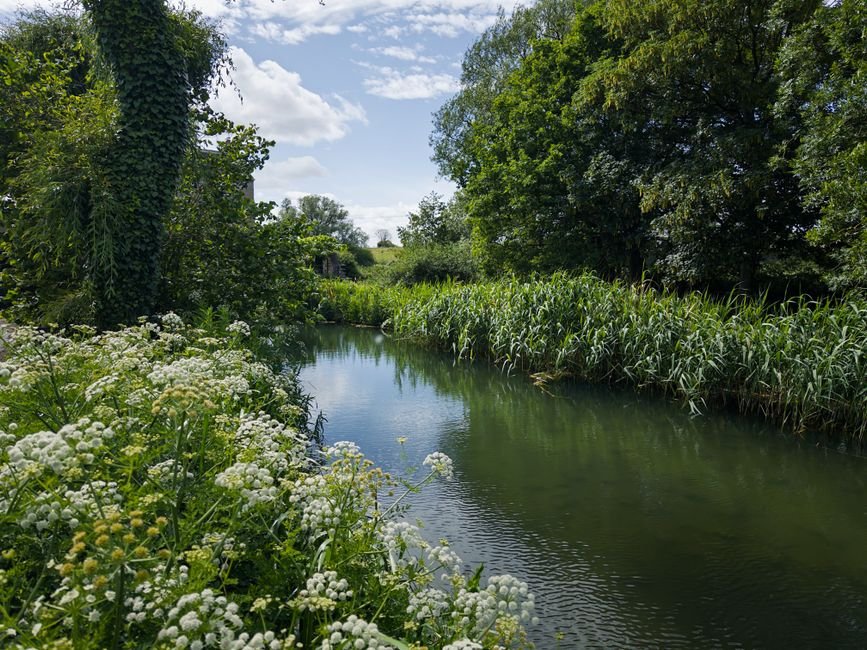
The Fight to Save the UK’s Rare Chalk Streams, Among the Rarest Ecosystems on Earth
There are roughly 200 chalk streams in the world. Of those, about 160 are in England. The rest are spread across northern Europe. There is nothing else quite like them. Fed by groundwater that has been filtered through chalk aquifers over decades, these streams emerge at a constant temperature, with crystal-clear, alkaline water that supports a web of life found nowhere else on the planet.
But despite their clarity, many of the UK’s chalk streams are in poor ecological health. Pollution from agriculture, water abstraction, and the pressures of adjacent land use have taken a quiet toll. Now, a series of conservation projects across southern England, from Wiltshire’s River Wylye and River Ebble to the headwaters of the Hampshire Avon, are fighting to reverse that decline.
An Ecosystem Like No Other
Chalk streams are defined by their geology. Rainwater percolates through porous chalk, the compressed remains of ancient marine organisms, and emerges as clean, alkaline spring water that stays at roughly 10 degrees Celsius year-round. This stable temperature and chemistry create ideal conditions for plants and animals that cannot survive in warmer, murkier waters.
The signature plant of healthy chalk streams is water crowfoot, or Ranunculus, which spreads across the riverbed in flowing green ribbons. Brown trout, Atlantic salmon, otters, and water voles depend on these streams for spawning and feeding. The streams also support abundant insect life, including the rare southern damselfly.
“They support very unique biodiversity,” said Alice Eley, water team manager at the Wiltshire Wildlife Trust. “But they react very strongly to pollution. A small water quality change can have a devastating impact.”
Projects on the Ground
In Wiltshire, the Wylye Chalk Stream Project brings together farmers, the Wessex Rivers Trust, and the Wiltshire Wildlife Trust in what Eley described as an unprecedented collaboration. The project, funded by the government’s Landscape Recovery scheme, aims to return stretches of the River Wylye to a more natural course, replacing straightened, deepened channels with meandering sections that vary in depth, flow speed, and substrate.
Farmer Josh Stratton, who is participating in the project, put it plainly: “My tonnes per hectare of water voles will be increasing, not my tonnes per hectare of wheat.”
Further south, the Crystal Clear Ebble project, a five-year effort that recently concluded, worked with landowners along the River Ebble to open up the waterway, introduce beneficial plant species, and improve water quality. Small grants enabled projects like rebuilding riverbanks with coir matting, replanting marginal vegetation, and thinning tree canopy to let in more light.
Simon Allsebrook, one of the participating landowners, described the results: “There are more birds. There are more animals around. You notice the huge improvement.”
The projects also protect a centuries-old industry: watercress farming. Keith Hitchings, whose family has run Chalke Valley Watercress for more than 140 years, explained that the natural spring water rising through the chalk provides the perfect conditions for the crop. “The nutrients are actually naturally in the chalk, which is carried into the water. The quality is absolutely fantastic.”
A Global Responsibility
The global rarity of chalk streams places a disproportionate responsibility on the UK. With 85 percent of the world’s total, the country is both the custodian and the last chance for these ecosystems. The challenges are not small: agricultural runoff containing fertilizers and silt, over-abstraction of groundwater, and the encroachment of development all threaten the delicate balance that keeps chalk streams healthy.
But the conservation projects now underway offer a model for how to address these pressures at scale, by bringing farmers, conservationists, and government funding together around a shared goal. The Wylye project is one of 34 schemes funded by the Landscape Recovery program, and its early results suggest that giving rivers space to move, flood, and meander can restore ecological health even in heavily managed landscapes.
“Farmers are almost the lifeblood of the river, all of our rivers go through farmland,” Eley said. “We want farmers to give rivers space, to grow, move, flood out, to do all the things a natural river should do.”
Sources
[1] “Fight to save rare ecosystem of chalk streams.” BBC News, 20 July 2026. https://www.bbc.co.uk/news/videos/c05qgmgq28qo
[2] “Wiltshire scheme aims to protect unique chalk streams.” BBC News, 3 March 2024. https://www.bbc.co.uk/news/uk-england-wiltshire-68415043
[3] Marks, S. “Chalk stream conservation hailed a success.” BBC News, 15 July 2025. https://www.bbc.co.uk/news/articles/c3en2l0jd0yo