

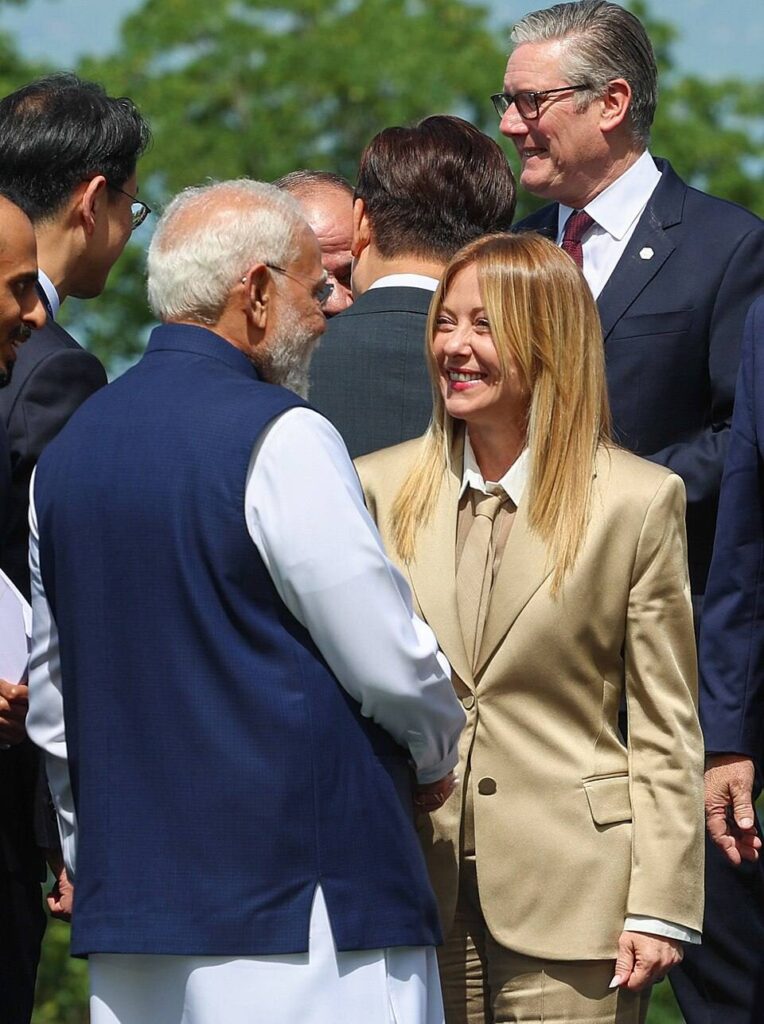
The G7 friendship that seemed to promise so much has shattered in spectacular fashion, with Donald Trump and Giorgia Meloni trading bitter accusations over a disputed photo that has now triggered a full-blown diplomatic crisis between Washington and Rome.
What began as an offhand remark by President Trump to an Italian broadcaster has spiraled into the most serious rupture in U.S.-Italy relations in years. At the center of it: a photograph taken at the G7 summit in Evian, France, and two wildly different accounts of how it came to be taken.
Trump told La7 television that Meloni “begged” him for the picture and that he agreed only because he “felt sorry for her.” The Italian prime minister did not let the claim stand. She called it “completely fabricated” and said she was “frankly stunned” by the president’s choice to attack a fellow ally in such terms.
Rather than de-escalate, Trump doubled down. From the Camp David presidential retreat on Saturday, he posted on Truth Social that Meloni had asked “over and over” for a photograph during the summit. He then broadened the attack, reviving long-standing grievances over NATO burden-sharing and Italy’s refusal to support U.S. military operations during the Iran war.
“She is doing poorly in Italy with her level of popularity, possibly because she turned down the United States of America, a Country that truly loves and protects Italy, when it came to denying Iran from obtaining or developing a Nuclear Weapon,” Trump wrote, misspelling Meloni’s first name in his initial post.
He accused her of refusing to allow the U.S. to use Italian landing strips and runways during the conflict, a reference to Italy’s decision in March to deny American bombers headed for the Middle East access to a base in Sicily without parliamentary approval. Trump claimed she now “wants to be friends again” after the U.S. reached a deal with Iran, only to boost her domestic polling numbers. “No thanks!!!” he wrote.
Meloni fired back on Instagram. She called Trump’s attacks “constant, unprovoked” and “senseless.” In a pointed rejoinder, she wrote: “Being your friend certainly has not helped it, nor does it depend on my relationship with you. My popularity depends on my ability to defend Italy’s national interest, and that is exactly what I have always done.”
She added a sharper barb: “In any case, my popularity is none of your concern. I suggest you focus on yours.”
The Italian leader also accused Trump of showing more deference to adversaries than to allies. In an earlier video posted on X, she said: “I don’t know why the president of the United States behaves this way with his own allies. It’s a pity he doesn’t show the same determination with enemies of the West, with enemies of the United States, with leaders with whom, instead, he is far more accommodating.”
The diplomatic fallout was immediate. Italian Foreign Minister Antonio Tajani canceled a planned trip to Miami for a business conference with U.S. Secretary of State Marco Rubio. The State Department confirmed the cancellation. Tajani said Trump’s words “offend all of Italy.” Justice Minister Carlo Nordio called the remarks a “painful injury” to bilateral ties, and Defense Minister Guido Crosetto said such “jokes do not benefit anyone.”
The rupture is especially striking because Meloni had positioned herself as one of Trump’s most natural partners in Europe. As the leader of the far-right Brothers of Italy party, she shares much of his ideological orientation on nationalism, immigration, and traditional values. She invested heavily in personal diplomacy with Trump, visiting the White House in April 2025 and cultivating the relationship as a bridge between Washington and a skeptical European continent.
But tensions have been building for months. In April, Trump criticized Pope Leo XIV for his anti-war stance on Iran, and Meloni defended the pontiff. Trump then accused her of failing to help the United States through NATO. At the G7 summit, Meloni described the atmosphere as “very positive” with “no friction,” acknowledging only that she and Trump both have “quite strong characters.” The pair were seen together several times, including during a sofa-side conversation after which Trump appeared to pat her shoulder.
Saturday’s exchange has changed the calculus entirely. For the first time, a European leader who aligned herself with Trump has been publicly humiliated by him, and her government has responded with unified outrage rather than diplomatic silence. Meloni said Saturday would be her last public comment on the matter, but the damage to the relationship may take far longer to repair.
The episode also underscores a broader pattern. Trump’s transactional approach to alliances has increasingly unsettled European partners already rattled by his handling of the war in Ukraine and his demands for greater NATO spending. If a leader as ideologically aligned as Meloni cannot maintain a working relationship with this White House, European capitals will have to ask themselves hard questions about what partnership with Washington now means.