

The Fleeting Laboratory: New Paper Offers Comprehensive Guide for Total Solar Eclipse Science
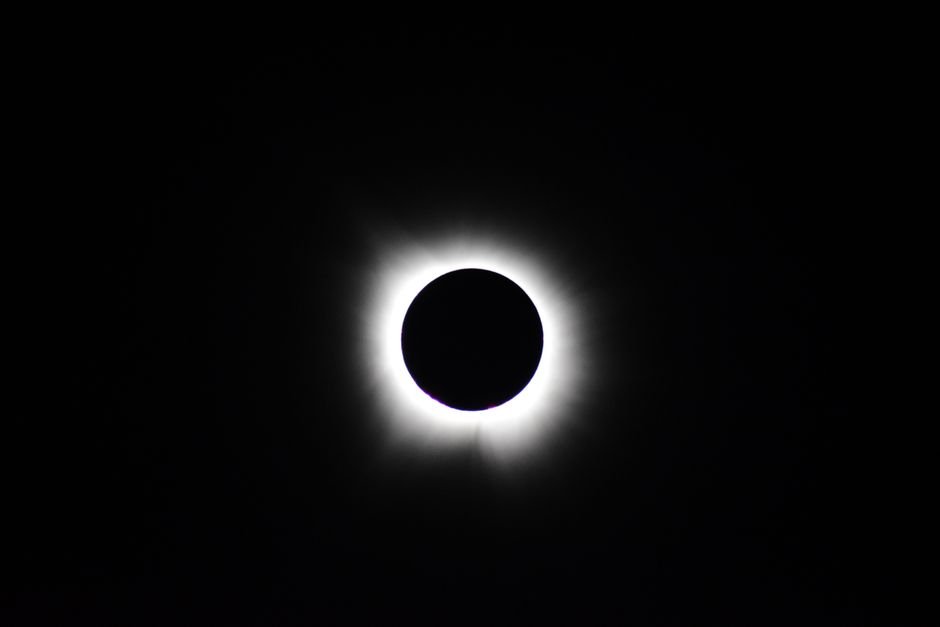
Featured image: [Composite image of the solar corona during the April 8, 2024 total solar eclipse showing intricate coronal streamers; credit: Suprit Singh/IIT Delhi]
A new paper published on arXiv offers what may be the most comprehensive practical guide yet written for conducting scientific experiments during total solar eclipses. Titled “The Fleeting Laboratory: An Experimental Guide for Total Solar Eclipses,” the work by Suprit Singh of the Indian Institute of Technology Delhi and Bharti Arora of the Jaypee Institute of Information Technology covers everything from equipment selection and observation planning to eight distinct avenues of scientific inquiry.
The paper argues that despite the existence of space-based solar observatories such as SOHO and the Solar Dynamics Observatory, total solar eclipses remain scientifically indispensable. Space coronagraphs use internal occulters that block the inner corona within approximately 1.5 solar radii, missing the critical region closest to the solar limb. The Moon, acting as a natural occulter at a vast distance, produces virtually no scattered light and grants access to this otherwise hidden territory.
“It is exciting times for eclipse-based experiments,” the authors write, noting that modern CMOS sensors have given consumer-grade mirrorless cameras scientific-grade capability, dramatically lowering the barrier to entry for high-quality eclipse science.
Eight Science Goals
The paper details eight major research objectives that eclipse observations can address. These include testing general relativity through precise measurements of gravitational starlight deflection, detecting fine-scale coronal dynamics at millisecond temporal resolution, understanding the coronal heating mystery through spectroscopic Doppler measurements, and mapping the three-dimensional topology of coronal magnetic loops through polarimetry.
The paper also covers predicting the solar corona through the validation of magnetogram-based computational models, measuring electron number density and magnetic field strength via Thomson-scattered polarized light, tracing emission lines across ultraviolet, visible, and near-infrared wavelengths to differentiate plasma regions by temperature and density, and merging eclipse data with space-based coronagraph observations to create a complete picture of the inner corona.
The Coronal Heating Problem
One of the enduring mysteries of solar physics is why the corona is millions of degrees hotter than the solar surface. Eclipse spectroscopy offers unique access to the critical inner corona where this heating occurs. By measuring Doppler shifts and line broadenings, researchers can identify the energy dissipation mechanisms responsible for heating the corona to 1 to 3 million Kelvin.
Eclipse polarimetry also maps the magnetic field structure that controls solar wind acceleration, distinguishing between the fast and slow solar wind regimes. Understanding this structure is essential for space weather prediction, as coronal mass ejections originate in the same low-corona region.
A Practical Guide for Modern Observers
The paper provides step-by-step guidance on equipment selection, recommending specific cameras such as the Sony A7RV for its high dynamic range and lack of documented artifacts, and modern harmonic-drive mounts for portability and tracking accuracy. It covers pixel scale calculations for achieving optimal resolution, focusing techniques that account for temperature-induced refractive index changes, and a detailed timeline for image acquisition from first contact through totality and beyond.
The authors describe bracketed exposure strategies for high-dynamic-range composite images, dark and flat frame calibration procedures, and specialized equipment for polarimetry and spectroscopy. An extensive accessory checklist includes notebooks, batteries, powered USB hubs, headlamps, and a GPS device for precise timing.
The paper is published under a CC BY 4.0 license on arXiv (ID: 2607.00014). As the next major total solar eclipse approaches, the guide arrives at a timely moment for professional astronomers, students, and advanced amateur observers preparing to make the most of their fleeting minutes of totality.