

By Marie
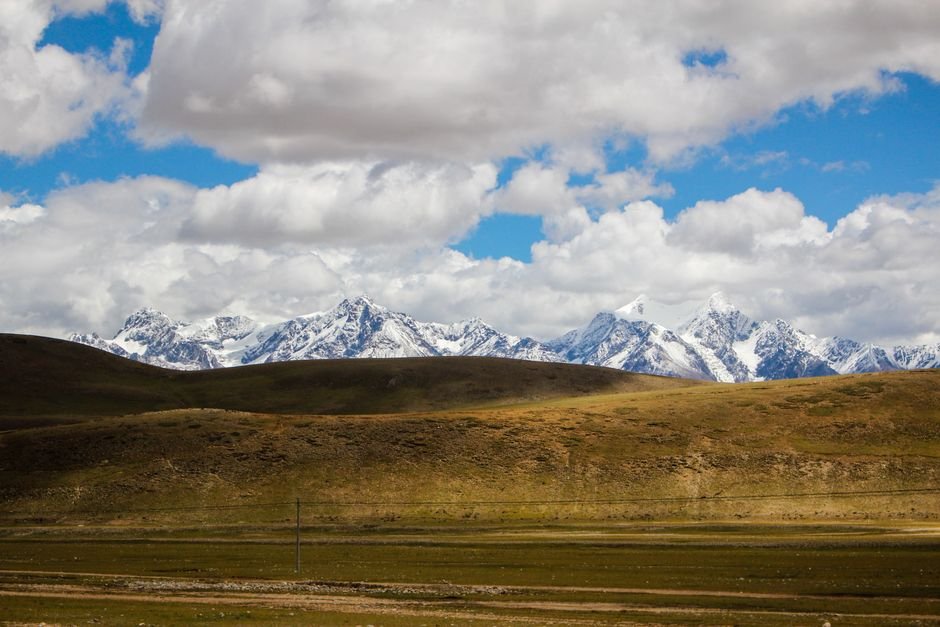
The Tibetan Plateau, Earth’s highest and largest plateau, spanning roughly 2.5 million square kilometers, is both a global biodiversity hotspot and a region where agriculture is already stretched thin. Crops grown on steep slopes and widespread overgrazing have long threatened long-term productivity, creating a tension between feeding a growing population and preserving fragile alpine ecosystems.
A new study published in PNAS by Wang, Polasky, and colleagues suggests that these goals may not be in conflict, at least not under steady climate conditions. The catch is that the climate is anything but steady.
Three decades of progress
The researchers traced food production on the Tibetan Plateau from 1990 to 2020, finding a 32.33% increase over three decades. By 2020, the plateau was producing 2,892.98 kilocalories per person per day, above the threshold for self-sufficiency.
But this production came with costs. Much of the cropland was on steep slopes vulnerable to erosion, and livestock numbers exceeded what the grassland could sustain. The agricultural system was productive, but not sustainable.
A warmer, wetter future
The team modeled three climate scenarios (SSP126, SSP245, and SSP585, spanning moderate to high emissions) and found that across all of them, the Tibetan Plateau will become warmer and wetter over the coming decades. At first glance, this benefits agriculture: longer growing seasons, more precipitation, and higher potential yields.
Combined with continued agricultural advances, mechanization, improved irrigation, and better crop varieties, the models project that yields could increase even if cropland area is reduced by 10%. That reduction is more than enough to retire all steep-sloping cropland and reduce livestock numbers, allowing the most environmentally damaging practices to be phased out while maintaining food production.
Under this scenario, key ecosystem services, carbon sequestration, water retention, and habitat quality, all improve.
The extreme weather wild card
The risk, the authors emphasize, is that these projections assume average conditions. Extreme weather events, droughts, snow disasters, heat stress, are increasing in both frequency and severity on the plateau. Under worst-case scenarios, these extremes could reduce crop yields and livestock productivity enough to threaten minimum nutritional intake.
The study’s lead author Lijing Wang and co-author Stephen Polasky (University of Minnesota) note that the modeling provides “quantitative evidence for reconciling food production and conservation goals,” but that the window for achieving this balance is narrowing as climate extremes mount.
Broader relevance
The Tibetan Plateau is not a unique case. The tension between food production and ecosystem conservation is a core challenge for the UN Sustainable Development Goals worldwide. The study demonstrates that agricultural intensification, when paired with strategic land retirement, can relieve pressure on ecosystems, but only if the climate remains within predictable bounds.
The findings echo the broader message of the EAT-Lancet framework cited in the paper’s references: that transforming food systems requires not just dietary and technological shifts, but accounting for the growing instability of the climate within which all agriculture operates.
Sources:
1. Wang, L. et al. “Opportunity and risk in achieving food production and conservation goals at high altitude: Evidence from the Tibetan Plateau.” PNAS 123(28) (2026). DOI: 10.1073/pnas.2600030123