

Ancient Astronomers Were Right: Theta Eridani Really Was 12 Times Brighter for a Thousand Years
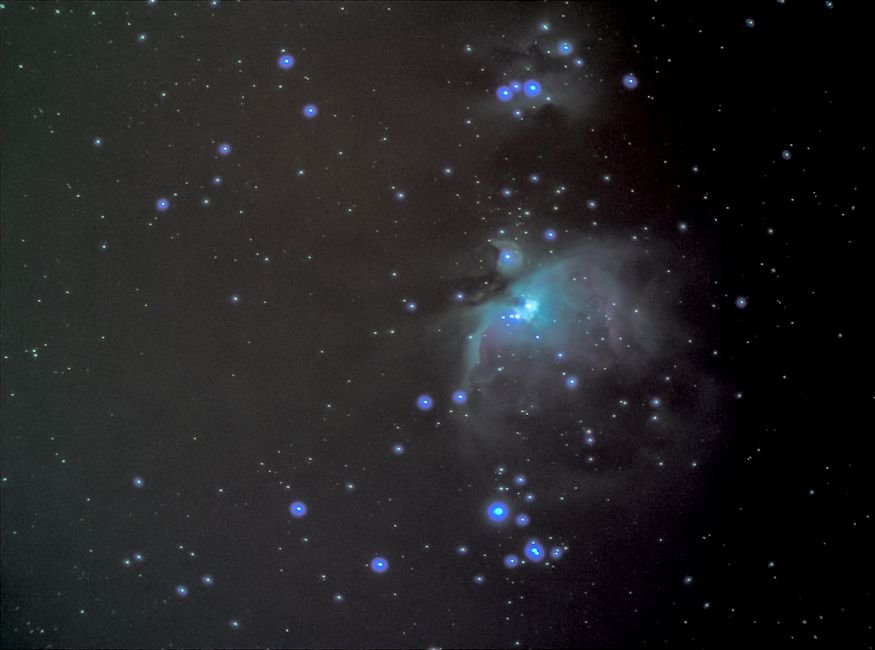
Featured image: Digitized Sky Survey image of Theta Eridani in the constellation Eridanus. Credit: STScI/DSS
For more than a century, astronomers assumed the ancient stargazers had made a mistake. Three independent observers over nearly a thousand years listed the star Theta Eridani, also known as Acamar, among the brightest in the night sky. Yet today it is a modest V=2.9 star, barely noticeable among the thousands of pinpricks in a clear sky. The discrepancy was attributed to observational error, atmospheric extinction, or a cataloging mistake.
A new study published on arXiv by independent researcher Idel Waisberg and Boaz Katz of the Weizmann Institute of Science proves the ancients were right all along. Theta Eridani genuinely was about 12 times brighter for roughly a thousand years, powered by a rare and previously unrecognized type of stellar transient: orbital energy extraction during a long-lived common envelope stage.
The magnitude discrepancy, at approximately 2.7, is the highest among the roughly 1,000 stars in Ptolemy’s Almagest.
The puzzle that refused to die
Four historical records spanning nearly 1,600 years all placed Theta Eridani at magnitude 1, among the elite 13 brightest stars visible from the northern hemisphere. Hipparchus around 129 BC described it as a “particularly bright star” in his Commentary on Aratus. Ptolemy in 137 AD rated it magnitude 1 in the Almagest. Al-Sufi in 964 AD independently confirmed a magnitude 1 classification in The Book of Fixed Stars. Ulugh Beg in 1437 kept the magnitude unchanged in his star catalog.
But by the time southern-hemisphere observers like Frederick de Houtman, Edmond Halley, and Nicolas-Louis de La Caille turned their telescopes on Theta Eridani in the 17th century, it was a magnitude 3 star. The star had dimmed by a factor of about 12.
Historians and astronomers considered three explanations: confusion with the much brighter star Achernar (Alpha Eridani), which was invisible at the latitudes of Alexandria and Shiraz; a typographical error in the ancient catalogs; or systematic overestimation of the brightness of low-altitude stars due to atmospheric extinction. The paper systematically refutes all three.
A star caught in the act of evolution
The researchers used the Very Large Telescope Interferometer (VLTI/PIONIER and VLTI/GRAVITY), the ESPaDOns and FEROS spectrographs, and TESS photometry to dissect Theta Eridani’s true nature. What they found was a triple star system: a visual binary where the primary star, Theta 1 Eridani A, is itself a very tight spectroscopic binary of two almost-identical stars.
The inner binary has a period of 4.107704 days, with the two stars separated by just 0.083 astronomical units, or less than one-tenth the Earth-Sun distance. The primary has a mass of approximately 2.3 solar masses and the secondary about 2.2 solar masses. Both are bloated to roughly 4 solar radii, filling about 80 percent of their Roche lobes.
Critically, the primary has just finished core hydrogen burning and is expanding into a red giant. This post-main-sequence expansion triggered the sequence of events that made the star so bright for so long.
How a star became 12 times brighter for 1,000 years
Here is the sequence the researchers reconstructed. The binary was originally in a highly eccentric orbit (eccentricity approximately 0.6). As the primary expanded after exhausting its core hydrogen, it filled and overflowed its Roche lobe, the gravitational boundary within which material stays bound to the star. In an eccentric orbit, mass transfer is concentrated near periastron, making it dramatic and long-lasting.
As material streamed from the primary onto the secondary, orbital energy was extracted and dissipated into the surrounding envelope. The result was a luminous common envelope that engulfed both stars, dramatically increasing the system’s luminosity. The transient lasted roughly 1,000 years before the orbital energy dissipated, the binary settled into a quieter, less eccentric orbit (current eccentricity 0.105), and Theta Eridani faded to its present magnitude.
The authors call this a “millenary transient” and note it may be a ubiquitous but short-lived phase in the evolution of close binaries that has been missed by modern surveys precisely because of its thousand-year timescale.
Vindication for Hipparchus, Ptolemy, and al-Sufi
The paper carries a deeper message about the reliability of ancient astronomical records. Ptolemy’s Almagest is often treated with skepticism by modern astronomers, who assume its magnitudes are rough or corrupted. Waisberg and Katz show that the ancient observations were precise enough to detect a 2.7-magnitude change in a star over two millennia.
Al-Sufi’s independent confirmation is especially significant because he worked 800 years after Ptolemy, from a different location, and under different cultural traditions. That both observers recorded the same anomaly strengthens the case that the brightness was real and not a copying error.
The discovery also opens a new window onto stellar physics. The “millenary transient” powered by orbital energy extraction during Roche lobe overflow may explain other historical brightness anomalies in the ancient records. Many stars in the Almagest show magnitude discrepancies with their modern values that could be due to similar processes.
For now, the story of Theta Eridani stands as a reminder that the night sky is not static. A star can brighten for a millennium, fool everyone on Earth, then dim back to obscurity, leaving only a puzzle for future astronomers to solve.