

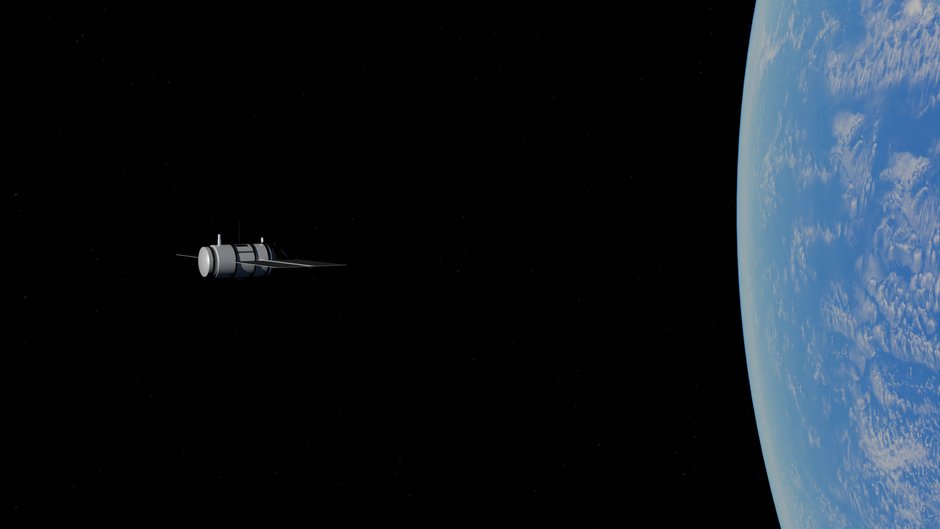
Bending Spacetime Reveals New Planet Hidden in Archived TESS Data
Featured image: [Illustration of gravitational microlensing effect showing a foreground star bending spacetime and magnifying a background star; credit: NASA/JPL-Caltech]
NASA’s Transiting Exoplanet Survey Satellite (TESS) has found a Jupiter-like world orbiting a star 40,000 light-years away using a technique straight out of Einstein’s theory of general relativity: gravitational microlensing. The discovery, published in The Astrophysical Journal Letters, marks the first definitive detection of a gravitationally bound microlensing planet in TESS archival data.
The planet, designated Gaia23bra b, has a mass of about 1.63 Jupiter masses and orbits a K-dwarf star at a projected separation of roughly 4.8 astronomical units (AU), similar to Jupiter’s distance from the Sun. Its host star, a small orange dwarf about 80 percent the mass of the Sun, lies far beyond TESS’s typical transit-search radius of roughly 150 light-years, demonstrating the satellite’s reach across the galaxy.
The discovery relied on a cosmic coincidence: a three-body alignment between Earth, the foreground star-planet system, and an unrelated background star. As the foreground star drifted across the sky, its gravity bent and magnified the background star’s light like a lens. The planet acted as a secondary mini-lens, producing a sharp, short-lived deviation called a caustic-crossing feature that revealed its presence.
How the discovery unfolded
The story begins in 2023 when ESA’s Gaia mission flagged an unusual stellar brightening under the alert name “Gaia23bra.” Gaia’s all-sky monitoring recognized it as a potential microlensing event, but its observations were too sparse to resolve planetary-scale signals.
TESS happened to be monitoring the same region of sky at a high cadence of roughly one frame every 200 seconds for two consecutive sectors, totaling about 60 days. When researchers led by Mallory Harris, a doctoral candidate at the University of New Mexico, reanalyzed the archived TESS full-frame images, they found caustic-crossing features in the light curve that Gaia had missed.
“Its high-cadence light curve revealed details that no other survey could have spotted,” the team noted. Joint modeling using the pyLIMA and pyLIMASS software packages on both the Gaia and TESS datasets confirmed the binary-lens signature of a planet.
Why this matters
Fewer than 5 percent of the roughly 6,000 known exoplanets have been found through microlensing. The method is uniquely sensitive to planets at wider orbital distances, near the snow line where gas giants like Jupiter form, which are difficult to detect with transit or radial velocity surveys. However, microlensing events are one-time occurrences: the alignment never repeats, making each detection precious.
The discovery proves that TESS, designed exclusively for the transit method, can also serve as a microlensing observatory. This opens the possibility that many more planets are already hiding in eight years of TESS archival data that were never analyzed for this signal.
The result also serves as a pathfinder for NASA’s Nancy Grace Roman Space Telescope, scheduled for launch in late 2026. Roman will conduct a dedicated microlensing survey of the galactic bulge, expected to yield roughly 1,000 microlensing planets.
The paper, “Gaia23bra b: A Microlensing Planet Discovered in Archived TESS Data,” is published in The Astrophysical Journal Letters (DOI: 10.3847/2041-8213/ae7a50) and features co-authors from the University of New Mexico, Texas Tech University, Ohio State University, and other institutions.