

TESS Accidentally Finds a Planet 250 Times Farther Than It Was Ever Meant to See
Date: 2026-07-08
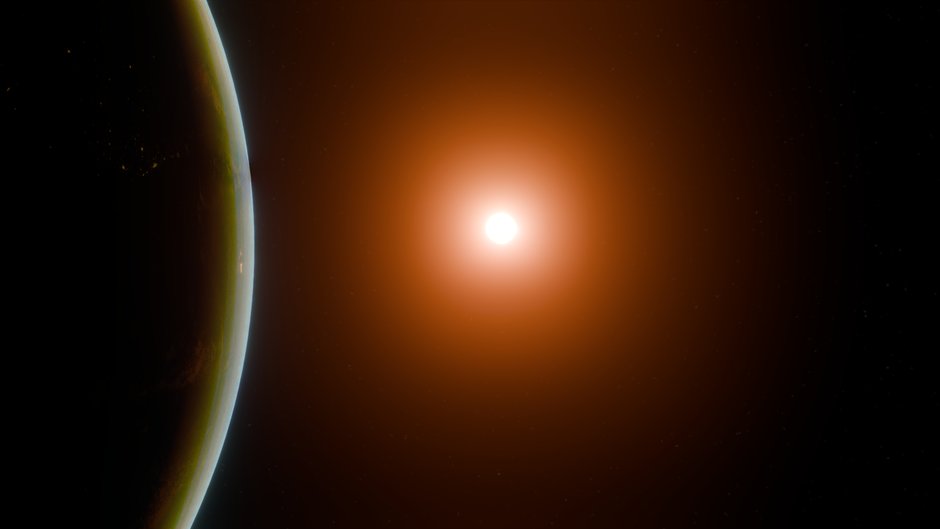
Featured image: Artist’s concept of a super-Jupiter exoplanet orbiting an orange dwarf star; credit: NASA GSFC
NASA’s TESS spacecraft was designed for one job: stare at nearby stars and watch for the periodic dimming caused by planets crossing their faces. It has excelled at that task, cataloging thousands of exoplanet candidates over its eight-year mission. But last week, an international team announced that TESS had done something its engineers never intended: find a planet 40,000 light-years away using a completely different detection method.
> “When TESS launched, no one expected it to ever be capable of finding this kind of planet,” said Diana Dragomir, a professor at the University of New Mexico and co-author of the study published in The Astrophysical Journal Letters.
The planet, designated Gaia23bra b, is a super-Jupiter weighing about 1.6 times the mass of Jupiter, orbiting an orange dwarf star roughly 80 percent the mass of the Sun at a distance of about 4.8 astronomical units (similar to Jupiter’s orbit around our Sun). What makes the discovery remarkable is not the planet itself, but how it was found.
Bending Spacetime to Find Worlds
The method is gravitational microlensing. When two stars align from Earth’s perspective, the foreground star’s gravity warps space-time, acting as a natural lens that magnifies light from the background star. If the foreground star hosts a planet, that planet creates its own tiny lensing signature: a brief deviation in the brightening curve lasting hours to days.
This is fundamentally different from the transit method TESS was built for. Transits reveal planetary size and work best for large planets on short orbits near their stars. Microlensing reveals planetary mass and orbital distance, and it can find worlds at wide separations that transits can never see. Fewer than 5 percent of the 6,000-plus known exoplanets have been found this way.
A Serendipitous Alignment
The discovery began in April 2023, when ESA’s Gaia spacecraft spotted an unusual brightening of a star detected by its Science Alerts system. But Gaia’s observations were too sparse to resolve any planetary signal.
TESS, however, happened to be staring at the same patch of sky for two consecutive sectors, collecting images every 200 seconds.
> “Gaia’s observations were too sparse to pick up on the planet,” said Mallory Harris, a Ph.D. candidate at UNM and lead author of the study. “The TESS spacecraft happened to be monitoring the same area of the sky during the event, and its denser time coverage showed extra features in the light curve caused by a planet.”
Nearly three years later, Harris and her team combed through archived TESS data, found the same microlensing event, and detected caustic-crossing features in TESS’s light curve: the unmistakable signature of a binary lens (star plus planet). The paper was published July 1, 2026.
A New Treasure Hunt
The discovery implies that TESS’s eight-year archive likely contains more microlensing planets hiding in plain sight. Researchers never systematically looked for them because the mission was not designed for it.
> “The discovery implies that there are probably other so-called microlensing planets hiding in TESS’s data that we hadn’t previously thought to look for,” Dragomir said.
The arXiv and Universe Today put it more bluntly: “Bending Spacetime Reveals New Planet Hidden in Archived TESS Data.”
Michael Fausnaugh of Texas Tech University, another co-author, noted that the find serves as a preview for NASA’s Nancy Grace Roman Space Telescope, launching August 30, 2026. Roman will conduct a dedicated microlensing survey of the Galactic Bulge, predicted to find roughly 1,000 microlensing planets and 100,000 transiting planets over its mission.
> “This is a bit like a preview of the microlensing NASA’s Nancy Grace Roman Space Telescope will do,” Fausnaugh said.
Why Microlensing Matters
Most exoplanet surveys target stars within a few hundred light-years, where transits and radial velocity measurements are feasible. Microlensing reaches across the galaxy. Gaia23bra b sits at roughly 40,000 light-years, more than 250 times farther than TESS’s typical target range, in a region near the Carina spiral arm tangent.
Microlensing also fills a persistent gap in exoplanet demographics. The 2010 and 2020 Astronomy Decadal Surveys both identified a blind spot at orbital distances comparable to or beyond Earth’s orbit. Transits and radial velocity struggle with wide orbits; microlensing covers them naturally.
The catch is that microlensing events do not repeat. As Harris put it: “Microlensing events happen once and they are gone. I like to joke that we will probably find the first Earth analog with microlensing, and then wave at it as it goes by because we will never see it again.”
What Comes Next
The Harris et al. paper, published in ApJL (DOI: 10.3847/2041-8213/ae7a50, also on arXiv: 2607.01853), used joint modeling of Gaia and TESS photometry with the pyLIMA microlensing software to confirm the detection. For TESS, the discovery opens a new scientific frontier long after its primary mission ended. For Roman, it offers a proof of concept that space-based microlensing works at high cadence.
For astronomers, the message is clear: TESS has been doing more than anyone asked it to, and there may be dozens more planets hiding in its archives.