

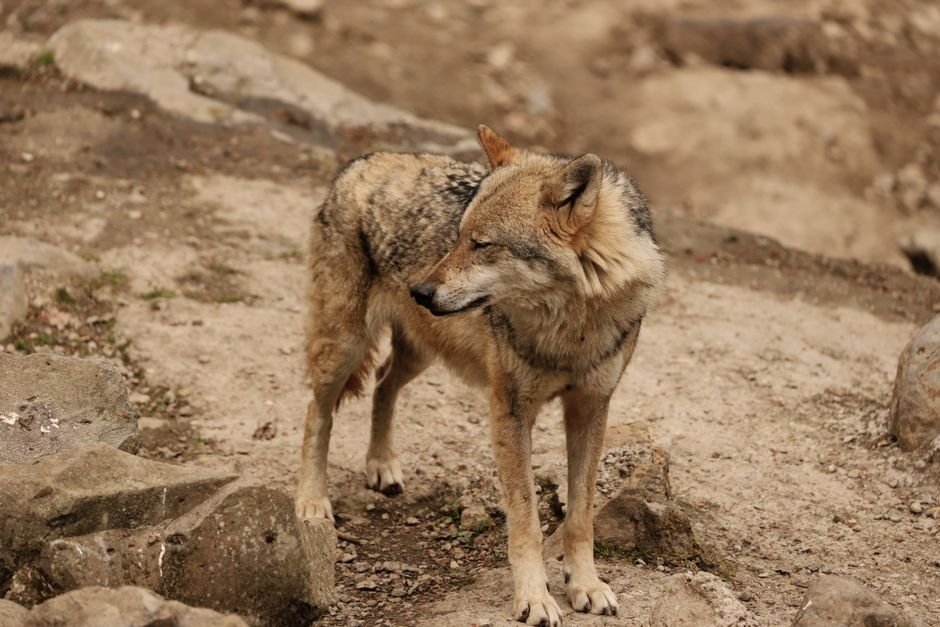
The remains of two wolves found in a cave on the remote Swedish island of Stora Karlsö are challenging assumptions about the earliest human-wolf relationships. The wolves, dated to between 3,000 and 5,000 years old, could only have reached the island by boat, and their bones tell a story of human provisioning, possible care, and a failed or abandoned domestication experiment.
The findings, published in the Proceedings of the National Academy of Sciences (PNAS), raise the possibility that prehistoric humans in the Baltic region were keeping and managing wolves, providing them with food, transport, and perhaps even medical care, long before the genetic signatures of full dog domestication became widespread.
Island Wolves
Stora Karlsö is a small limestone island, roughly 2.5 square kilometers, in the Baltic Sea about 80 kilometers from mainland Sweden. It has no native land mammals today, and there has never been a land bridge connecting it to the mainland. The two wolf skeletons were excavated from Stora Förvar cave, a site known to have been heavily used by Neolithic and Bronze Age seal hunters and fishers.
Led by Linus Girdland-Flink (University of Aberdeen) and Anders Bergström (University of East Anglia), with senior author Pontus Skoglund (Francis Crick Institute), the team performed genomic analysis, radiocarbon dating, and stable isotope analysis on the remains. The genomic data confirmed the specimens were wolves, not dogs, their ancestry was indistinguishable from other ancient Eurasian wolves. The radiocarbon dates placed one in the Neolithic (approximately 5,000 years ago) and the other in the Bronze Age (approximately 3,000 years ago).
The key finding came from isotope analysis: the wolves’ diets were rich in marine protein, seals and fish, matching the diet of the human seal hunters who used the cave. The wolves almost certainly did not catch these marine prey themselves; they were provisioned by humans.
Evidence of Human Association
The case for managed wolf-keeping rests on multiple lines of evidence beyond the diet. One of the wolves was smaller in body size than mainland wolves, a pattern often seen in domesticated or confined populations. The same individual showed exceptionally low genetic diversity, lower than any other ancient wolf sequenced to date, consistent with an isolated, bottlenecked population, or possibly selective breeding.
A Bronze Age wolf showed a healed limb bone pathology that would have made hunting difficult, implying that it received care from humans during its recovery. All remains were found within the human-occupied cave settlement.
“It was a complete surprise to see that it was a wolf and not a dog,” said Skoglund. “This is a provocative case that raises the possibility that in certain environments, humans were able to keep wolves in their settlements and found value in doing so.”
The Boat Problem
The most straightforward argument for human involvement is geographical: Stora Karlsö has no land connection to the mainland, and wolves are not known to swim 80 kilometers across open sea. The authors propose that Neolithic and Bronze Age seal hunters transported the wolves to the island by boat, possibly as part of a managed population.
However, this point is contested. In a critique published in PNAS in June 2026, Luc A. Janssens and L. David Mech argue that natural ice-crossing during Baltic winters is a more plausible explanation. “Wolves regularly cross sea ice in the Canadian Arctic and the Baltic region,” they wrote. The original authors responded with a reply defending the human-transport interpretation, noting that while ice-crossing is physically possible, the combination of the marine diet signal, healed pathology, and low genetic diversity makes the boat hypothesis the more coherent explanation.
The debate is not settled, and the study’s authors acknowledge that the ice-crossing alternative cannot be ruled out entirely.
An ‘Aborted Domestication’
Regardless of how the wolves arrived, the evidence that they lived alongside humans, ate human-provided food, and in at least one case received care, paints a picture of a relationship that did not lead to full domestication. The authors describe it as an “aborted domestication experiment”, a form of wolf management that never progressed to the genetic changes that define domestic dogs.
“If confirmed, this suggests that human-wolf interactions were more complex and varied than we previously imagined,” said Jan Storå of Stockholm University. “The combination of data has revealed new and very unexpected perspectives on Stone Age and Bronze Age human-animal interactions.”
The findings add to a growing body of evidence that the path from wolf to dog was not a single, linear event, but a series of experiments in coexistence across different times and places, most of which, like the Stora Karlsö wolves, did not result in domestication.
Disclosure: Based on a peer-reviewed paper in PNAS. DOI: 10.1073/pnas.2421759122. Lead author Linus Girdland-Flink (University of Aberdeen). A critique by Janssens and Mech (DOI: 10.1073/pnas.2607054123) and a reply by the original authors have also been published.