

Published: June 04, 2026, 01:54 UTC
Sun Erupts with 3 Colossal Solar Flares in Less Than 24 Hours — G3 Storm Watch Issued, Aurora Chances Surge
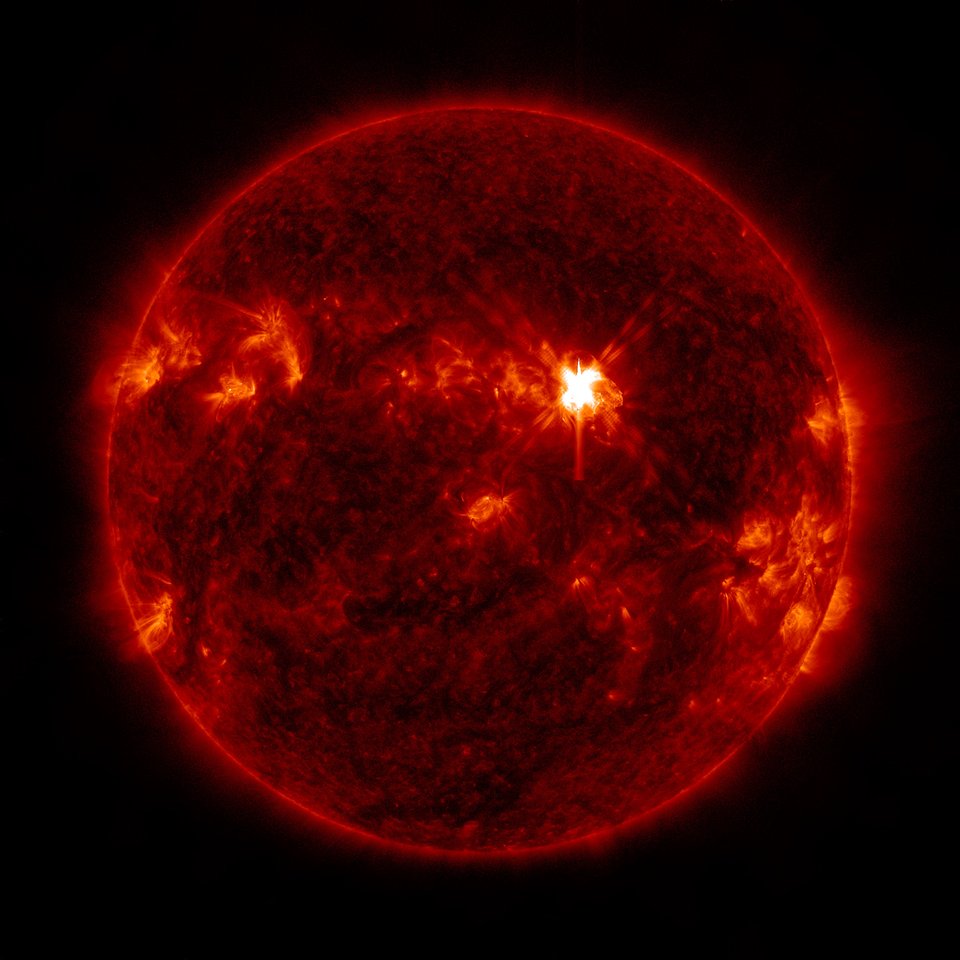
The Sun is putting on a spectacular show this week. Active Region 4455 — a magnetically complex sunspot cluster rotating across the Earth-facing solar disk — unleashed three powerful solar flares in rapid succession over a span of less than 24 hours, triggering radio blackouts across the globe and prompting NOAA’s Space Weather Prediction Center (SWPC) to issue a G3 — Strong Geomagnetic Storm Watch for June 4 and 5.
If the associated coronal mass ejections (CMEs) deliver the expected magnetic punch, skywatchers across the northern United States, Canada, and parts of mid-latitude Europe could be treated to vibrant aurora displays tonight and tomorrow night.
A Three-Flare Salvo from an Unstable Sunspot
The barrage began on the evening of June 2, when Region 4455 emitted an M9.3 solar flare that peaked at 9:36 p.m. EDT (01:36 UTC on June 3). M-class flares are considered moderate, but at M9.3 this event was perilously close to X-class territory — the most powerful category of solar flare. The eruption triggered a moderate R2 radio blackout across parts of East Asia and Australia, temporarily degrading high-frequency (HF) communications and navigation signals in the sunlit hemisphere.
Just over five hours later, at 3:00 a.m. EDT on June 3 (07:00 UTC), the same sunspot fired off an M7.9 flare, producing another R2 blackout — this time over Europe and Africa. Space weather physicist Tamitha Skov noted the growing threat on social media, writing: “Region 4455 strikes again! Region 4455 continues to grow in complexity, so X-flare risk will remain elevated over the next 72 hours at least.”
Her warning materialized swiftly. At 7:28 a.m. EDT (11:28 UTC) on June 3, Region 4455 unleashed an X1.0 flare — the strongest classification on the solar flare scale. This final eruption generated an R3 — Strong radio blackout across Europe and Asia, disrupting HF communications for approximately one hour over wide areas. According to the SWPC, such blackouts can affect airline communications, maritime operations, and emergency band frequencies.
CMEs Headed Toward Earth
Each of the three flares was associated with a coronal mass ejection — a massive cloud of magnetized plasma hurled into interplanetary space. While space weather forecasters are still refining their models, preliminary analysis indicates that at least two of the three CMEs contain Earth-directed components.
The CME from the M9.3 flare became visible in LASCO C2 coronagraph imagery at approximately 02:13 UTC on June 3. SWPC forecasters reported that GOES/SUVI imagery suggested a partial-to-full halo structure, while STEREO satellite triangulation pointed to an Earth-directed component. The M7.7 flare produced a larger CME, first seen at 07:48 UTC, which may have been partially deflected northward by a nearby coronal hole but still carries a significant Earth-directed component. Analysis of a possible CME from the X1.0 flare was still pending at the time of the latest SWPC forecast discussion.
The SWPC’s ENLIL model — which simulates solar wind and CME propagation — indicates that the two confirmed CME clouds may interact before reaching Earth, with the faster, later ejection catching up to the earlier one and merging. This interaction can compress plasma ahead of the combined structure and amplify the resulting geomagnetic storm potential.
“This type of CME interaction can compress plasma ahead of the arrival and increase storm potential, although the final geomagnetic response will still depend on the magnetic orientation of the incoming solar wind,” forecasters at The Watchers noted in their analysis of the event.
G3 Storm Watch: What It Means for Aurora Watchers
Based on the trajectory and estimated arrival times of the CMEs, the SWPC has issued a G3 — Strong Geomagnetic Storm Watch for June 4 and 5. The highest predicted storm level is G3 for both days, with conditions expected to drop below G1 (Minor) by June 6 if no further Earth-directed eruptions occur.
A G3 geomagnetic storm carries several potential impacts. Power systems may require voltage corrections and false alarm triggers on protection devices are possible. Spacecraft operators may see increased surface charging and drag effects on low-Earth orbit satellites. Satellite navigation and HF radio communications may experience intermittent disruptions, particularly at higher latitudes.
But for the general public, the most welcome consequence is the aurora. Under G3 conditions, the auroral oval expands significantly, pushing the Northern Lights southward into latitudes that rarely see them. Auroras may be visible across the northern tier of the United States — from Washington and Montana through the Great Lakes region into New England — and across Canada, Scandinavia, Scotland, and northern Germany.
The most likely viewing window begins late on June 4 and extends through the night of June 5, though the exact timing depends on the CMEs’ arrival velocity and magnetic orientation. Southward-pointing magnetic fields in the solar wind couple more efficiently with Earth’s magnetosphere, producing stronger auroral activity. Forecasters caution that predictions can shift as new satellite data arrives.
Region 4455: A Complex and Growing Threat
Active Region 4455 is the star of this show — and potentially a persistent one. The sunspot group exhibits what solar physicists call an anti-Hale configuration, meaning its magnetic polarity pattern is reversed relative to the typical Hale-Nicholson law for Solar Cycle 25. This magnetic complexity — combined with continuous flux emergence, mixed polarities, and substantial magnetic shear — creates ideal conditions for strong flaring.
The region’s instability suggests the solar fireworks are not over. The SWPC forecasts continued moderate-to-high solar activity through June 5, with additional M-class flares likely and a continued slight chance of further X-class eruptions. Other active regions on the visible solar disk — including AR 4458, 4461, and 4462 — also bear monitoring.
Solar Cycle 25 at Full Throttle
This week’s activity is the latest reminder that Solar Cycle 25 — which began in December 2019 — is approaching its predicted peak. The cycle has consistently outperformed initial forecasts, delivering more sunspots, more flares, and more geomagnetic storms than scientists originally anticipated. Major eruptions in May 2024 produced the strongest geomagnetic storms in over two decades, and February 2026 saw an extraordinary barrage of 18 M-class and 3 X-class flares in a single 24-hour period from another volatile sunspot.
For now, all eyes are on Region 4455 and the incoming CMEs. Space weather enthusiasts and aurora chasers are urged to monitor NOAA’s SWPC website and local aurora forecasts for real-time updates. Clear skies and patience will be the keys to catching the show — if the Sun delivers as expected.
“Wow, the Sun is certainly putting on quite a show this week,” wrote Space.com skywatching editor Daisy Dobrijevic in her coverage of the flares. With a G3 watch active and the sunspot showing no signs of quieting, the show may have only just begun.